


Suncor v. Boulder County, which the Supreme Court will hear this term, asks whether a Colorado county can sue two oil companies for the costs of climate change — essentially, whether Exxon and Suncor owe Boulder money because the planet is warming. But on Aug. 31, NBC’s senior Supreme Court reporter, Lawrence Hurley, published a preview of the case built around the Marshall Fire, a 2021 blaze that destroyed homes outside Boulder.
There is just one problem.
The fire was ignited, investigators said, by downed power lines and hundred-mile-an-hour winds on a single dry December afternoon, with no mention of carbon dioxide in the incident report. Oh, and it occurred three years after Boulder had filed its case. The lawsuit didn’t grow out of the fire. The story just tells it better that way.
Mr. Hurley is not a stranger to environmental advocacy dressed as reportage; before he covered the Supreme Court, he wrote for Greenwire, a trade publication that covers energy and environmental policy for an audience of activists, regulators and lobbyists, and whose reporters are not known for reflexive sympathy toward oil companies.
That background shows. His story treats “attribution science,” the young, disputed practice of pinning a specific wildfire on greenhouse-gas emissions generally, as settled fact, when its own practitioners will tell you it isn’t. It leans on internal oil-industry documents to suggest decades of cover-up, when those same documents mostly show an industry as uncertain about the future as everyone else was at the time. And it never once tells readers that federal and state judges have already thrown out versions of this legal theory as sweeping and unworkable.
None of this would be objectionable on the opinion page, where readers know what they’re getting. The trouble is that Supreme Court previews are not supposed to double as advocacy briefs, and NBC would have readers believe this is straight-shooting analysis. What Mr. Hurley has produced is an editorial with a dateline — masquerading as objective news and footnoted with the plaintiffs’ preferred data. In court that’s called an amicus brief.
Worst-case climate scenarios are wrong
The premise underwriting most of the alarm in Hurley’s piece, that unchecked warming puts Colorado on a trajectory toward ever-worse fire seasons, leans heavily on the kind of high-emissions climate projections that a growing body of expert literature has deemed unrealistic.
Climate scientist Zeke Hausfather and energy researcher Glen Peters made this case directly in a 2020 Nature commentary, writing that the field’s own worst-case pathway “was intended to explore an unlikely high-risk future” rather than describe where the world is actually headed. Roger Pielke Jr. and Justin Ritchie went further in a 2021 assessment, calling the continued reliance on that scenario one of the more significant failures of scientific integrity in climate research and calling for a course correction.
Treating that scenario as a likely baseline rather than a tail case has real consequences for how a story like this gets framed, and Hurley’s piece never flags the distinction.
Wildfires less frequent, burned area declining
The single biggest fact missing from Hurley’s account is the global trend line. A widely cited satellite-data study published in Science found that global burned area fell by roughly a quarter over an 18-year period, driven mostly by agricultural expansion and intensification in savanna and grassland regions. That’s the opposite of the “fires are getting worse everywhere” backdrop the NBC piece takes for granted, and it comes from peer-reviewed satellite observation. It’s a finding replicated in multiple recent studies, all pushing against the narrative driving this litigation.
A specific fire, in a specific place, on a specific dry and windy day, can still be devastating. But a single local disaster is not evidence of a global trend, and Hurley’s story repeatedly blurs the two. This distortion is obvious because he notes in passing that the lawsuit was filed three years before the Marshall Fire was ignited — but not before using the blaze to justify the lawsuit as an attempt “to hold energy companies accountable for the costs of adapting to a climate altered by fossil fuel emissions.”
Weather-related economic damage is declining, not rising
The story leans on the framing that climate-driven disasters are an escalating and unmanageable cost, hence the suggestion that oil companies should be made to help cover it. But normalized for the size of the global economy, weather- and climate-related losses have been trending down since 1990. Heat mortality tells a similar story: even as average temperatures have risen, deaths attributed to extreme heat have declined over the past several decades as urban areas and populations have adapted.
A 2021 study in The Lancet found that cold, not heat, remains the far larger climate-linked mortality risk worldwide, with roughly nine times as many excess deaths tied to cold temperatures as to hot ones between 2000 and 2019. These trends undercut the “costs are spiraling out of control” framing that gives the lawsuit, and the story, its emotional urgency.
Attribution “science”: preliminary and timed for litigation
Hurley’s piece treats the link between climate change and any specific fire as a matter of settled science. It is no such thing. The field of “attribution science,” which purports to calculate how much any single weather event owes to greenhouse gas emissions, remains young and methodologically contested, to say the least. Its own leading practitioners acknowledge that it is poorly suited to explaining what happens in one place over a short period of time, as opposed to global, long-run trends.
That caution hasn’t stopped activists from deploying the field on a suspiciously convenient legal timeline. The National Academies of Sciences released a major report in July declaring that individual weather events can now be robustly attributed to climate change. Its acknowledgments include a Sher Edling-affiliated attorney (the firm suing the oil industry on behalf of multiple jurisdictions), researchers tied to advocacy-funded climate communications work and a Washington Post reporter who briefed the committee on how attribution stories perform with readers.
Notably, the report landed just eleven days before the plaintiffs’ merits brief was due at the Supreme Court.
At least one federal judge (and a half-dozen state courts) have already rejected the underlying legal theory as groundless. Ruling on a similar public-nuisance claim brought by the city of Oakland in 2018, US district judge William Alsup called the scope of the plaintiffs’ theory “breathtaking,” writing that it would reach the sale of fossil fuels anywhere in the world, including all past and otherwise lawful sales, wherever the seller knew that burning fossil fuels contributed to global warming.
A reader of Hurley’s piece is left believing attribution science is settled, uncontroversial evidence rather than a still-developing field whose most prominent recent showcase happened to arrive on the eve of a Supreme Court filing deadline.
The “Exxon hid what it knew” narrative doesn’t hold up
The entire legal theory in cases like Boulder’s depends on the claim that oil companies possessed internal knowledge about climate change and concealed it from the public. But the industry documents most often cited to support that claim, the same trove historian Naomi Oreskes has drawn on for years, don’t actually show a company suppressing settled internal findings. Instead, they reveal an industry that was as uncertain about future climate change as anyone else at the time was. Consider this 1980 memo from the American Petroleum Institute.
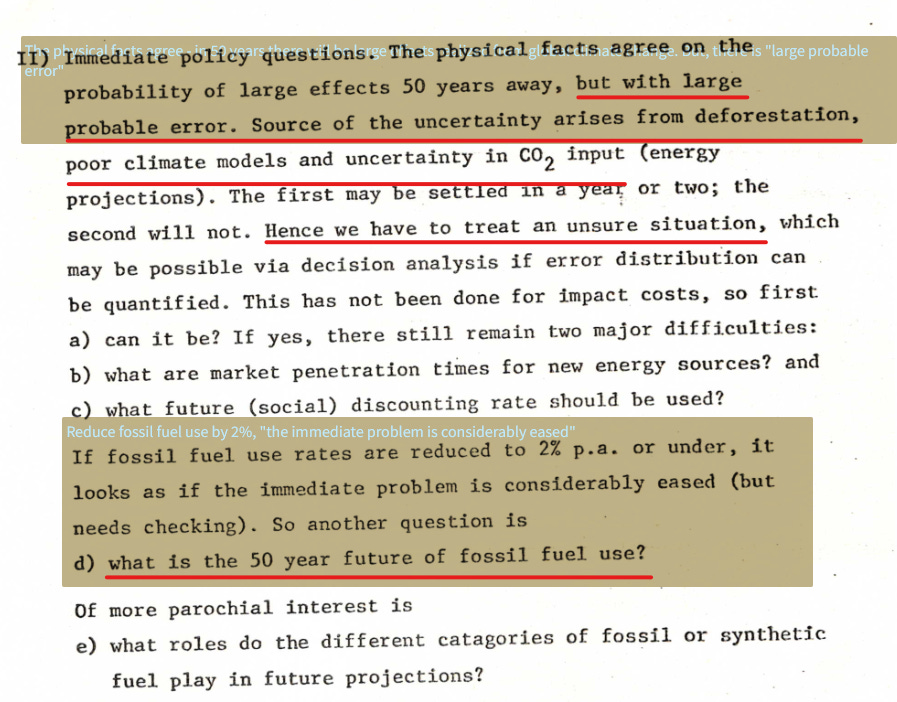
Court rulings dismissing similar claims have noted that the state failed to show the public lacked access to the same climate information the industry supposedly hid, undermining the “greenwashing” theory at its foundation. One Delaware judge pinpointed the absurdity underlying the plaintiffs’ claim: they allege that climate change is an undeniable disaster while the oil industry successfully suppressed evidence it was happening.
Allows us to explain the fallacy to the journalists reading this. It’s impossible to know that human-caused climate change is a pending disaster if you’ve been deceived about humanity’s role in climate change. Only one of those statements can be true, but the plaintiffs want everyone to believe both.
That gap between the internal-documents narrative and what the documents themselves show deserves far more scrutiny than a single-sentence characterization in a wire-style Supreme Court preview.
This isn’t an isolated lapse in Hurley’s coverage
Hurley’s April 2023 piece, “Supreme Court deals blow to oil companies by turning away climate cases,” covered a narrow, procedural ruling: the Court simply declined to hear a set of climate suits, deciding nothing about whether the companies are actually liable. His own text called the ruling “relatively narrow.” Yet the headline and lead adopted the plaintiffs’ framing of that non-decision as “a loss for business interests,” and quoted an activist accusing oil companies of planning to “defend their climate lies in front of juries,” with no comparable counterweight.
Another leftward hook out of bounds is his August 2026 story on the Federal Judicial Center’s climate chapter, part of a guide the federal judiciary publishes to help judges weigh scientific evidence. Hurley introduced his piece as “the curious tale of the right-wing attack on the climate change chapter,” casting critics as aggressors rather than the ones flagging an egregious conflict.
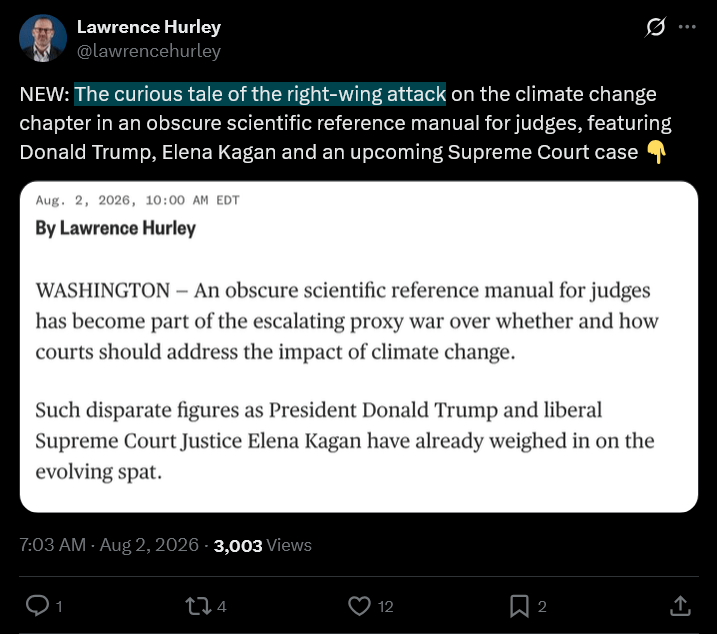
This was no obscure dispute; it drew sustained coverage across outlets from Bloomberg Law to Fox News, a rebuke from President Trump and a direct question to Justice Kagan from Sen. Susan Collins in a Senate hearing, after a coalition of Republican attorneys general objected that Michael Burger, of counsel at Sher Edling, the firm representing the plaintiffs the chapter’s conclusions stood to help, had reviewed it before publication.
The clearest instance of Hurley inserting his own opinion comes in a follow-up post on Justice Kagan’s recusal from the case that would decide those same climate-litigation theories. Writing in his own voice, not as a quote from any source, he declared “ethics experts say no need for recusal,” settling the very question the story was meant to be reporting on. That same post labels the recusal push “activists on the right,” a tag never matched for the senator he quotes making the opposing case.
Conclusion
None of this disputes that the climate is warming, that the Marshall Fire was a real tragedy or that Colorado is dealing with genuine drought and fire risk. What’s in dispute is whether NBC’s framing serves its readers or serves the litigation. A Supreme Court reporter covering a case built on disputed science has an obligation to tell readers the science is disputed.
Hurley’s story instead borrows the plaintiffs’ framing, cites the plaintiffs’ preferred data points and leaves out the body of research that would complicate the narrative. Readers deciding what to make of Suncor v. Boulder County deserve a preview that isn’t written from inside the plaintiffs’ brief.