


In a recent article, I wondered where all of the activists have gone. Have we stopped caring for the environment? Then again, we rarely hear the term “environmentalist” used today. Is this eco-religion no longer serving as the opium of the masses? Does this cult that once gave meaning to post-religious sophisticates somehow feel awkward now?
When was the last time you heard someone call themselves an “environmentalist”?
A decade ago, self-professed environmentalists would proudly claim to all in earshot that they cared for the environment, that they lived sustainably and answered to a higher calling as agents of change to make Mother Earth whole again. These martyrs for the cause identified themselves by their green choices and eagerly displayed their badges and totems. The implication, a decade ago, was that the rest of us were heathens, polluters and peasants.
But does such eco-prescription resonate today? Do green policies garner as many votes today as a decade ago? Are people willing to pay more for a product based on its ecological claims? The eco-class no longer seems to be held in high esteem or valued on a higher plane.
When did the term “environmentalist” fall out of fashion?
Was it when the Extinction Rebellion protestors glued themselves to buses and trains, making Londoners late for work?
Was it after the energy, food and transportation inflation caused by green regulations?
Did other issues, like wars and pandemics, take over and put the elitist green agenda into perspective?
Or perhaps the environmentalists have become victims of their own success. We have all become greener and no longer feel vulnerable to stricter ecological prescriptions.

I’d like to think of myself as caring for the planet. I don’t litter, use more energy than I should or consume things I don’t need. I would like to think that I understand enough on how to live sustainably and make responsible choices. I am not shamed by the ever-increasingly stringent standards imposed by the eco-elite (to go organic, drive an electric car or install a heat pump).
This is where environmentalism as a cult religion has reached its limit. If I turn the lights off, take the bus, recycle or save water, my choices are not green, they are rational. When I invested in solar panels on my roof, it was not to seek approval from my neighbors but to save money. When I added a home battery, I felt that I was wasteful, but I no longer trusted my utility and needed to secure my energy supply. These are practical decisions. I don’t think of myself as an environmentalist, but a decade ago, I would have been.
An added problem is in the baggage carried by the word “environmentalist”. It carries a connotation of smug elitism. It suggests a state of being (a purity) rather than a progression toward making the world more sustainable. I know I will always pollute, so I strive to pollute less.
I pollute … and so do you!
In reality, we all pollute from the moment we are born and start having an impact on the planet until the time our ashes are spread across a field as fertilizer (that’s a thing now). Breathing, eating, consuming... all leave a footprint. I wrote an article on this twelve years ago called “I Pollute!” where I set the goal of my ecological decisions to pollute less. Environmentalists believe they don’t pollute, and that others do. On climate change, plastic pollution, wastewater emissions, soil degradation ... they appropriate blame on others and not themselves. And they won’t stop until they fix others, change regulations, ban industries and products in order to transition to their perfect world of zero waste, net zero CO2 emissions, zero plastics ... until we reach some mythical world with zero risks.
Twelve years ago, before it was articulated as “degrowth”, I presented the environmentalist ideology:
Part of the idealists’ dream is a world of micro-economies, locally growing their own produce, goods and services while consuming much less, free from plastics and chemicals (sic) and free from the powers of multinationals and world powers. They have rejected the dream of modernism (that science and technology will continue to solve the problems we face), demanding that the world transform itself with locally generated, green smart grids and small agricultural communes (entailing a Neo-Malthusian drive to depopulate and reverse the present path of development). (I Pollute)
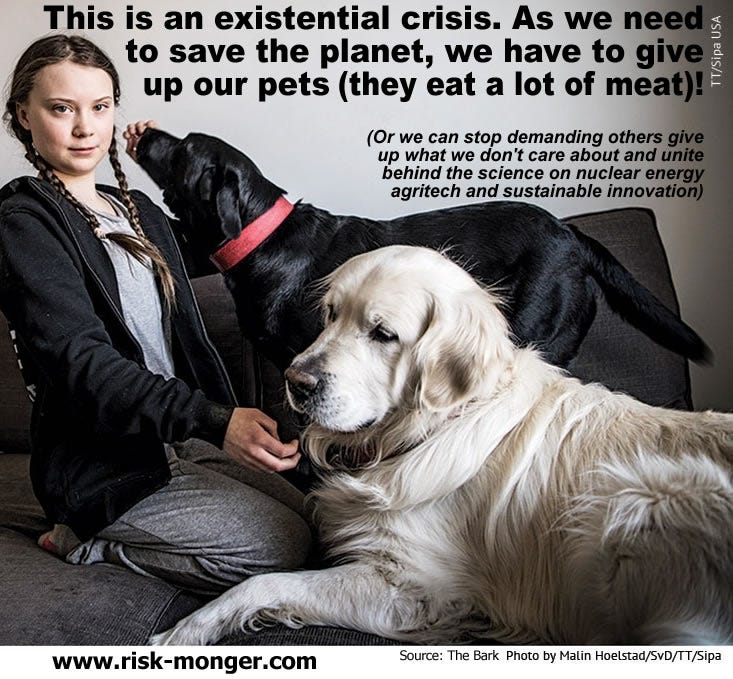
Nobody seems to still be talking openly about this environmentalist utopia today. The climate campaigns eventually drowned in the activists’ own hypocrisy of Davos Man’s private jets, gated mansions and over-consumption. Even Greta’s two large dogs raised some undiscussed ecological challenges.
In any church, the zealots occupying the front pews will claim to be the true believers, loudly judging those at the back who may not be practicing according to their strict interpretation of the scriptures. But zealots often push a religion to its limit, relying on fire, brimstone and the fear of their god. Faith should be humble (as we bow to something greater than us).
In the church of environmentalism, should the activists (the zealots) be given the torch to lead the movement, turning sustainable decisions into a condemnation of the heathens while scaring those who don’t meet their transcending green standards? The humble who recognize that they pollute and strive to pollute less will just find another church (and they have).
Rather than scaring or shaming, perhaps another approach should be taken.
Progression and Pragmatism
It would be best to ignore the zealots, their condemnations and fearmongering and focus development on a continuous improvement within the scope of the best available alternatives. This progressive pragmatism seems to be where environmental policy is today as Green Deal regulations in Brussels are being scaled back and the US deregulation strategy is confronting excessive green restrictions.
Some examples of progressive pragmatism replacing environmentalist ideology:
We are not scrapping all fossil fuels because of some diktat imposing renewables, especially if that means interruptions in power supply or more expensive utility bills. If there is to be a transition to renewables (not a foregone conclusion), it would need to be gradual (to minimize impact on the poor populations) and only when the technology has matured.
As populations grow and put greater pressure on food production, we don’t impose low-yield organic farming (especially in developing countries) but rather look at how to improve food production while lowering the impact on soil, water and air.
If plastics are finding their way into the environment, we don’t ban these products (that are more sustainable than glass, steel, paper and copper) but rather develop means to reduce emissions, manage waste and inform populations.
A progressive pragmatism is about developing solutions and improvements. While it may not reflect the ambitions of the zealot activist elite, the evolutionary development will do more to advance the environment while keeping humans engaged in the process. An environmentalism that only rewards those committed to some static green dogma will not achieve a better environment. Sustainability is a process, a continuous improvement, a development - it should not be considered as a virtue.
Nature First or Human First?
The word “environmentalist” is tainted in its misanthropic superiority, laden with judgement, hypocrisy and rhetoric. Sustainability has become rather hollow as a reference to reduced impact when the term could mean almost anything. Environmentalism has become “anti-human”, campaigning against technology, capitalism and consumerism. The planet would be just fine, they argue, if there were no humans. Human intervention invariably damages nature and the best we can do is stand back and let nature heal itself. This was the environmentalist paradigm of William Vogt presented by Charles Mann in his seminal book, The Wizard and the Prophet.
There are other elements at play than merely bowing unquestionably to the primacy of Mother Nature. One of the issues that had harmed the environmental movement was the drive to put planet first, regardless of the consequences. There was an uncomfortable reaction to a eco-theology that would look the other way when poor economies suffered under our demands for lower carbon emissions; when children died or went blind from of vitamin A deficiency even though Golden Rice could be cultivated; or when food production is lost because Western elites want to impose a Marxist agroecology ideology on subsistence farmers.
The precautionary principle became the most wicked tool of these misanthropic environmentalists. Under the pretence of risk management, they endeavored to delay or reject any innovation or technology that would go up against Mother Nature, regardless of the negative consequences to mankind.
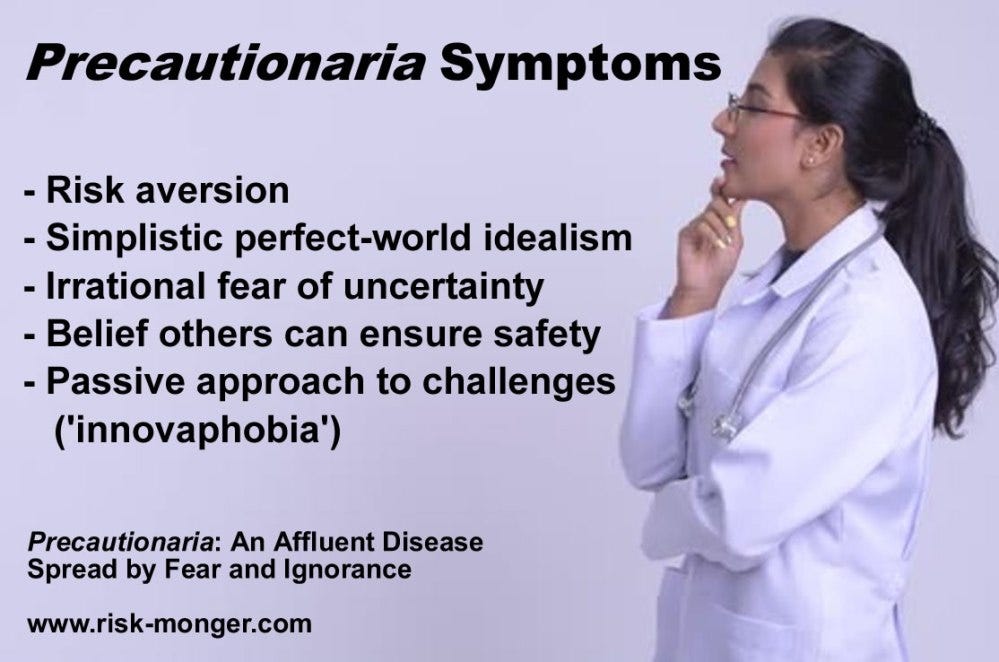
Three decades of precautionary campaigns against GMOs, five decades against chemical disinfectants and six decades against nuclear energy were enough to conclude the game is up. We are no longer willing to tolerate the loss of beneficial technologies because some small group of activists are seeking to impose their political dogma via fear and outrage. This “only if I can be certain it’s safe” precautionaria is a relic of the lost environmentalist perfect-world ideology.
Today the word “precaution” readily draws scowls. If there is an emerging ecological problem, like increasing power demands from AI data centers, we are looking for the best solutions, not running to door and imposing precautionary bans or restrictions. Leaders are learning that they have to make hard decisions rather than sweeping emerging innovations under the rug of some contrived regulatory principle.
A Return to Realpolitik
As we tend to lock ourselves into a binary logic, and if we no longer use the terms “environmentalist”, “activist” or “precautionista” in our lexicon, what alternatives are there?
The term “ecomodernist” was introduced to refer to a pro-science approach to solving ecological problems. But this has served more as a foil to the emotional environmentalist campaigns. Today, most green activists call themselves ecomodernists, but, like agroecologists, their scientific method is so weighed down by ideological restrictions and caveats that they would cause Francis Bacon and Karl Popper to roll in their graves.
Recently the term “eco-humanist” has been discussed to guide a more human-centered green narrative. But the prefix is merely an add-on to more deeply integrate humanism. Humanism with a concern for the environment is simply … humanism.
At the end of the day, caring for the environment, using the best available science and technologies to solve problems, and promoting human well-being are all common sense decisions. There is no need to label it to justify some eco-prescriptive policy or virtuous elitism. The environment (however defined as a nexus with humans) should be managed from a pragmatic ideology: a progressive approach along a path of continuous improvement of the environment while protecting humanity, societal goods and well-being.
Several years ago, I argued for a return to the practice of Realpolitik in environmental policies. I defined it more by what it is not:
Realpolitik “refers to decisions not made solely on issues of ideology and morality. In other words, Realpolitik refers to pragmatic decisions based on best possible outcomes and compromises (something done when leaders have to face unpleasant realities). Ideologues can easily ignore scientific facts when imposing their power but Realpolitikers will follow the best available science while appealing to reason.”
This pragmatic approach, going back to the 1850s, rejected ideology, religious dogma and some vision of a perfect world, and realistically sought better solutions. We accept that we pollute, but the goal is to pollute less, either by lowering consumption or adopting better technologies.
Environmentalism and the campaign to put the planet first, over and beyond human aspiration, is dead. Long live pragmatic, progressive environmental solutions. Welcome back to a policy world driven by Realpolitik.
all flesh is grass and grass loves carbon dioxide and nitrogen.
if yr nought burning fuel to get summat done yr a wastrel suppin on the state teat.