


Here we go again.
The rather tiresome Activist Playbook is being applied again, this time not to pesticides, plastics, fossil fuels or chemicals like PFAS, but now to so-called ultra-processed foods. A recent study published in the British Medical Journal (BMJ) by a group of French activist scientists and their doctoral students has been making headlines in the food-fear world. They are suggesting that exposure to chemicals used in six food additive preservatives (like vinegar) increases the risk of cancer. Which types of cancer? All of them, it seems.
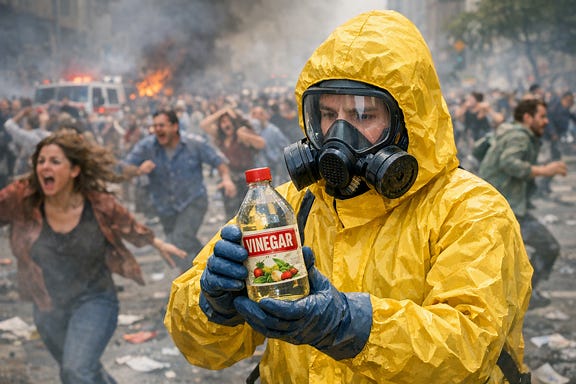
This article will examine this recent paper, the motivations behind it and how it plays within the wider Activist Playbook. It will conclude with a translation of a report by the German Federal Institute for Risk Assessment (BfR) which concluded that the paper had a number of significant limitations and uncertainties.
The Activist Playbook is a well-oiled machine:
Fund some scientists to produce a study suggesting a health risk or correlation to a cancer (in mice) from lab exposure to a chemical found in consumer products.
Use a communications consultancy to create a significant amount of media coverage and public outrage.
Use your network within the Ramazzini/IARC activist community to push forward a hazard-based monograph on these chemicals to further legitimize your alarmist claims.
Get NGOs to use these fears to push the anti-industry, post-capitalist narrative.
Once the International Agency for Research on Cancer (IARC) pronounces their cancer classification, let the media and NGOs amplify the campaign as the US litigation industry begins to file lawsuits at a targeted company.
Bring regulators into the game to invoke the precautionary principle, enhancing the perception of cancer causation to help influence the lawsuit outcomes.
With hundreds of thousands of walking-wounded victims filing lawsuits and a select group of media-darling scientists force-feeding the public on a diet of fear and confusion, extort the targeted company into a multi-billion dollar settlement that hopefully bankrupts them.
Take the cash and move onto the next chemical substance.
Ultra-processed foods are the next Holy Grail as the litigation industry’s climate lawfare and herbicide and talc honeypots run out of momentum. The first attempt, to identify the artificial sweetener, aspartame, as a carcinogen failed. But there are many chemicals used in the so-called ultra-processed food industry, so the activist scientists just moved on to a selection of preservatives used in food additives. Like aspartame though, the scientific community, fed up with the junk science designed for the media, is wasting no time to speak up and voice their criticisms.
The Relentless Madame UPF
The BMJ study was led by Mathilde Touvier, a French researcher and media darling who has always been ready for a microphone or a spot on a daytime talk show. I came to discover Madame Touvier’s tactics in the failed campaign to use the Activist Playbook to bring aspartame into the litigation industry’s arsenal of extortion. Then she was using any tactic she could to get the public outraged by the artificial sweetener, breaking rules of scientific integrity (like releasing possible findings of her study to the media prior to peer review). Her most recent attack on the chemicals in food preservatives reflected similar tactics and ethical issues.
In the BMJ paper, Touvier threw shade on the source of the study’s funding (perhaps trying to hide how much of it was a one-woman-show). She was a European Research Council (ERC) grantee (receiving €2 million in funding for this project) and she was awarded a funding prize from the Fondation Bettencourt Schueller. But rather than simply acknowledging that she had personally received direct EU and foundation funding, Touvier opted for the more deceptive line of saying: “This project received funding from the European Research Council (ERC) ... and a Bettencourt-Schueller Foundation research prize 2021”. This is typical of Touvier’s tactics, consciously trying to hide the fact that she received direct funding. Why didn’t she just acknowledge that she herself received the funding?
There was some interesting wording in the Bettencourt-Schueller Foundation funding award (“to identify correlations between ultra-processed foods and health”). The funding was not for a researcher to study a causal link between food and health issues, but rather was specified to identify correlations between certain foods and diseases. It is widely accepted in the scientific world that correlation does not imply causation. Touvier’s study seems to be another case of an activist foundation funding an activist scientist to develop activist-modeled assumptions for an activist fear campaign.
The Relentless Communicator
Once the study was published, the ultra-processed food campaigners took over amplifying the news in the mainstream media, including getting Touvier’s name all over articles in CNN, the Guardian and LeMonde. None of these articles covered dissenting views or discussed weaknesses and issues with the research. The BfR was motivated to issue the statement on this study (see below) because it had “garnered significant media attention”.
Getting the mainstream media to pick up an scientific journal article within 24 hours, and parrot the press release, does not happen normally with scientific publications unless a communications consultancy is employed to amplify the impact.
It should be noted that the same group of authors published a second article from the same research (on the very same day as the BMJ cancer correlation article) in Nature Communications claiming a link between these chemical preservatives in food additives with an increased risk of Type 2 diabetes. Given that the articles were submitted for peer review in popular journals four to five months in advance, it is extraordinary that the authors would demand to coordinate publication on the very same day, January 7. The purpose, of course, was to make a bigger impact in the mainstream media on January 8, 2026 so I suppose everyone wins (except the truth).
The two journals, BMJ and Nature, also behaved shabbily here in agreeing to Touvier’s media stunt, opting to publish activism to garner clicks rather than advance serious scientific research.
Next Step: Get an IARC Monograph Cancer Classification for the US Litigation Industry
Touvier has recently been elected to represent France on IARC’s Scientific Council. The study also includes another IARC author, Inge Huybrechts, so we can expect an IARC monograph on ultra-processed foods in the coming years based on the correlation findings of this study. Like the late addition of glyphosate to an IARC monograph on insecticides, the US litigation industry will do what it can to accelerate this process in order to then start amassing plaintiffs to sue a targeted food corporation.
Some would argue that this is a very cynical criticism. Not every scientist accepts and compulsively uses adversarial regulation tactics to attack industry. Some do this research because they believe they are advancing scientific discovery and keeping people safe. If Mathilde Touvier were to fit this mold, then she would have used a proper methodology rather than relying on correlations, she would have adjusted findings to consider confounding factors and false positives and she would have done deeper research into the level of exposures that could create a causal relationship between a chemical and a cancer (see BfR critique below). But as she did not, we can only assume that Touvier’s motives for producing this study were to create a strong media reaction and public outrage, advance her personal campaign against ultra-processed foods and create a benchmark for (regulatory, activist and litigious) pressure against the food industry.
The litigation industry does not need quality evidence to create a case to persuade a jury.
The activist NGOs do not need quality evidence to run a campaign and create public fear.
The foundations do not need quality evidence to set up a funding program.
The Activist Playbook is built to thrive even if the scientific evidence falls flat. But in any case, we still need to ask: What did the scientific community think about the quality of Touvier’s research, her methodology and her conclusions?
The Scientific Community Reacts
After the last decade of campaigns built on junk science, the scientific community is no longer as patient with the tactics of these fear-mongering activist scientists. Last month, the German Federal Institute for Risk Assessment (BfR) examined the Touvier cancer correlation paper and concluded that the publication did not provide any data that would make the agency consider reevaluating its position on the safety of the six preservatives used in food additives (ie, that Touvier failed to provide sufficient data or information to suggest these preservatives were carcinogenic).
As the BfR published their critique in German, the Firebreak provided an English translation below. The German risk assessment agency summed up the quality of the study as follows:
From the perspective of the German Federal Institute for Risk Assessment (BfR), the study is subject to a number of significant limitations and uncertainties. Therefore, the BfR currently sees no reason to reassess the health risks of the preservatives in question based on this study.
In other words, while it may not affect the Activist Playbook and the intentions of the tort lawyers, NGO activists, foundation funders and media scaremongers, from the scientific position, Mathilde Touvier’s latest anti-UPF campaign stunt can be summed up in two words: “Junk science”.
English translation of the original BfR text published on March 17, 2026.
Study on preservatives and cancer has weaknesses
The Federal Institute for Risk Assessment arrives at a critical assessment.
This is what it’s about:
A study conducted in France has identified six preservatives as being linked to an increased risk of cancer. The recently published research has garnered significant media attention. It is based on an analysis of questionnaires completed online by more than 100,000 participants in the NutriNet-Santé cohort study over an average period of 7.6 years.
From the perspective of the German Federal Institute for Risk Assessment (BfR), the study is subject to a number of significant limitations and uncertainties. Therefore, the BfR currently sees no reason to reassess the health risks of the preservatives in question based on this study.
Link to the study: https://www.bmj.com/content/392/bmj-2025-084917
The study used participants’ dietary information to infer the preservatives contained in their food. At the start of the study, the 105,260 participants were free of malignant tumors. During the study period, 4,226 of them developed cancer.
Eleven of the 17 preservatives examined were not associated with the occurrence of cancer. For the remaining six substances, a statistically significant association with an increased incidence of tumors was found. If the results for these preservatives are confirmed, the study authors believe it would be a reason to reconsider their current regulation.
The BfR has assessed the publication and points out a number of weaknesses in the study:
Questionable causality: The NutriNet-Santé study is an observational study that investigated statistical associations (correlations) between preservatives and the occurrence of cancer. However, statistically significant associations cannot automatically be interpreted as causal relationships.
Multiple testing: This study examines associations between a variety of preservatives and the occurrence of cancer. Therefore, it is susceptible to the phenomenon of multiple testing: When several statistical tests are performed, it is to be expected that some will randomly produce a false positive result. Since many preservatives were investigated in this publication, positive associations could be due to chance.
Confounding factors: A significant problem in observational studies is the occurrence of confounding factors. These must be taken into account during data analysis. This is done, among other things, using statistical methods (adjustment). Despite extensive adjustment, residual confounding may remain. For example, it is difficult to separate the effect of certain preservatives from that of the foods in which they occur. Thus, the intake of sulfites (a preservative in wine) is associated with wine consumption. The observed cancer risk associated with sulfites may therefore be more likely attributable to alcohol consumption than to the preservative itself. Regular alcohol consumption is an established risk factor for certain cancers.
Unclear recording: The data basis for the estimate of the intake of preservatives (exposure) in this study was based on the self-reported data of the participants. Inaccurate or incorrect answers lead to uncertain estimates of the preservatives ingested with the food.
Questionable plausibility: The study reports an increased cancer risk of 12 percent (acetic acid) and 15 percent (acetates) for acetic acid and acetates, respectively (hazard ratio of 1.12 and 1.15, respectively). This is of the same order of magnitude as the increased cancer risk identified in the study for sorbates (14 percent), sulfites (12 percent), sodium erythorbate (12 percent), and potassium nitrate (13 percent). Acetic acid and acetates are natural components of many foods and are also produced in significant quantities during human metabolism. This calls into question the plausibility of the associations found for these preservatives and suggests that they should be considered of limited relevance.
Reassessed: The preservatives discussed in the study were reassessed by the European Food Safety Authority ( EFSA ) as part of its program for the reassessment of approved food additives. With regard to potentially genotoxic and carcinogenic properties, EFSA had no health concerns for the additives in question.
Conclusion: For the majority of the preservatives considered in the study, no association with the occurrence of cancer was found. The observed associations are subject to uncertainties and should be interpreted with caution. It is unclear whether the observed associations are the result of multiple testing. If the observed associations do indeed describe existing effects, it remains unclear whether these are truly attributable to the additives. As the authors of the publication also emphasize, the results would need to be confirmed by an independent body. From the BfR ‘s perspective, this publication does not justify changing the risk assessments of the preservatives in question carried out by the EFSA .
End of translation