


The State Energy & Environmental Impact Center (or State Impact Center) was a project operating out of New York State University (NYU) on $5.6 million of seed funding from Bloomberg Philanthropies. While their lofty claims say the organization was “dedicated to working towards a healthy and safe environment, guided by inclusive and equitable principles”, the reality was more sinister.
When the heat was closing in, and a number of investigations and lawsuits loomed, this Bloomberg operation did what any other criminal organization would do, they scattered into the dead of night. At the end of last month, the State Energy & Environmental Impact Center literally disappeared. They left a message on their website saying site was no longer updated and since they did not officially exist as an organization (a common Bloomberg tactic), there was no paper trail.

A Shifting Mandate Challenging Ethics and Law?
The State Energy & Environmental Impact Center claimed it would provide “expertise to interested attorneys general on specific administrative, judicial or legislative matters involving clean energy, climate change and environmental interests”. This involved helping attorneys general to employ NYU Law Fellows to serve as Special Assistant Attorneys General (SAAGs).
But this mandate evolved into the State Impact Center appointing their own people as SAAGs and paying them directly from Bloomberg funds. The mandate further evolved when special assistants put into the State AG offices started concentrating on prosecuting energy providers. These State Impact Center SAAGs were appointed in the District of Columbia, Delaware, Connecticut, Illinois, Maine, Minnesota, New Mexico, New York, Oregon, Washington, and Wisconsin AG offices (all Democrat run AGs suggesting this was a politically targeted campaign).
What we find here is less than innocent. Michael Bloomberg made a donation to NYU to act as the fiscal sponsor to the State Impact Center that then paid his people to operate within the AG offices in 11 states to influence the agenda and implement his climate lawfare strategy. This raises many questions:
Should billionaires be allowed to buy influence within state judicial systems?
Did the funding compromise state AG independence by allowing privately funded prosecutors to carry out work on behalf of the state.
Were the lawsuits carried out by these Bloomberg appointees in the interest of the public or of some activist campaign agenda?
Was the sudden, quiet closure of the State Impact Center an attempt to avoid the House investigation into their practices?
What happens to all of the SAAGs on Michael’s payroll still carrying out his marching orders in the eleven state AG offices?
Can Michael Bloomberg or NYU be held liable for damages caused by their fiscal sponsor project?
In any foundation-led campaign operation, executed with military precision, sometimes efficiency runs faster than moral integrity. Rather than just supporting the State AGs, the most efficient manner was to let the Big Boys with the deep foundation pockets move in and take control of the operations. Of course, having privately funded special interest groups running State AG prosecutions was not allowed, neither ethically nor legally, so a certain level of subterfuge was required. But it was apparently not hidden enough. Following a Free Beacon exposé, the House Oversight and Government Reform Committee opened an investigation into the State Impact Center’s use of funds and the State AGs’ prosecutions.
The Firebreak showed how individuals acting as Special Assistant Attorneys General could come in and manipulate the justice system to advance their special interests. Michigan, for example, appointed Sher Edling as their SAAG to launch a climate lawfare suit against fossil fuel companies in the name of the State AG, Dana Nessel. See an excerpt below from the Michigan AG’s SAAG contract. Michigan was not one of the states involved in the State Impact Center scandal because, I suppose, Dana’s office was already bought and paid for by the tort law firm created and funded by a group of foundations, including Bloomberg Philanthropies.
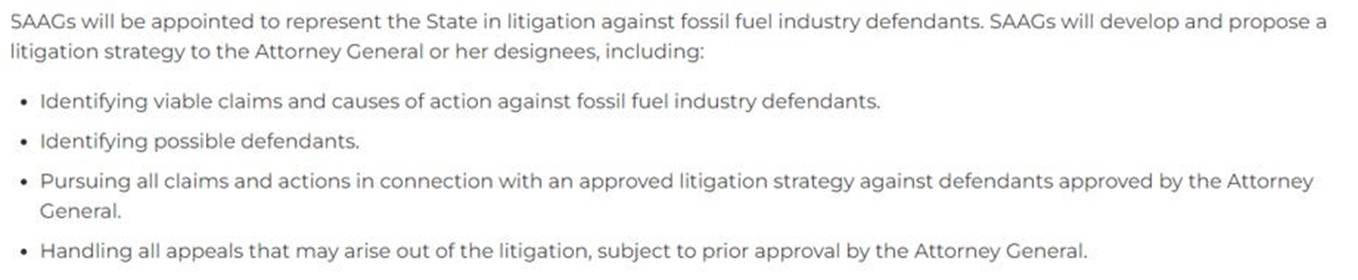
In another case, Wisconsin dairy farmers are suing the state AG, Josh Kaul, for giving a “privately-funded attorney ... the authority to impose fines and pursue criminal charges against our farmer members” while not being accountable to the state AG. The SAAG is a legal fellow paid by the State Energy and Environmental Impact Center. See the case here.
Commodore Mike
I often wondered why Michael Bloomberg almost always chooses to create his own advocacy groups via fiscal sponsors like universities rather than funding existing organizations. I had assumed it was about control. Bloomberg’s generals would issue the orders from central command for the foot soldiers to carry out. We saw how complex this command structure got with his flotilla of tobacco control operations, spreading funding between organizations as each supposedly independent body was coordinated into a massive campaign to carry out Bloomberg’s whim of banning tobacco harm reduction products.
The Firebreak has investigated many of these Bloomberg babies, criticizing how their existence only via fiscal sponsors (often universities like Bennington College or University of Bath) is designed to evade transparency and accountability issues. Groups that look like and function like NGOs or institutes, but are simply (very large, long-term) projects give a certain control and flexibility that appeals to impact-oriented professionalized philanthropy consultants. And if such projects find themselves in a situation where they may be forced to be accountable or transparent, then like the State Energy & Environmental Impact Center, it can be dissolved in the middle of the night and no one would ever speak of it again. Control, flexibility, invisibility.
The ability for the State Impact Center to simply vanish with the wave of a billionaire funder’s hand is a further argument for why the US should ban the use of fiscal sponsors to run “projects” to avoid having campaign groups registering as legal entities. There needs to be accountability. Would Bloomberg Philanthropies be held liable for any laws that may have been broken? Or does accountability rest with NYU?
Since the State Energy & Environmental Impact Center doesn’t exist, and their website was easily closed, no one seems particularly concerned about what happened. They will probably resurface as another fiscally sponsored project once Bloomberg Philanthropies fixes that disclosure failure that exposed their involvement.
Ethical Rules do Apply to Philanthropists
This is not an ethical way to run an organization, creating dark bodies for political activism that are in no way accountable for their actions. In all fairness, I have to admit admiring how cheeky Bloomberg’s generals have become, assuming they can just move in and take over the state judicial systems. When you spend your days sitting on a mountain of money, you quickly assume everyone can be bought (especially lawyers). And if things get messy, just shut it down and say nothing more about it.
As wickedly efficient as this all sounds, shouldn’t Michael Bloomberg, at some level, be considering such abuse of influence as morally questionable.
It should not be forgotten that Michael Bloomberg is not a philanthropist. He is a politician and a business entrepreneur. He runs his foundations, Bloomberg Philanthropies and the Bloomberg Family Foundation, as extensions of his political activism: to lobby for policy change and to control the agenda. He will continue to pump money into a campaign, however flawed, until he gets his way. And if any of his groups gets caught doing something illegal or unethical, he just shuts it down and tries another tactic.
This is the first time in history that a billionaire has decided to use his wealth for political influence on such a global scale without getting directly involved in political movements (like, for example, George Soros). He is, for example, essentially running a WHO program on tobacco control and has shown other billionaires that it can be done for a mere $2 billion. He has spent hundreds of millions relentlessly trying to obstruct fossil fuel companies via activist campaigns, strategic litigation or media attacks. The $5.6 million spent to set up the State Impact Center was just a small bet on his climate lawfare roulette wheel. They got caught, so he just shut it down. Maybe he’ll be luckier next time.
How would a genuine philanthropist spend $2 billion? If Bloomberg had made charitable donations instead of shelling out on highly-paid lobbyists, he could have made significant inroads in addressing the mental health and homeless crises in US cities ... or curbed poverty and malnutrition in sub-Saharan Africa. Instead, he runs a complex network of organizations campaigning against public access to affordable energy or raising doubts on vaping or nicotine pouches as effective tobacco harm reduction tools. And for that he can tout the titles of WHO Global Health Ambassador or UN Special Envoy for Climate Action.
Michael Bloomberg is no philanthropist, and his unethical strategies do not merit special UN titles. He should be held liable for the costs of the misdeeds of the State Energy & Environmental Impact Center. Lacking transparency, accountability and ethical principles, Bloomberg’s win-at-all-costs to control policy and public behavior merits a new title: “philoligarch”. An article on that new billionaire species is in production.