


If you’ve been following the Firebreak’s running investigation into how U.S. foundations use fiscal sponsors, NGO networks, and compliant journalists to reshape entire industries in their own ideological image, then Marc Gunther’s piece this week in Inside Philanthropy (“Yanqui Go Home: Chilean Salmon Farmers Say U.S. Foundations Are the New Colonialists”) will feel immediately familiar. The David and Lucile Packard Foundation, headquartered in Los Altos, California, is funding a coordinated network of NGOs, legal groups, journalism programs, and certification bodies systematically working to shut down Chilean salmon farming, an industry that generates $6.3 billion in annual exports and supports between 60,000 and 86,000 workers across the Araucanía, Los Lagos, Aysén, and Magallanes regions of southern Chile.
Gunther tells the story well, but the scale of the operation is such that one can’t capture it in a single feature piece. One of Gunther’s sources, a letter sent from the Chilean Salmon Council to Packard’s Board several months ago—a copy of which the Firebreak has obtained—is rife with detail about that foundation’s work that didn’t make the cut.
Here’s some of what was left out.
Where the “green colonialism” comes from
Juan Carlos Tonko Paterito is the president of the Kawésqar Indigenous Community in Puerto Edén, a remote fishing settlement deep in Chile’s Patagonian channels. In July 2019 he published an open letter in the ICCA Consortium’s Latin America bulletin titled “Indigenismo y colonias verdes”: Indigenism and Green Colonies. He was writing about what he had watched happen to his territory after the Tompkins land donation put Magallanes on the international conservation map, and the NGOs followed.
“Diverse organizations of environmentalists have appeared here for the business of conservation, humiliation and submission,” he wrote. He described how they arrived with maps already drawn, dividing territory between them—“an NGO here, another there.” One representative told him Magallanes should become “a climate refuge.” Tonko Paterito asked the obvious question: for whom? Not for the Kawésqar, who already lived there. “They are trying to depopulate forever a huge territory,” he wrote, “as a ‘climate refuge’ for rich green people.”
He called indigenous communities that cooperated with the NGO network “the new yanaconas”—a charged historical reference to the indigenous people who served as auxiliaries to Spanish colonial forces. “The new yanaconas are now digital and globalized at the hand of the green colonialists.” He was not writing in support of the salmon industry. He was writing about the loss of his people’s sovereignty over decisions affecting their own land. “Our counterpart are the States, not the NGOs,” he concluded. “It cannot be that we are at the mercy of organizations we don’t know, ones for which the Chilean citizens have not voted to govern our destinies.”
That is the precursor of the phrase “philanthro-colonialism” that the Chilean Salmon Council’s letter deploys.
The boat that wouldn’t dock
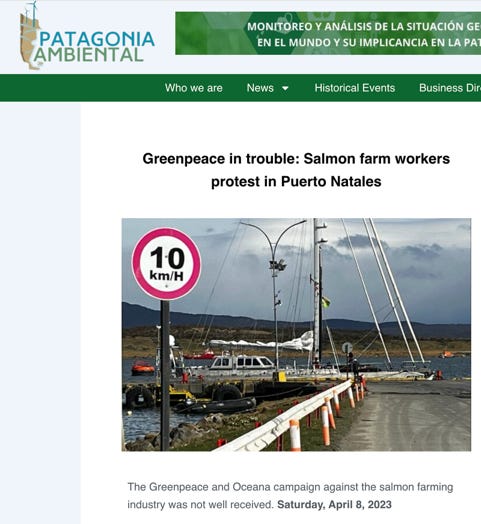
In April 2023, a local media group, Patagonia Ambiental, reported on how Greenpeace and Oceana sailed the yacht Witness through the channels and fjords of southern Chile on a campaign they called “Patagonia sin salmoneras”—Patagonia without salmon farms. The campaign was well-funded, well-publicized, and designed to document the industry’s environmental footprint from the water.
When the Witness arrived at the pier in Puerto Natales, it was met by a protest. Artisanal fishermen, processing-plant workers, and representatives of the Kawésqar community had turned out on the dock with banners. Among them was Amil Caro, a Kawésqar elder, holding a sign that read: “Greenpeace won’t pay my bills.” He had tried to approach the vessel to speak with the crew. The crew chose not to disembark. Port authorities had to prevent protesters from approaching the boat.
According to Chilean journalist Claudio Andrade, it was the first time Greenpeace had encountered this kind of reception in the region. Greenpeace raises significant funds presenting itself as the protector of indigenous communities. That April, a Kawésqar elder walked to the dock to speak with them. They stayed on the boat.
Carlos Odebret, president of the Magallanes Salmon Farmers Association, told the trade publication Salmonexpert afterward: “There is no possible improvement if activists, like Greenpeace, without asking anyone, seek to leave the people of Magallanes without opportunities.”
The legislation the NGOs are weaponizing
The letter to Packard devotes considerable space to a regulatory mechanism that hasn’t gotten much attention in English-language coverage: the ECMPO, or Coastal Marine Space for Native Peoples (Espacio Costero Marino de los Pueblos Originarios), established under Chile’s Lafkenche Law. The law allows indigenous communities to petition for coastal exclusivity over traditional-use areas—a legitimate protection mechanism that, the letter argues, is being systematically deployed by NGO-funded legal teams as an industrial chokehold.
In Chiloé, ECMPO applications covering more than 621,000 hectares have been filed on behalf of just 36 indigenous people. The math: roughly 17,000 hectares of marine exclusivity per person. Marcelo Lipka, VP of the Multi-Union of Salmon Farming Workers, described it plainly: those 36 people “now get to say who works in their areas and who does not, thus impacting our work.” Gerardo Balbontín, General Manager of Blumar, said the NGOs had found a way to “trap” salmon farming by overwhelming the regulatory system with ECMPO requests faster than it could process them.
Packard has funded this directly: $836,100 to FIMA, Chile’s foremost environmental litigation firm, with one 2025 grant explicitly labeled a “civil society communications campaign.” FIMA has won five consecutive environmental tribunal rulings against named salmon farms. Packard separately gave $226,000 to Observatorio Ciudadano to build a “legal network for indigenous communities”—the mechanism that connects the litigators to the indigenous plaintiffs whose standing the lawsuits require. The lawfare is coordinated, not coincidental.
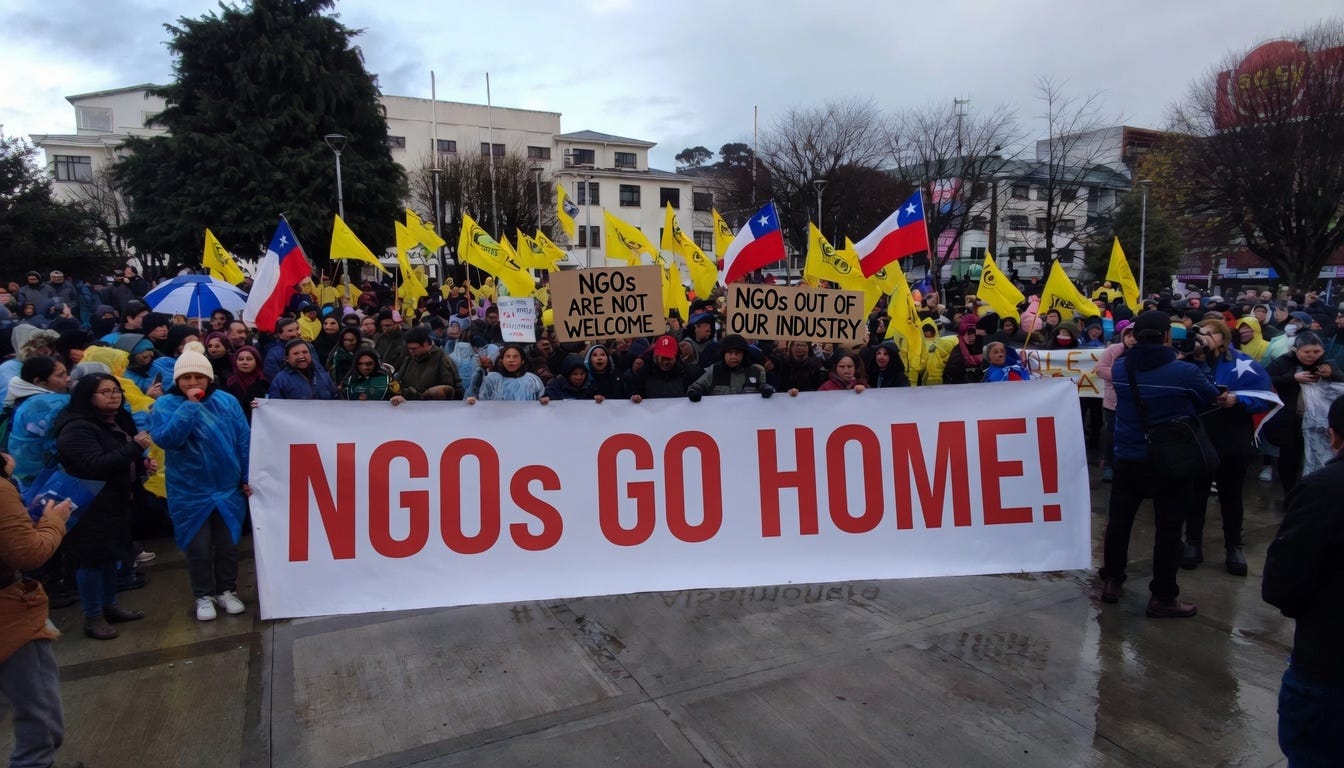
What it produced in practice: In May 2023, tens of thousands of workers marched from Biobío to Magallanes against pending legislation that would have further restricted salmon farming in protected areas. The marches stretched the length of a country. Signs read: “¿Sin salmoneras quién nos paga el sueldo? ¡¿Las ONGs?!”—“Without salmon farms, who pays our salary? The NGOs?!” The protest in Puerto Natales alone drew 2,000 people and a vehicle caravan four kilometers long. Participants included not just salmon workers but artisanal fishermen, shellfish farmers, truck drivers, and indigenous community members.
Chilean Senator Fidel Espinoza captured the mood with a tweet directed at the government: “Stop governing from Ñuñoa and from comfortable positions.” Ñuñoa is a wealthy Santiago suburb.
The response from Packard? The letter reports that not one of the workers, union leaders, indigenous representatives, or elected officials mentioned in its pages has ever met anyone from the foundation, received a call, or received a reply to correspondence.
The NGO transparency bill they’re trying to stop
One consequence of all this that hasn’t been reported in English at all: Chile is on the verge of passing landmark legislation requiring NGOs to disclose their foreign funding. Deputy Miguel Ángel Calisto, who represents Aysén—the region most affected by the regulatory campaign—authored the bill.
Calisto’s stated rationale cuts to the heart of what Gunther’s piece describes: many NGOs “mask negative intentions, such as undermining industries like salmon farming, behind positive rhetoric,” he said, and use regulatory mechanisms to “trap” the sector. “There are some organizations labeled ‘indigenous’ but some are disguised to hide their true intentions. We need to know how many NGOs are in the country and who finances them.”
Greenpeace Chile Director Matías Asun gave the Senate Environment Committee an unintentionally useful piece of testimony in 2024. He told the committee that his organization had “so many economic resources that he could easily stop projects of industries like salmon for up to 2,000 days.”
Packard’s website promises “engaged sensitivity toward the communities its work impacts.” It promises to “work with those communities to develop and carry out solutions” and to ensure “communities have a meaningful voice in decisions that impact their lives.” It is a reasonable aspiration. The gap between that language and what Tonko Paterito described in Puerto Edén, what Amil Caro experienced at the Puerto Natales dock, and what the workers marching from Biobío to Magallanes were protesting—that gap is so big not even Gunther’s carefully reported piece could capture it all.
Will Packard Defend Its Actions?
The Packard letter from which most of these details come is signed jointly by the Chilean Salmon Marketing Council and El Instituto Tecnológico del Salmón, and runs to several thousand words. It is addressed directly to Jason K. Burnett, Chair of Packard’s Board of Trustees, with the full board copied.
It closes with three questions: 1) Whether the board believes Packard’s conduct in Chile meets its own stated ethical standards for community engagement. 2) Whether it is troubled that a comprehensive range of Chilean stakeholders feels deeply insulted by the campaign it has underwritten. and 3) Whether the board will commit to visiting the affected communities in person for direct dialogue.
The Firebreak has spent three years documenting a specific and repeating pathology in the world of big-philanthropy-funded environmentalism: the substitution of communities’ own expressed interests with the preferences of distant, wealthy institutions that claim to speak on their behalf. We’ve tracked it through agricultural policy in Europe, through fisheries debates in the North Atlantic, through the quiet defunding of inconvenient science. The Chilean salmon story is—so far—the most completely documented single case of the pattern we’ve found anywhere. This is what the Firebreak exists to document: not the lofty stated goals of these institutions, but the real-life consequences for the people in the communities where their money lands.
Clarification / Editor’s Note:
Firebreak has received an email from Oceana declaring the organization “had no involvement whatsoever with the yacht Witness or with the “Patagonia sin salmoneras” campaign, contrary to our reporting. Oceana points to a passage in our article that, “In April 2023, Greenpeace and Oceana sailed the yacht Witness… on a campaign they called ‘Patagonia sin salmoneras’” insisting that was incorrect.
Our characterization was based on Chilean news outlets (such as this article in Patagonia Ambiental) that reported on the Greenpeace and Oceana campaign against the salmon farming industry and described local demonstrators as being outraged at both groups. Here is a key passage from that Patagonia Ambiental article, reporting contemporaneously from the scene of those demonstrations.
“Two environmental organizations, Greenpeace and Oceana, are carrying out a plan of action against the continued presence and installation of salmon farms in the region. Aboard the Greenpeace yacht Witness, they are traveling through the channels and fjords of southern Chile until April 22. According to their statements, their task is to document the activity of the salmon farming industry in the region and how it affects the environment.
This campaign affected their arrival in Puerto Natales, where people who earn their income from the activity turned out to demonstrate. Artisanal fishermen, representatives of the Kawésqar community, and employees of several processing plants received them with banners in which they defended salmon farming activity, opposing the environmentalists’ intention to ban the industry throughout Patagonia.Faced with this situation, the crew of the yacht — among whom are journalists, scientists, and Greenpeace campaigns coordinator Estefanía González — decided not to disembark to avoid conflicts. Port authorities, meanwhile, prohibited protesters from approaching the vessel.”
We can assume that Oceana has already contacted the Patagonia Ambiental media group with a similar complaint, but they seem to be standing by the evidence they reported on.
It’s worth noting also that, over just five years, Packard has given Oceana close to $1 million, according to Packard’s financial disclosures — while both organizations operate as part of the same coordinated multi-funder coalition driving anti-salmon-farming advocacy in Chile.
We are glad to note here, however, that Oceana explicitly disavows any involvement in the Greenpeace yacht or the Patagonia sin Salmoneres campaign — and we have modified that portion of our article to reflect the original attribution to Chilean news outlets.