


This is the first of a three-part series on the Plastic Fear Complex. It will look at how plastics are being positioned to be the next global crisis, following the climate change playbook of controlling the narrative and fabricating fear. Part One looks at how media groups are starting to finally wake up to the nonsense published by activist scientists about the faux risks of microplastics. This though does not matter so long as large foundations continue to pump funds into activist science research, NGO campaigns and media reporting against plastics (Part 2). Part 3 will be a review of a foundation-funded anti-plastics lobbumentary just released on Netflix as a case in point of how facts don’t matter when emotional, anti-industry campaigns have unlimited funding to control what the public perceives.

Since the rise of MAHA in US policy, journalists have been starting to question the findings of activist scientists, and instead of amplifying their campaigns and scary conclusions (as scandals and crises make better headlines), they are shining a spotlight on the nonsense being published, propagated and promoted on behalf of some undisclosed funders and special interests. In particular, in 2026, journalists are starting to wake up to the poor research, bad methodology and lack of integrity of scientists publishing their insignificant findings and questionable conclusions from “research” on microplastics and nanoplastics claimed to be present in humans and the environment.
The realization of bad science was slow to arrive. The Firebreak was one of the few sources to report last October about the European Food Safety Authority (EFSA) literature review that concluded that almost all published microplastic and nanoplastic studies were littered with mistakes, poor methodologies and unjustifiable conclusions.
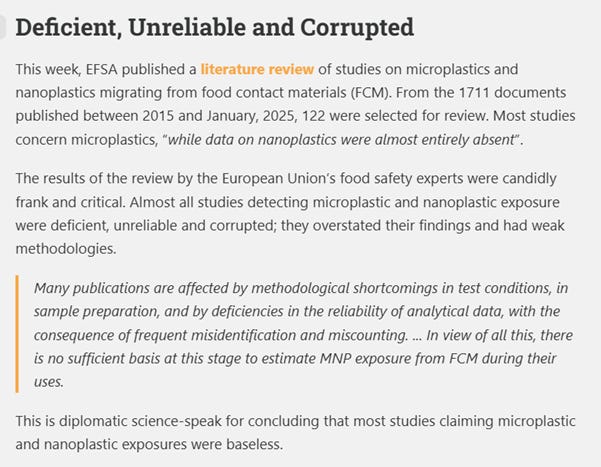
The Firebreak analysis of the EFSA report rejecting the validity of most micro/nanoplastic studies concluded with advice on what journalists should be covering each time (each week) another publication comes out making some ridiculous claim about the risks of our exposure to plastics.
I have been playing this game for far too long to imagine any mainstream media groups would forego the instant attraction of catastrophic/crisis reporting in favor of hard truths and scientific facts. Imagine my surprise when the first media group to find reporting integrity and report the reality of the anti-plastics tactics was The Guardian.
The Guardian Bombshell
In January, the Guardian published a scathing article by their environment editor, Damian Carrington, calling most microplastic studies meaningless, scaremongering, a joke or biologically implausible. The article, entitled “‘A bombshell’: doubt cast on discovery of microplastics throughout human body” starts off with a reality check:
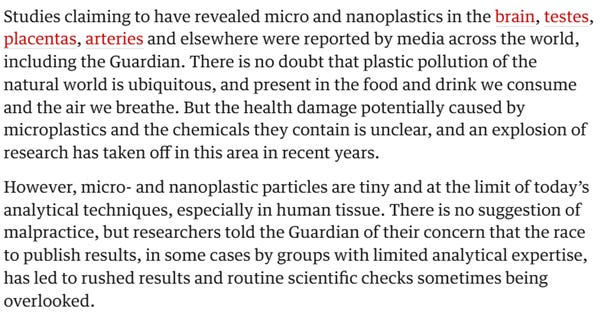
Carrington’s Guardian article looked at seven particular microplastic studies, measuring the reactions within the wider scientific community and found cases of poor methodology, bad lab practices, false positives and claims not supported by evidence from researchers lacking any analytical chemistry knowledge. The level of doubts being voiced in the scientific community at the number of studies and their unjustifiable claims was termed “a bombshell”. Until this article though, the mainstream media has not been honestly reporting on the dissent from credible scientists on the ridiculous claims about the microplastic invasion.
The next question for the media to start considering is why there are so many (expensive) studies on microplastics and nanoplastics conducted, published and widely amplified. Who is funding them and what are their interests? If David Carrington actually does read The Firebreak, he might have another media scoop.
What was interesting from a mainstream media group that habitually promotes scaremongering campaigns (touted by reporters like George Monbiot and Carey Gillam) is the Guardian’s appeal now to reduce scaremongering and to tone down the level of public internecine sniping between scientists. The main conclusion of this article is not to panic when alarmist claims are made and trust that the analytical technology is improving as the science evolves.
The Empire Strikes Back
Eight days after the “bombshell” Guardian article, a group of activist scientists struck back with a rebuttal stressing the dangers of microplastics. The authors, Joe Yates, Philip J Landrigan, Jennifer Kirwan and Jamie Davies, were coordinated (by some unmentioned organization) to write separate letters bundled into a response article to try to diffuse the Guardian’s unexpected criticism of the anti-plastics campaign.
Their main point, outside of the usual “industry collusion” trope, is that disagreement is an important part of the scientific process but the media should not use it for political purposes. I wonder why these “independent scientists” did not publish the same responses when their papers arguing that microplastics are causing serious health issues were amplified by the same media groups.
Most well-known in this group was Philip Landrigan who didn’t really address the arguments in the Guardian bombshell article, but just repeated the activist talking points on how bad plastics are. He also used the opportunity of his short letter to plug his Lancet Countdown on Health and Plastics, an assembly of activist scientists he is leading that is starting yet another exclusive academic platform for publishing their research agenda. This academic sideshow is funded by the Minderoo Foundation (see Part 2 of this series).
A Credit Card of Microplastic Scaremongering
This month, New Scientist came out with an even more critical assessment of the poor methodology and ridiculous conclusions from the recent slew of studies on micro/nanoplastics. The article, written by Chelsea Whyte, entitled: “How worried should you be about microplastics?”, concluded that you should not be worried at all, but rather, mildly bemused.
The article started with an assessment of the exposomist claim that we ingest 5 grams, or the equivalent of one credit card, of microplastics per week. Whyte claims the study used some very shoddy math and in reality, we more likely ingest only “0.0041 milligrams per week, which is less than a grain of salt)”. Like the Guardian “Bombshell” article, she examined the flawed methodology of vaporizing tissue samples, a practice that would convert human fat into microplastic false positives.
The article then asked the more important but rarely considered question. If there are microplastics in our bodies, no matter how little, what is the risk? Whyte looked at the possibility of other harmful chemical additives leaching out of the microplastics into human bodies and concluded that the amount and risk were negligible. Many animal studies providing massive microplastic doses to mice and pigs proved to be unrealistic.
The New Scientist article concludes that these claims feed “into our doomerism feelings about the pollution happening all around us” but there are many more pressing issues we should be worried about than microplastics in our bodies.
How is Such Misrepresentation Possible?
Whether the studies are raising fears about microplastics, ultra-processed foods, PFAS or glyphosate, the reality is that these nonsense studies are making their way into journals because of the broken peer review process, a myriad of funding interests and the rise of a post-capitalist activist ideology ripping through the academe. And news organizations love their cataclysmic claims.
In some cases, articles with alarmist findings on microplastics were published by lab technicians. Universities spending large budgets on high-precision laboratory analytical equipment need to promote their facilities to gain stature and market opportunities. Publishing detection findings of nanoplastics crossing the brain-blood barrier will certainly get attention in the research community.
But shouldn’t the peer review process filter out the bad research methodologies and unjustifiable conclusions?
Today most journals are no longer respecting a credible peer review process. I have written in the past how the system is broken, how many predatory journals funnel papers through via a pay-to-play process and how even credible journals favor the shock headline articles over good methodology.
Then there are the outside interests who will benefit from the public fear and reaction against plastics. Many of the studies are funded by NGOs, activist foundations and competing industries with alternatives to plastics. Part 2 of this series will examine such cases.
But surely we can now assume, given the mainstream media reaction against the Plastic Fear Complex, these studies, the funding and the campaigning will now have to stop.
Is the Microplastic Myth Now Dead?
Where do activist campaigns go when they have been thoroughly discredited?
Chemtrail conspiracies have been refuted.
The MMR vaccine – autism link categorically rejected.
4G fears became 5G campaigns that will soon look in horror at 6G.
The endocrine disruption doomsday scenarios fell flat as the decades passed.
But still these myths are propagated every day, they find activists willing to put old fears in new bottles and keep a residue of uncertainty in the back of the forever frightened public’s minds. Too much has been invested in the Ban Plastics movement to let a little reality and a few bad articles interrupt a multi-pronged activist campaign.
The Plastic Fear Complex has become too large to simply be unwoven.
There are too many anti-plastic NGO campaigns depending on continued public fear and outrage.
There are too many activist scientists midway through a research study that relies on the publication of a paper with preset conclusions to justify the funding.
There are too many foundations that have moved a certain number of fund managers and five year budgets from climate campaigns to their ban plastics division (as an extension of their anti-fossil fuel strategy).
There are too many industries with alternatives to plastics that have invested in communications and lobbying campaign groups.
Even without facts, reliable studies or mainstream media support, there is still ample foundation funding, public fear and an army of interest groups that will push the well-oiled Plastic Fear Complex forward (dreaming of the next plastic straw opportunity). Too many upcoming studies and investigative journalists are in the pipeline to let the facts get in the way. They’ll just move the goalposts, wordsmith their slogans and carry on as if nothing has changed.
But will the rest of us continue to allow ourselves to be fooled? That is the question of this Plastic Fear Complex series. Part 2 will look at how the activists, with unlimited funding, will be able to manufacture a flood of anti-plastic campaign materials.