


A recent US Department of the Treasury announcement that organizations claiming tax exempt status (NGOs, foundations, universities and some media groups) will have to be transparent about their project and campaign funding has changed the rules of the US policy game. The news went largely unnoticed, but the Firebreak celebrated how this little adjustment to the tax declaration process will force activist groups to declare billions of dollars in dark campaign funding (which will likely deter secretive interest groups from funding further covert operations via activist groups, foundations, universities...) The environmental-health policy playing field has just been levelled, eliminating the means for NGOs to so easily control the narrative, media and public opinion.
Another Silver Spoon NGO
If anyone needs an example of abusive activist behavior from dark, special interest funding, they need to look no further than the hundreds of millions of undeclared funds pouring into the coffers of Earthjustice. Earthjustice is a law firm / NGO founded in 1972 as the Sierra Club Legal Defense Fund (changing its name in 1997). While it functions like a law firm, Earthjustice is structured as a tax-exempt (501(c)(3)) NGO.
Looking at this non-profit’s latest IRS 990 declaration and its website, some curious things emerge. In 2025, Earthjustice had a revenue of over $207 million. But as a law firm, only $5 million of that amount came from court awards while the rest came from donations and investments. With 150 ongoing litigations in 2025, this implies that they are losing most of their cases (or have a very bad cash management system). There are two possible justifications:
As an NGO, they exist to sue industries as flanking strategies in support of other activist campaigns. Its clients are mostly other NGOs like the Sierra Club, Wilderness Society and Natural Resources Defense Council, as well as local conservation groups and native tribes. In other words, their goal is to continually file nuisance lawsuits against companies and governments, clogging up the US legal system with no intention of winning their cases. Much like the foundation-funded law firm, Sher Edling, lawfare is their business model.
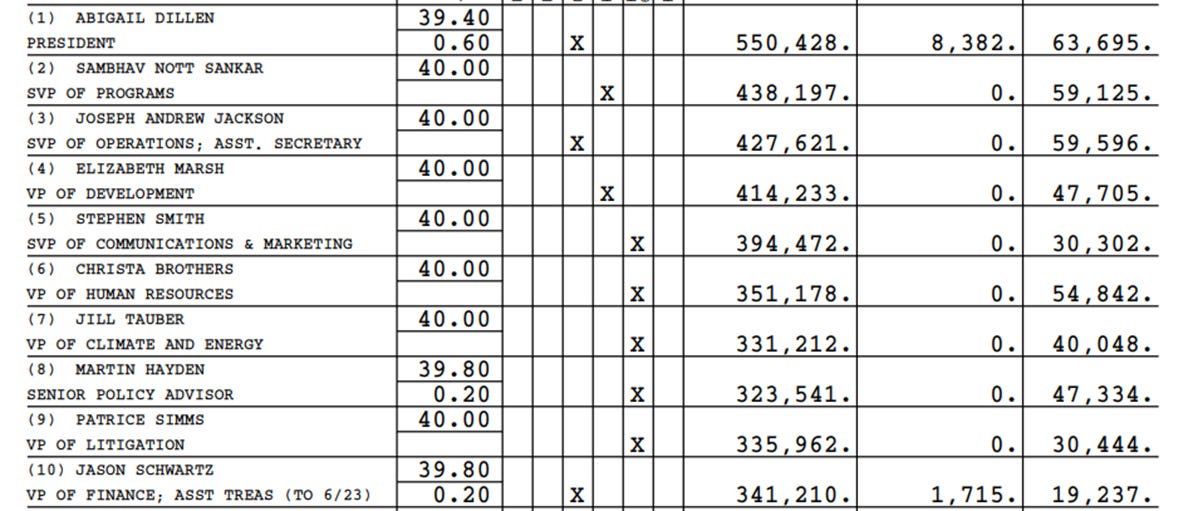
The other possible explanation is that Earthjustice staff and management are living too high off the hog. Their IRS 990 declaration reveals that the top ten managers in the NGO pay themselves annual base salaries ranging from $620,000 to $360,000 - or from $50,000 to $30,000 per month (see image below). From the $207 million in 2025 revenue, $167 million went into salaries and wages.
Given how unsuccessful Earthjustice’s legal outcomes have been, and that they are functioning as an NGO, the tolerance of these unhinged salaries, like Bloomberg’s flotilla of anti-nicotine NGOs, implies that billionaire philanthropists are operating behind the scenes and allowing such largesse.
If only these foundations and NGOs would have spent this kind of money planting trees, we could finally say they are doing something positive for the environment.
Foundations and Special Interests Hiding in the Shadows
While Earthjustice chose not to be transparent on which foundations or special interests are funding their lawfare activities, a quick scan of the websites of large foundations that tend to fund NGOs to conduct similar lawsuits did show a considerable network of well-connected funders.
The Ford Foundation was one of the initial founding donors of Earthjustice. Does it really make sense for a philanthropy built on a century of auto industry profits to be funding an NGO suing the fossil fuel and tire industries? The Ford Foundation remains a funder but there has been no disclosure of recent donations.
The MacArthur Foundation has made 11 grants to Earthjustice totaling almost $15 million. Most of those payments have come in the last six declared years.
Other foundations that have listed support for Earthjustice include the Sandler Foundation, Packard Foundation, Rockefeller Brothers Fund, and the Hewlett Foundation, to name but a few (source: InfluenceWatch).
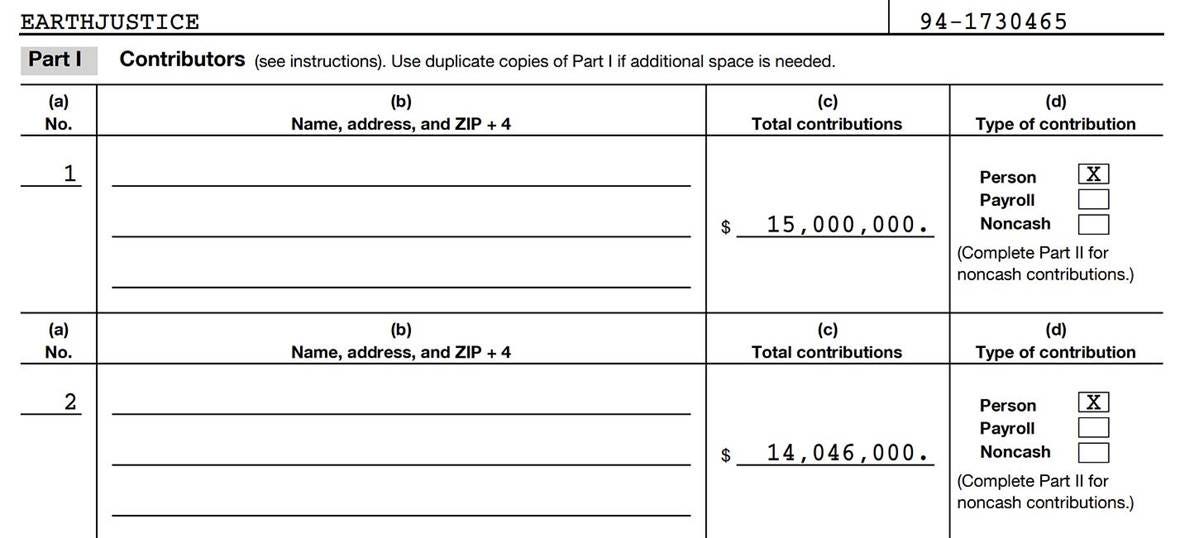
Earthjustice claims that only 17% of their funding comes from foundations, but they do not provide details. Until the Department of the Treasury announced changes to the tax declaration process, they did not have to. In their IRS 900 declaration, they list the top two donations in 2023 from two individuals, one for $15 million and the other for $14.05 million (see image below). The identity of neither donor was declared, but we can assume these individuals have means (and probably very special interests).
Why is transparency important in this matter? First of all, transparency is always important from the perspective of credibility. As long as NGOs like Earthjustice think they don’t need to reveal the interest groups operating from behind the curtain, they will never be considered as credible. How do we know that neither of the anonymous $14 million or $15 million donations in 2024 from private individuals weren’t from billionaires who would benefit from an alternative product once a competitor succumbs to relentless litigation? As these individuals would stand to profit nicely should the courts order that an industry stop using a product, then Earthjustice has a fiduciary duty to declare this conflict of interest. But they don’t.
From the 2025 financial statements, almost $25 million of Earthjustice’s net assets are donor restricted, meaning the residual funds remain earmarked for certain cases. That Earthjustice is taking these marked millions and keeping quiet is a clear indication of how morally compromised these activist zealots have become. Normal people must be wondering how these corrupted environmental campaigners sleep at night? Like most tort lawyers, they must need “very well-padded” pillows.
Even worse, Earthjustice is reportedly receiving funding from the Chinese Communist Party via an aligned Chinese energy foundation. An investigation by the Pelican Institute For Public Policy revealed that Earthjustice received donations exceeding $6.5 million from Energy Foundation China to file lawsuits against American fossil fuel energy interests. Chinese industries would benefit both from the sudden increased market for renewables and batteries in the US and from handicapping US energy and industrial capacity. Did Earthjustice file a FARA registration for foreign funding? Of course not. Like every other donation, the NGO kept its funding non-disclosed. The US government should shut Earthjustice down as an enemy of the state.
Conflicts of interest are only recognized as conflicts if the activist organizations decide to declare them. Zealots, though, think the objectives of their campaigns are more important than any ethical codes of conduct, so declaring their special interest funding will only happen if they are forced to. With the recent changes to the US IRS 990 form tax requirements, Earthjustice can no longer maintain these secret, dark alliances.
In a case like this, saying: “Trust us, we’re an NGO!” just doesn’t cut it. Especially when top directors are already enriching themselves and have an obvious interest that goes well beyond any so-called justice for the earth.