


The European Commission is in the process of harmonizing tax policies on nicotine pouches and e-cigarettes.
Their proposals will increase taxes by up to 50%.
The EU ignored the overwhelmingly negative reactions in the consultation process.
Higher taxes could undo a decade of tobacco harm reduction achievement as consumers might switch back to smoking.
Like other countries that introduced similar high taxes, nicotine black markets and organized crime will proliferate.
Homebrew juicers will become commonplace, putting quality and safety at risk.
Reasons for Regulating
What is a regulation for? Why do governments regulate? When a regulation is good, it often goes unnoticed (cleaner environment, economic expansion, better quality of life…). When it is a bad regulation, the consequences could be catastrophic (rise in organized crime, loss of respect in regulatory authorities, economic decline…). While the European Union embarks on a series of regulatory simplifications (deregulation), the important metric for each case is to ask what the regulation is for.
Some would argue that regulations should be introduced to change people’s behavior – to nudge them to more sustainable practices with carrots and sticks. If you want a healthier population, you need to encourage fitness and that includes investing in sports centers, parks, infrastructure, subsidizing healthier foods… Others would say we regulate to stop bad behavior, protect populations and discourage certain lifestyle activities. Ban a substance, prevent access or tax it out of a market.
As it is often easier to control people from doing something rather than encouraging better behavior, regulators tend to fall into the latter camp. Taxes are the regulatory weapon of choice as it supports a side-occupation – to raise revenue (where more revenue is measured as better). With this one-weapon arsenal, regulatory failure is measured by how consumers respond to ever-increasing tax measures (by adopting more harmful alternatives, adopting illegal practices or moving to lower quality products).
Taxing Harm Reduction
Last year the European Commission proposed significant increases to excise duties on vaping products and nicotine pouches, with new minimum taxes to be implemented to harmonize rates across the EU by 2026-2027. Their proposed rates include up to 40% tax for higher nicotine e-liquids (at €0.36 per ml) and a 50% tax on nicotine pouches. Last January the European Council proposed to lower the tax rate on higher nicotine e-liquids (at 0.20 per ml), extending the implementation phase-in, while leaving the tax on nicotine pouches unchanged at 50%. This means a €5 pack of nicotine pouches could cost €7.50. The European Economic and Social Committee warned about the risk of black markets coming from such restrictive taxes. The European Parliament is now considering this legislation.
The European Union is imposing these tax increases via the tax harmonization mechanism (is that even legal?) to comply with the wishes of the World Health Organization, which is pushing for higher taxes on tobacco harm reduction alternatives like vaping and nicotine pouches (… to comply with the wishes of Michael Bloomberg whose $1.6 billion in donations is essentially running the WHO’s MPOWER strategy).
But are any of these overpaid officials actually thinking of the damage their bad regulations will cause? These health advocate zealots are nudging consumers off of a cliff, pushing them toward unhealthy decisions that will lead to more cancer and more death.
There are many reasons why taxing tobacco harm reduction products is the wrong approach for public health, the economy, public safety and tobacco control strategies.
Gateway Back to Hell
People using tobacco harm reduction products like e-cigarettes or nicotine pouches often were only able to quit smoking with these products. If you tax these low-harm alternatives beyond people’s financial capacity, sadly, many will go back to smoking. Ideally, tobacco harm reduction products should be tax-free or subsidized to prevent consumers from taking the much higher risks with tobacco. It would be a major public health disaster if vapers go back to smoking, but that is what this EU regulation is encouraging.
While there may be short-term fiscal opportunities in implementing higher taxes on tobacco harm reduction products, over the long term, the added healthcare costs in treating patients for the consequences of continued smoking far outweigh the fiscal benefits.
Homebrew Juicers
Moonshiners in the 1920s needed a significant investment, feedstock and skillset to run basement distilleries during the US Prohibition on alcohol and still the businesses (and organized crime) proliferated. I have argued before that Al Capone was the product of bad regulations pushed by the prohibitionist zealots. Who will be Michael Bloomberg’s Al Capone?
To mix e-liquid for vapers, you essentially need a Grade 10 science education and a few bottles and syringes to mix the nicotine with propylene glycol and vegetable glycerin … and any flavors you might fancy. Just Google “How to make your own vape juice” for some frighteningly simple videos.
The reality is that if governments impose a regressive excise tax on e-liquids, people will just make their own or find someone in their neighborhood who can supply them a favorite nicotine juice at a reasonable price. So rather than a small tax the authorities would be able to receive, enabling them to monitor consumption and apply their safety and quality standards (what regulators are supposed to do), there will be no tax revenues and no understanding of how consumers are using the vaping products.
Gangland Violence
The disaster following from the misguided Australian nicotine regulations is worthy of some mention. The authorities have willfully imposed restrictive tobacco and e-cigarette tax and distribution policies and within a short period of time, this policy led to black markets and organized crime with gangs fighting for turf and bombing distribution shops. With a five billion Australian dollar illicit trade market following from the prohibitionist tax policies, there have been over 200 tobacconists that have seen their shops firebombed. Different Australian states have lost control as the gangs have become heavily armed.
Is the Antwerp-Brussels cocaine corridor next for a new European black market?

Dangerous Unregulated Substances
Your neighborhood homebrew juicer, operating out of a back patio or online account, may start to get creative adding more flavors or additives, branching into stimulants or narcotics and increasing production. As a little knowledge is a dangerous thing, this Grade 10 science graduate is not qualified (or concerned) on product safety or quality. Products approved for sale by regulators comply with production standards, packaging and storage requirements, assuring the consumer a high level of quality and safety. Black market bootleg e-juice does not.
The Bloomberg-funded NGOs campaigning for higher taxes on nicotine products, I suspect, are not worried about the increased risk of people dying or getting sick from illicit nicotine contraband. It will allow them to then demand a total ban on all tobacco harm reduction products because of these elevated risks. They will come up with new names to scare people. They will not accept responsibility for the carnage their myopic dogma is causing but rather use it to further their prejudice against harm reduction advocates. Something must be done about these horrible little zealots.
Economic Decline
The growth of vape shops in many European countries has been impressive, offering a wide variety of new products from small and large companies. Raising taxes by 40 to 50% will wipe out this emerging market of tobacco harm reduction products literally overnight, putting the vape shops out of business and removing the ability to control and monitor the consumers (age and product choice). E-cigarette and nicotine pouch producers were already struggling with lost market share due to counterfeits and homebrew juicers, but this increase in taxation will erase any remaining trust in the authorities and open the floodgates toward the black market.
Only the tobacco companies in this product space will survive as some vapers will return to smoking (fulfilling the false, Bloomberg-led prophecy that Big Tobacco is controlling this market). How do you spell ‘stupid’?
Poor Consultation Process
For regulations to be comprehensive, they should involve inclusive public consultations. Even though the European Commission conducts such open surveys every day, the inquiry on the proposed tobacco and nicotine taxation strategy was so badly managed as to be an embarrassment. See the Clearing the Air analysis. First the questionnaire was written in a way to discourage people from expressing their concerns. The process to register to participate in the consultation is so cumbersome as to prevent members of the public from taking to time to enter the process.
Even then, an overwhelming number of EU citizens and consumers participated in the consultation on the tax harmonization proposals, with 89% disagreeing with the European Commission’s strategy. EU citizens made up 93% of the consultation’s participants. These consumers did not want to be forced to go back to smoking.
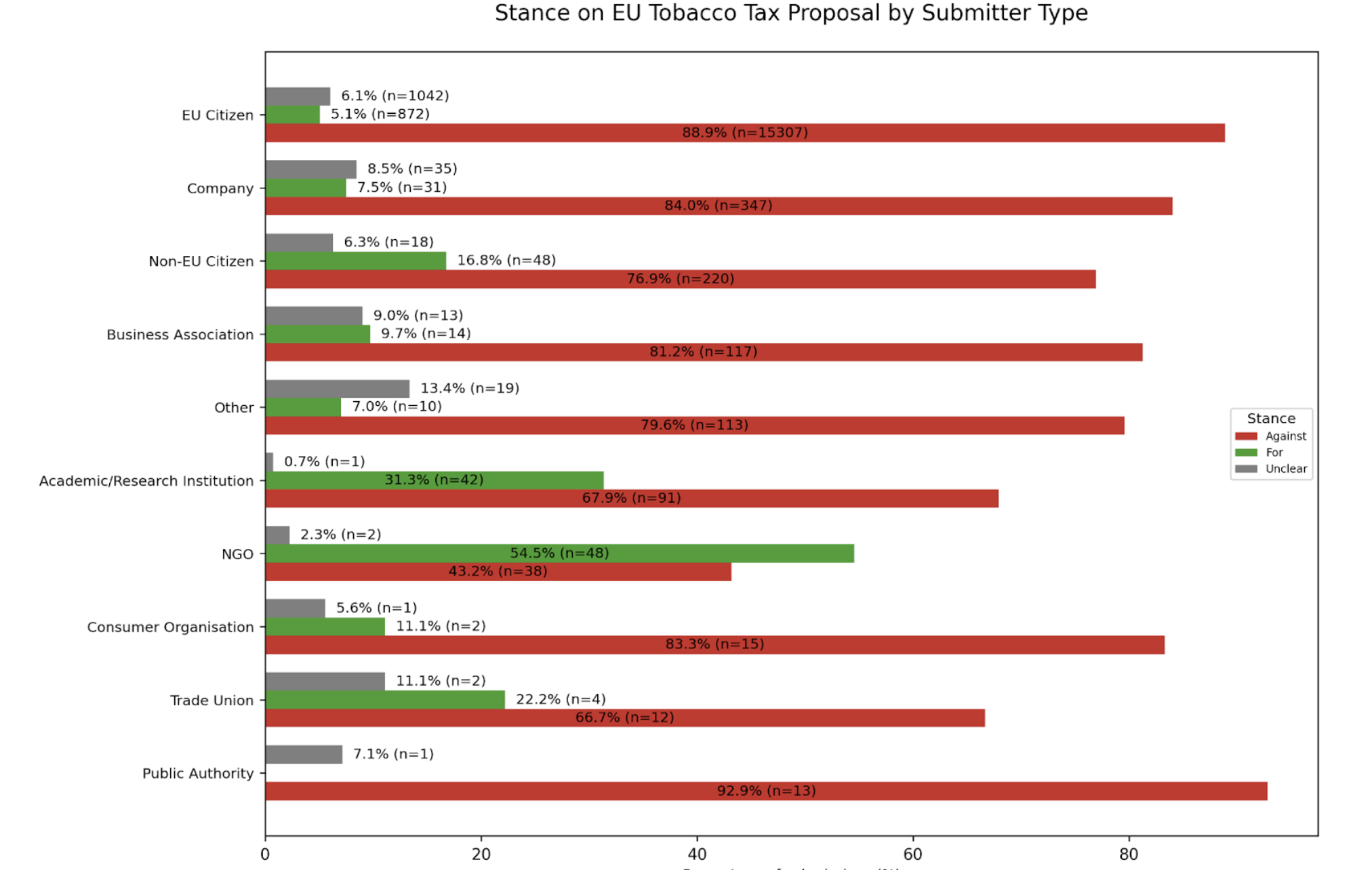
The consultation results should have been a clear indication for the European officials to go back and revise their proposed regulation. But instead they doubled-down, agreeing with the Bloomberg-funded NGOs that the consultation may have been skewed by an organized “industry” action against the European Commission’s taxation plans.
No doubt the vape shops mobilized their customers to stand up and defend their right to reduced harm alternatives to tobacco. That is their right and many vapers are very passionate about how they were able to beat smoking. But the clear voices of thousands of consumers should carry more weight than a foundation-funded non-profit that is essentially three people in a room with a laptop.
Instead the European Commission is committed to following the WHO’s MPOWER dictates of increasing taxes on tobacco harm reduction tools (even though this WHO strategy is funded and managed by the US billionaire, Michael Bloomberg). To the zealots, imposing severe taxes is more important than any democratic process or rational regulation.
When do you know a regulation will be bad?
When consumers will be forced to go back to more harmful alternatives.
When black markets and organized crime will fill the void left by the bad regulation.
When consumers will make or buy homemade alternatives that have lower safety and quality levels.
When regulators are not listening to the interests of consumers.
If you want to know what a bad European regulation is, watch this space.