


At the beginning of the year, President Trump announced that the United States would be leaving a large number of international organizations. Globalists were shocked by the magnitude of organizations being abruptly abandoned by the leader of the free world, declaring an imminent decline in US statesmanship on the world stage.
But the president, known for his transactionalism, used a different metric for US involvement in such global organizations, putting each international body under microscope while asking the same questions: How much do we spend on this? and What are we getting in return? Under such a metric, it is surprising the number of organizations that the US has left is so little.
International organizations have become beasts upon themselves, achieving very little more than holding meetings and making declarations nobody reads. They are kept alive by the patronage of globalists (international administrators, delegates and uncles who were owed favors) perpetuating a chronic movement from one international secretariat to another annual conference in some far-off tourist destination. As a closed, semi-diplomatic clique, no one knows whom these people are or what they do because, well, their roles and posts are useless to the core. No one will notice a loss in global achievement with the large-scale US withdrawals because these organizations never actually did anything of substance.
Each country’s membership in any international organization entails maintaining a Commissioner’s office where their phones never ring, their reports are never read, and their meetings are never covered in the media. This globalist waste would be comical if it weren’t for the high number of diplomatic salaries, Commissioners, red passports and travel budgets squandered on meaningless verbiage blown into the wind. Every single day, in some resort / conference venue by the sea, “high-level” ministerials rifle through an agenda to nowhere, clicking their PowerPoints until it’s time for lunch.
The US is a fairly wealthy country and can afford the wasted billions spent maintaining ineffective secretariats and open budgets to send these international delegations on the road to nowhere. What is more obscene is the amount spent by poor, often corrupt countries to keep seats at the tables of organizations that do nothing so spectacularly. I fear that much of the development aid distributed through these global bodies will go first to paying off the quasi-diplomatic delegations who faithfully show up year after year at some host-nation events and working group meetings. Given there are literally thousands of such international bodies covering every possible interest, there are a lot of uncles cashing in on the favor banks in these otherwise impoverished countries.
Case Study: The Developing 8
I recently discovered one of those useless international bodies, known as the Developing 8 (or D-8), that has existed since 1997 (perhaps as a foil to the G-8 at the time to represent Muslim-majority developing countries). I cannot see anything useful that they have achieved in their 29 years of existence, except a series of ministerial meetings, Commissioner retreats, policy statements, amiable goals, and well, more meetings. As Indonesia takes over the chair with an ambitious program (I wish I were making this up), it seems like the D-8 is primed for … more obscurity (although deftly executed with an ample budget for the Indonesian rotating chair).
For those who have never heard of the D-8, you are not alone. It was founded to promote development cooperation among eight emerging nations: Bangladesh, Egypt, Indonesia, Iran, Malaysia, Nigeria, Pakistan, and Turkey. 27 years after the Istanbul Declaration, this global organization, out of nowhere, decided to expand with the addition of Azerbaijan.
The D-8 have set many lofty policy goals like:
growing intra-organization trade by $500 billion (but achieving just $60-70 billion by 2023);
increased shared investment vehicles (although China, a non-member, seems to be exerting more influence with its infrastructure loans to Nigeria, Egypt and of course, Pakistan);
their “D-8 Payment Arrangement” for banking cooperation hit a small snag given that Iran is a D-8 member, leading to the risk of the US imposing sanctions on the block;
even more troublesome, holding D-8 payment reserves is quite risky given the recent extreme volatility in the Turkish lira, Egyptian pound, and Pakistani rupee.
In short, the D-8 has achieved nothing in its 29 years of meetings, conferences, ministerials and policy strategies. Still, everybody (and their uncles) continue to travel around the world, attend meetings and sign more declarations.
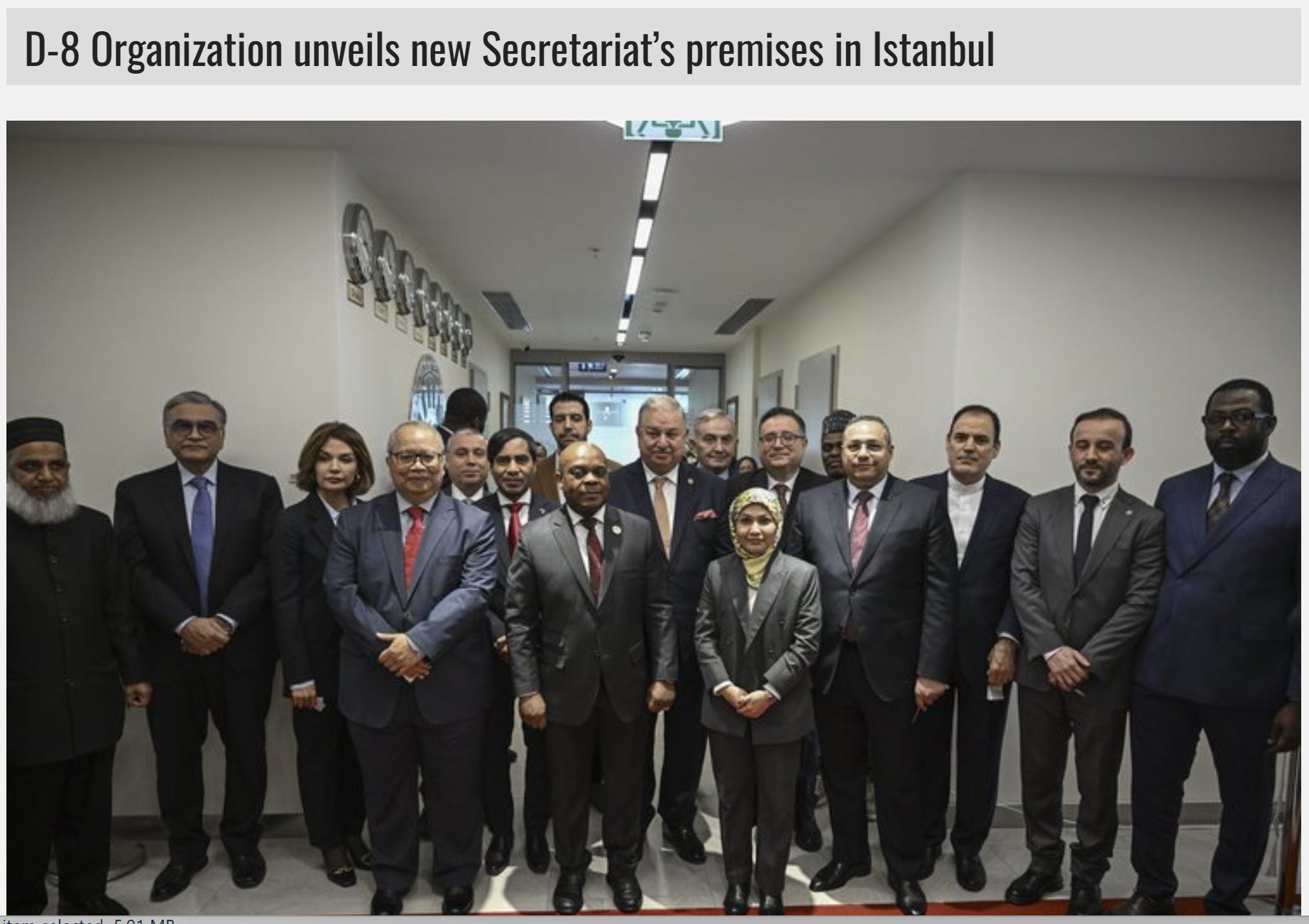
Outside of national expenditures, D-8 Commissioner offices and rotating chair costs, the D-8 General Reserve Fund has an annual budget of around $1.3 million (based on calculations from the D-8’s 49th session report). This pays for their secretariat offices in Istanbul. A problem though is that Iran has been in arrears due to sanctions restricting foreign exchange transfers. They are considering resorting to cash settlements following the model set up by the Indian Ocean Rim Association (IORA) ... another international organization, also set up in 1997, that seems to hum along to its own tune.
Given the global sanctions on Iran and their isolation on the world’s stage, their continued membership in the D-8 should raise concern (especially as there are several American allies in this global organization). But that assumes that leaders, including those from its own member states, actually know what the D-8 is and who belongs to it. Fortunately for Iran, there is very little risk of that happening.
What’s the Point?
Why do developing countries, some with massive debt or IMF obligations, continue to pay dues, name diplomats and reserve budgets for offices to completely useless global organizations like the D-8.
Perhaps a country like Iran gains recognition in such a membership and a platform for their foreign policy campaigns.
Perhaps it is a good dead-end post to send difficult diplomats (… or uncles owed a favor).
Perhaps governments lacking legitimacy can report to their populations that they are achieving something on the “global” stage.
But wouldn’t it be better for these governments to redirect the funds wasted on such global talking shops to more practical projects like improving water and sanitation, education, food security and infrastructure? Many of the leaders of these countries have never put a shovel into the ground. They likely cut their teeth in the political world working for globalist secretariats or got funding as a student to attend one of these faraway ministerials. It is easier for them to host conferences that make lofty commitments than develop their societies and promote their citizens’ well-being.
Then there are the political ambitions of the secretariat members. These dead-end global organizations are merely steppingstones up to the UN and their multilateral organizations (where real budgets and power reside). The networking opportunities are rich when a diplomatic functionary can get beyond his or her borders. Key actors at this point are the globalist foundations and NGOs who are always looking to expand their networks and spheres of influence in the developing world.
Donald Trump did not understand the trials and tribulations of the low-level functionaries with big dreams and a taste for luxury, but in developing countries, these dead-end global organizations are about as close as these people can get to political opportunity. Organizations like the D-8 can continue to look forward to another three decades of meetings, a new member or two, some policy targets and reports, assured that their sheer existence is deemed far more important than their utility.