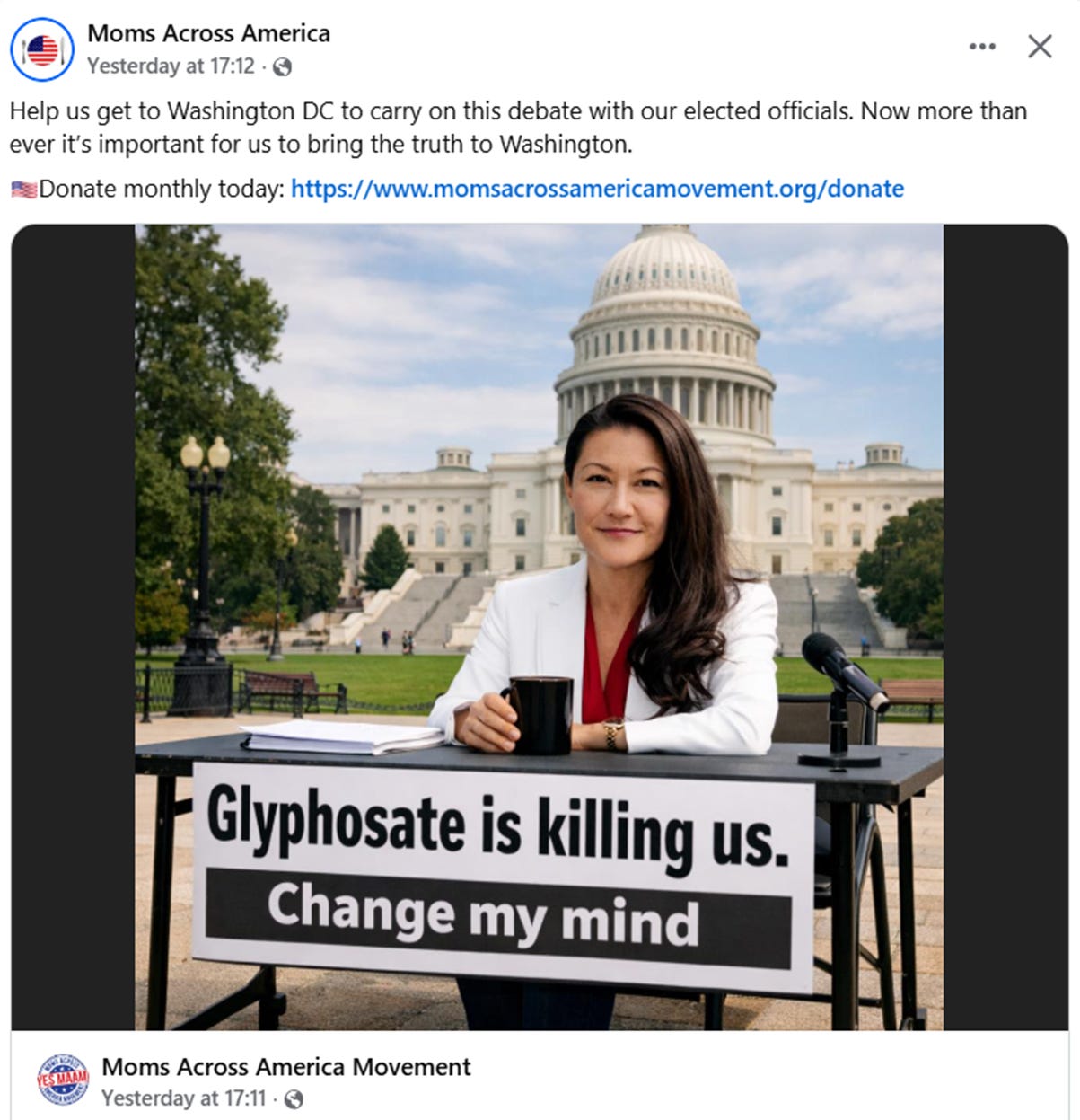
The Make America Healthy Again (MAHA) activist movement has gone on the war-path over the last week when President Trump signed an executive order declaring glyphosate and essential phosphorus to be federally protected critical resources.
The MAHA outrage was immediate. This was treacherous, a middle finger flipped upon all of the hard-working MAHA Moms, a declaration of chemical warfare on the American public and a bow toward the interests of the chemical lobby (read Monsanto) and their “systematic poisoning” of children.
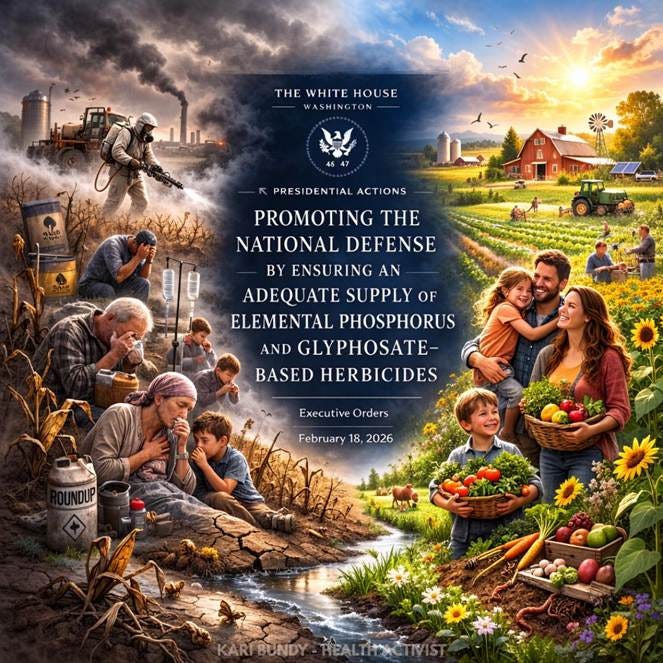
Even more infuriating, the MAHA leader, RFK Jr, issued a statement shortly after (obviously not written by him) supporting the decision and ensuring security for Americans.
Donald Trump’s Executive Order puts America first where it matters most — our defense readiness and our food supply. We must safeguard America’s national security first, because all of our priorities depend on it.
This is a far cry from MAHA orthodoxy.
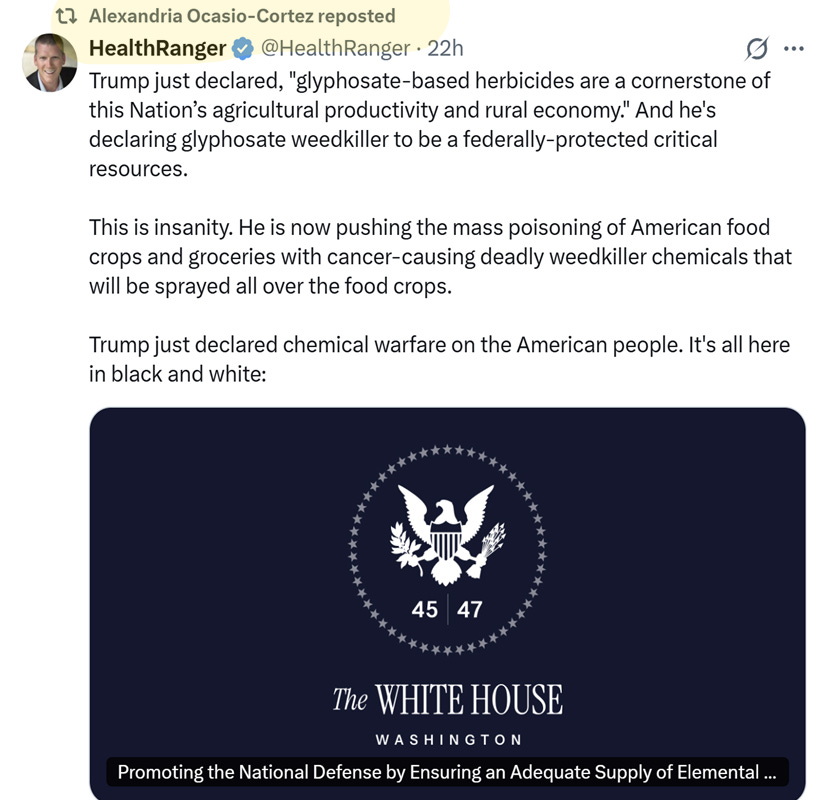
As America shifts into the next presidential election cycle, this executive order will be a rallying cry for the Democrats. Alexander Ocasio-Cortez, no longer hiding her presidential ambitions, shared a post by the conspiracy lunatic, Mike Adams, the Health Ranger (remember chemtrails?). Was she ill-informed or was this a cynical ploy to tap into the outraged MAHA Mom movement? As much as RFK Jr tries to play the anti-industry card, the post-capitalist home is firmly rooted in the democratic socialist wing of the Democratic Party. Even Cory Booker is trying to bring the MAHA Moms home.
While the New York Times reported that the “MAHA Moms have turned on President Trump”, there will be a lot of storms in some very chipped tea cups. As discussed in a recent article, the MAHA Moms can’t leave the movement so they will eventually suck it up and plod forward.
What did the Executive Order Actually Say?
The order will protect both elemental phosphorus and glyphosate-based herbicides (and not other herbicides under relentless attack). Elemental phosphorus is used in the production of glyphosate as well as military applications, solar cells and lithium-ion battery chemistries. US production does not meet domestic demand, leaving American industries vulnerable.
On glyphosate, the executive order states:
As the most widely used crop protection tools in United States agriculture, glyphosate-based herbicides are a cornerstone of this Nation’s agricultural productivity and rural economy, allowing United States farmers and ranchers to maintain high yields and low production costs while ensuring that healthy, affordable food options remain within reach for all American families.
While MAHA lobbyists like Vani Hari claim the pesticide industry wrote this document, it is clear the farmers were the sole interest group pushing for this. A large number of farmers would go out of business without access to herbicides like glyphosate. This would have a profound effect on US food security. This is basic common sense.
There is a curious point in the executive order about immunity for producers (what put a bee in the MAHA bonnet). It claims to confer “all immunity provided for in section 707 of the Act (50 U.S.C. 4557)” which states that “no person shall be held liable for damages or penalties for any act or failure to act resulting directly or indirectly from compliance with a rule, regulation, or orders, even if those rules are later deemed invalid by a court.” I am trying to understand why Bayer, last week, filed a second settlement offer against the existing glyphosate lawsuits if this order grants the company immunity.
Why is Glyphosate Essential?
I got into the glyphosate debate early on as I knew what the introduction of herbicides had done for modern agriculture (and by extension, the economic boom in the 1960s).
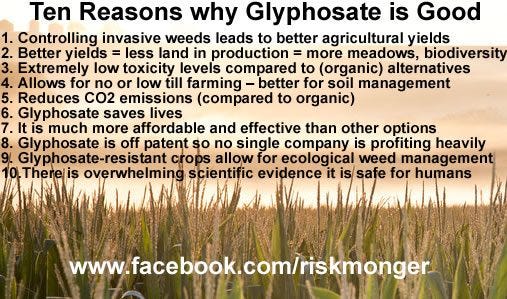
Here are some reasons why there could not be sustainable agriculture without herbicides like those containing glyphosate.
Sustainable Farming: The most important thing a farmer has is the soil. Lose the soil and you lose the farm. In the last 30 years, no-till or low-till farming has proven to be more sustainable as farmers don’t disturb the soil biota, release carbon or lose moisture, while allowing roots to aerate the soil. Tillage is done, particularly by organic farmers, to control weeds, leaving the valuable topsoil exposed to wind and water erosion. Herbicides, like those with glyphosate, have allowed farmers to control weeds without the unsustainable tillage (including lower CO2 emissions from fewer tractor runs). More advantageous for farmers, herbicide-resistant bred seeds like soy and maize let them delay killing the weeds until they start competing with the crops, reducing the need for multiple spraying (to even just once during the harvest cycle).
Feeding the Soil: Along with no-till farming, cover crops have become a valuable means to protect and nourish the soil during the off-season. Cover crops protect the soil from erosion, keep moisture in the ground, aerate the soil and add valuable nutrients reducing the need for fertilizers. In the last two decades, cover crop pioneers have been mixing different species to prepare the soil for the incoming cash crop, while reducing the prevalence of certain pests. The benefits from such sustainable innovations will be lost if farmers could not terminate their cover crops with herbicides like those containing glyphosate at the time of drilling their cash crops. Organic farmers cannot enjoy the benefits of multi-species cover cropping and need to repetitively plow their fields (losing much of the sustainable soil advantages from cover cropping).
Child Labor: As a child in the 1960s I was tasked with pulling weeds – an endless, thankless job battling to save the soil from the saturating strength of weeds. School had breaks in the summer months not so kids could go to camp or the beach, but because farmers needed them in the fields when weed infestation was at its highest. Farmers had to have big families because of the labor demand and weeding in an open, hot field was not considered exploitation then. When herbicides like those containing glyphosate were introduced, children were allowed to develop other skills far more valuable to society. Only then could regulators like the State of California pass a law banning hand-weeding as cruelty to farm laborers. Interestingly, the organic farming lobby got an exemption from this humanitarian law on the grounds that they don’t use herbicides.
Low Impact: Glyphosate has a very low toxicity level for humans with a LD50 level below that of salt, chocolate and baking soda. It breaks down quickly in the environment without damaging the soil or water tables. And while the anti-glyphosate interest groups have spent unimaginable sums funding studies by opportunistic activist scientists to try to prove health or environmental risks from the herbicide (if you torture the data long enough, it will confess to anything), no government regulatory risk body has concurred with the claims made in the activist scientists’ relentless stream of studies, resisting over a decade of nonsensical, politicized assault. No matter how many times MAHA Moms scream out their well-repeated slogans, glyphosate has an extremely low impact. The herbicide has also been off patent since 2001, with a multitude of producers, making glyphosate inexpensive and surprisingly still effective. Whereas industry could make more money selling patent-protected herbicides, farmers have been the key group demanding that President Trump give glyphosate the federally protected critical resource status.
Glyphosate works, it’s safe, it’s cheap and for that, it’s Public Enemy #1.
Who is Behind the Anti-Glyphosate Movement?
Glyphosate is the poster-boy of hate in the front line in the war against chemicals, conventional farming and capitalism. Never has such a benign product that has done so much good for the environment, society and economic prosperity been so vilified by such an ignorant population of activists. But this army of MAHA Moms, NGOs and 280-character influencers could not successfully sustain a campaign of intense popular outrage against the herbicide of the century, without any government regulatory support, evidence or alternatives, unless they had massive funding and coordination from special interest groups. Follow the money. Who were the groups behind these useful idiots, benefitting so greatly from their well-executed, but uneducated chemophobia?
The Organic Food Industry Lobby
Organic farmers don’t benefit from herbicides like glyphosate. This is an important factor in the yield gap between organic and conventional farming and as regenerative practices like no-till and cover cropping with herbicides begin to raise the sustainability gap, the “organic is better” argument is starting to ring hollow. The organic food industry lobby has funded many campaigns, activist scientists and NGOs (from US Right to Know to EWG to the Heartland Health Research Alliance) to try to ban glyphosate.
More challenging for the organic food industry is their rejection of the use of genetically modified or edited seed technologies. Given that GMOs have consistently been proven to be safe, the only way the organic food lobby could block these innovations is to make herbicide-resistant seeds unprofitable by banning the herbicides used to protect the crops. It should come as no surprise that the campaign to ban glyphosate was a last minute addition in 2014 to an IARC monograph on insecticides the year after the US organic food lobby campaign to label GMOs failed and the Seralini rat study was retracted.
The US Litigation Industry
When Christopher Portier was forced to reveal, under oath, that he was secretly being paid by the litigation industry to deliver the evidence several law firms could then use in courts to justify their claim that glyphosate is carcinogenic, I started to dig deeper into how this non-transparent, often ethically compromised tort law industry was financing activist scientists, NGOs, filmmakers and investigative reporters to produce evidence and public outrage they could convert into wealth, not for the plaintiffs but themselves. This research became SlimeGate, as I revealed an ecosystem of bottom-feeders, litigation finance loan sharks and extortionists trading plaintiffs in a victim misery exchange.
The litigation industry’s relentless onslaught on Monsanto and then Bayer, filing hundreds of thousands of lawsuits, mostly bogus cases, with the intent of extorting a settlement for the law firms (and not about justice for the plaintiffs) was too much for the company to withstand. With a first settlement of $11 billion and a second ongoing for $7.25 billion, there is no publication of how much actually went to the plaintiffs, but if past cases provide any measure, it will be minuscule. Most of the blood money goes to paying off the litigation finance lenders, the networks of advertisers and plaintiff processors, the lawyers and their private jets, with a few hundred million dollars put aside to buy scientists and activist campaigners. Money well-spent for future litigation harvests.
It is not about justice for the victims. It is not about ideology or changing the laws. It is about pure Predatort enrichment and doing whatever it takes to win. RFK Jr comes from this ilk and is continuing to play that game.
The Anti-Industry Post-Capitalist Movement
Green Marxism has become a thing (a sort of socialist paradise without the proletariat). Climate change framed the rebranding of Marxism with claims like “You can’t have capitalism and fight climate change at the same time”. The time was urgent to deindustrialize and transition (there is that word again) to a post-capitalist world order. Agriculture would have to abandon the conventional, industrial-based practices and return to traditional, peasant-farming techniques. For agroecologists and permaculturists, even organic farming was seen as too profit-oriented. Large cash crop farms would have to stop operations, livestock farming largely cut back with radical changes implemented down the food chain. Journalists like George Monbiot argue that the only way to save the world is to rewild a large part of our agricultural land.
As activists and Moms groups were convinced to campaign to ban essential agricultural tools like glyphosate, farmers will lose tools to make their operations profitable and environmentally sustainable. Fewer farms, more rewilding – mission accomplished. And more expensive food, but that never bothered these “champagne socialists”.