


The Nordic Swan is a leading ecolabel. It’s goal is to promote the most sustainable products.
It chose to exclude certifying PVC flooring because it felt it would threaten its reputation and be a challenge to communicate such a decision against NGO campaigns.
It tried to defend its decision with a series of contradictory claims.
The Nordic Swan admitted alternative flooring products have bigger issues, but only PVC was excluded from the certification process.
Its decision to exclude PVC flooring on the basis of bias and prejudice confirms that the Nordic Swan is not a research-based ecolabel.

A label is meant to guide consumers on the best products on the market. An ecolabel aims to highlight the most sustainable products. Often public institutions and green building certificates rely on ecolabel certifications in guiding their purchasing, procurement and material choices. We would expect then these labelling organizations to respect the best available evidence and manage their evaluations responsibly.
According to lifecycle assessments, plastics have historically been introduced as alternatives to less sustainable substances (like fur, leather, glass, paper, steel…). As well as the ecological benefits for production and eco-designs, in almost all cases, plastics emit less CO2 than alternatives. Ecolabel organizations should look favorably on plastics when evaluating products.
That is the case unless you are the Nordic Swan Ecolabel. In their case, they let bias and prejudice lead their labelling decisions in rejecting PVC outright in a recent assessment of sustainable flooring options. In a document shared to The Firebreak, the main reason they decided against giving a Nordic Swan certification to PVC was that it might damage the ecolabel organization’s reputation and be a challenge to communicate to the NGOs.
So much for respect for evidence and an objective evaluation of the data.
About Nordic Swan
The Nordic Swan Ecolabel operates across Denmark, Finland, Iceland, Norway, and Sweden to determine common standards and criteria for ecolabels in the Nordic region. Funding comes from a mix of government support and licensing fees paid by companies whose products are certified. They identify themselves as “one of the world’s toughest environmental certifications – and as such, a powerful tool for producers and brand owners”. Their ecolabel “promotes resource efficiency, reduced climate impact, a non-toxic circular economy and conservation of biodiversity – always with a strong focus on health”.
Article 6 of the Goals and Principles for the Nordic Ecolabel states:
“When drawing up and adopting Nordic ecolabelling criteria, the first priority is to take into consideration the environmental impact of products available on the Nordic market. When choosing new product groups for the Nordic Ecolabel, the focus should be on potential environmental benefits, and on consumers’ and purchasers’ need for guidance with regard to environmentally sound products. The value of ecolabelling a specific product group is assessed in relation to, among other things, current market research, technical developments and other relevant environmental information systems.”
This principle clearly states that decisions by the Nordic Swan should be research and science based.
About PVC Flooring
Polyvinyl chloride (PVC) flooring, also known as vinyl flooring, is available in various forms such as sheets, tiles, and planks, and is used in both residential and commercial spaces. Vinyl flooring is durable, water resistant and easy to install. It has a lower carbon footprint compared to wood, tiles, carpets or cement alternatives, mainly due to lower CO2 emissions during production and its long-lasting durability (often lasting more than 20 years). It is lightweight, easy to care for and available in a wide range of design options.
Compared to other flooring alternatives, PVC should be celebrated for its sustainability.
Unlike wood, it does not involve deforestation or require regular chemical treatment to preserve the flooring.
Unlike ceramic tiles or cement, PVC does not require a large amount of energy and CO2 emissions to manufacture, transport, install and recycle.
Unlike carpets, PVC is easy to care for and to clean, protecting residents from health issues caused by dust and air pollution.
By any measure of assessment, PVC flooring should be awarded an ecolabel for its sustainable benefits. According to Article 6 of the Goals and Principles for the Nordic Ecolabel, “the first priority is to take into consideration the environmental impact of products available on the Nordic market”, the evidence supporting PVC flooring should have a very favorable environmental impact.
Evidence or Reputation?
The Firebreak obtained an internal document entitled “Nordic Swan Ecolabel’s position on PVC in floor coverings” sent to the industry in 2023 explaining why the Nordic Swan rejected the request for an ecolabel for PVC flooring. After citing a series of environmental benefits of PVC flooring, the Nordic Swan document makes an astonishing about-face:

Despite the fact that the Nordic Swan identifies PVC flooring as better than some other flooring alternatives, that the industry has improved its manufacturing processes over the last decade, and has implemented a post-use takeback program (unlike many other flooring industries), the threat of reputation loss to the ecolabel if it had certified PVC flooring was too much for these activists to accept. PVC, they claim, has a bad reputation, but by refusing to certify PVC products, the Nordic Swan is simply amplifying that reputation.
This echoes a similar statement published by the Nordic Swan Ecolabel on PVC exterior panels and cladding:
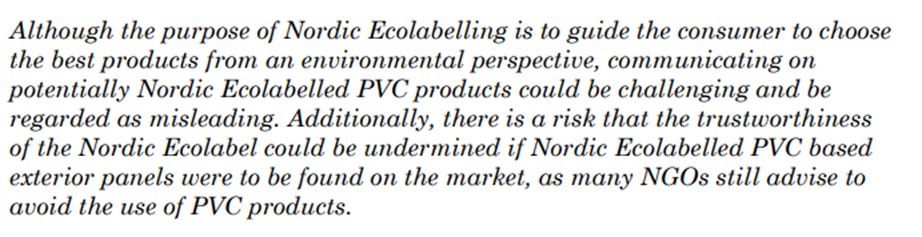
So out of fear of a potential activist NGO backlash, the Nordic Swan has decided to forego assessing facts and evidence. The admission here is that the Nordic Swan label is political rather than science based. How can anyone take this ecolabel seriously?
Squirming for Justification
The Nordic Swan document then tried to justify its purely political decision with a series of arguments against PVC that contradicted the ecolabel’s commitment to sustainable development.
Because PVC flooring is so long-lasting, Nordic Swan argues that there cannot be any realistic takeback policy (to promote the circular economy) as many of the takeback sources might no longer exist at the end of the flooring product’s life. Following this logic, if PVC were more like wood flooring, that usually lasts less than a decade, there would be no problem then?
Some PVC is still manufactured, they argue, with heavy metals like lead and cadmium or with certain harmful phthalates (although the Nordic Swan admits this production is no longer allowed in the EU). But isn’t the purpose of an ecolabel to guide consumers on the best brands that respect their environmental guidelines? Otherwise, that would be like the Nordic Swan not certifying wood flooring because one supplier is not using sustainably sourced raw materials.
The labelling body is concerned that there will be “negative reactions from the market (for instance producers who have developed alternative products)”. This is called competition. Any company can create a PVC-free flooring product if they think that marketing trick will make them money. How is this an issue for an ecolabelling body that should focus solely on a product’s sustainability?
Nordic Swan admitted that other flooring alternatives also faced “environmental and health challenges, that must be handled in the criteria, like high energy demand in production, unwanted ingoing substances and lack of possibility to separate and reuse the materials in end of life”. So why were these alternatives not equally excluded from the certification process?
The only legitimate reason for excluding PVC flooring from the certification process is the fear of any expected response from NGOs like Greenpeace and the Nordic Swan Ecolabel’s fear of loss of public trust and reputation. The decision is more of a question on the sustainability of the Nordic Swan brand than on the sustainability of PVC flooring. But let’s play this game.
The Nordic Swan recognized that the PVC industry has made considerable progress in reducing harmful chemicals, improving post-use product takeback and recycling levels. But they would find justifying the certification of PVC as “challenging”. So rather than standing up and defending the best research and scientific evidence, Nordic Swan chose to hide from upsetting the NGOs.
Cowards.
The report admitted recent polling that showed a more positive public perception toward PVC. Shouldn’t the Nordic Swan reflect that in their communications rather than continue pushing the unjustified activist narrative? As the criteria for certification must focus on the environmental properties of the products (which is positive for PVC flooring especially compared to alternatives), and the public is no longer so easily swayed by activist NGO campaigns against plastics, then the Nordic Swan should stand on principle. Instead, they have chosen the path of hypocrisy and political rhetoric.
What is the value of an ecolabel?
Ecolabels are intended to guide consumers and procurement officers on the most environmentally-friendly products. For a label to mean anything, it must be evidence-based and able to justify its decisions. The Nordic Swan has failed to live up to its own standards and principles with its prejudiced bias against PVC flooring. In its fear of risking its reputation and facing activist outrage, it has delegitimized its credibility as an ecolabel certification body.
As Nordic Swan define themselves as the best of the best, the entire ecolabelling process should now come under scrutiny.
If they are more political than science based, why are taxpayers still funding them?
If AI can provide better answers to procurement questions without the activist bias, should the labels still be trusted or consulted?
With the proliferation of so many labels today, does an ecolabel still command any value on a product?
Should companies still go through the cumbersome certification process and the added costs if the ecolabels are seen as biased and hypocritical?
25 years ago, I renovated my home and chose vinyl flooring in many of the rooms. The floors have held up well and should last for at least another 25 years. My floors will stay in service far longer than the Nordic Swan Ecolabel.