


Science communications is not an easy task. You have to be comprehensive and concise, simplifying the message while not dumbing it down. You are constantly facing emotional arguments where fear always has the upper hand over facts. You have to present data and evidence when most people are numerically illiterate. You have to quietly leave conversations when your evidence and facts are refuted by claims of “Shill!” … I’m glad I don’t have your job.
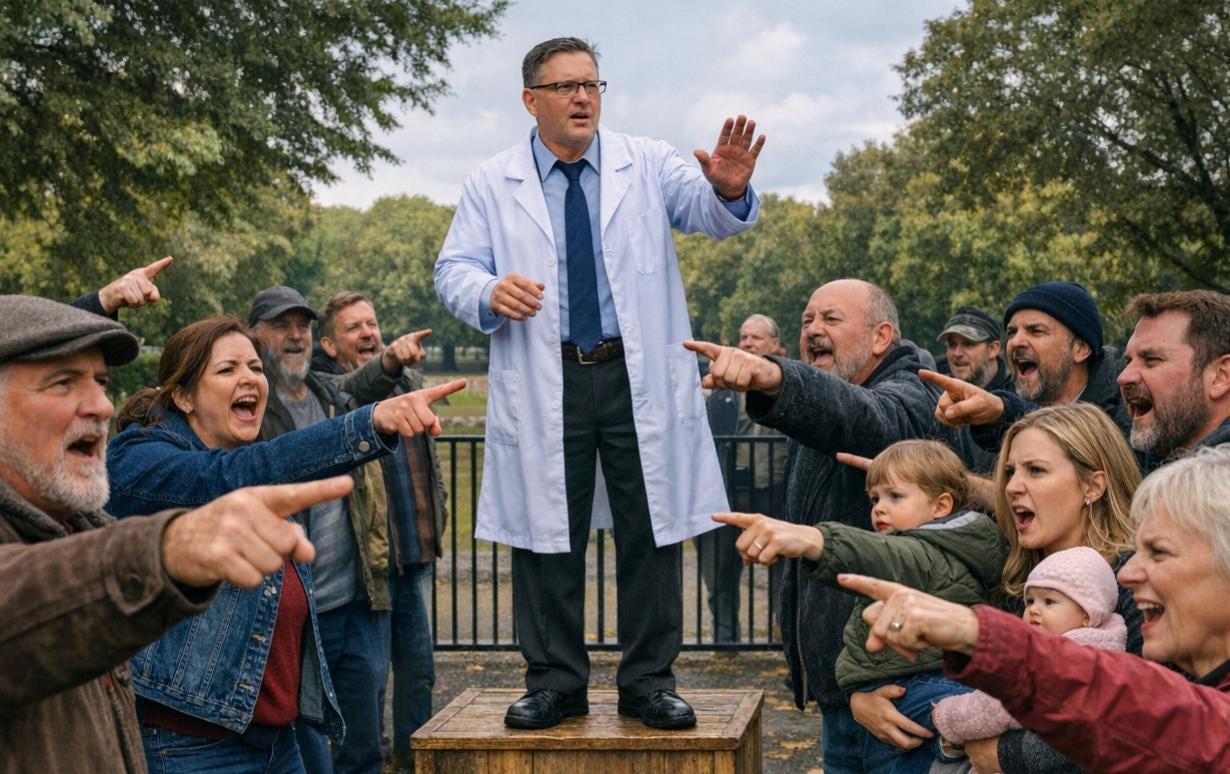
Scientists tend to get bogged down in the technical details when they try to explain something to a non-specialist. If I want to know if it is safe to eat an apple, I don’t want to know about maximum residue levels, LD50s or long-term, low-dose effects. I am searching for a simple message I can trust and relate to.
Where the scientists fail, the activist fear campaigners excel by simply saying: “There are chemicals on your apple that are banned in the EU. They will give you cancer and cause you to suffer a slow, painful death!!!” And if we try to explain the high levels of safety, their clear, simple message is: “Well, that is industry data. We just don’t know for sure what is an acceptable dose level so it is better to be safe than sorry!”
How do we deal with this message deficiency?
Too often the scientists get caught in the refutation trap: “No, this does not cause cancer!” or “There is no proof that this chemical causes autism.” These are not positive messages that the public is looking for. And the more you deny, the guiltier you look, falling into an unwinnable trap by merely associating the product with the risk. Trust is an emotional judgement and a positive message goes far in building confidence.
We tend to forget that the public does not want a comprehensive explanation or a science lesson. They are not looking for the facts. They are looking for a simple explanation, an image or story they can easily hold onto. Trust is built on information people can understand and relate to. They just want to know, with a reasonable confidence, that something will not harm them, so they can go on with their day (without fear and uncertainty). If that reassurance cannot be given to them in a way they can hold onto, then they are left with doubt, and are vulnerable to believe one of the many claims thrown at them by relentless fear-mongers.
The message game is played on uneven terms. The scientist has to be right, with certainty. The activist only has to get you to doubt something is certain. The science communicator has to respect the science and get the audience to reject the seeds of doubt.
I used to refer to activists as watchdogs. My dog could bark at the moon 99 times out of a hundred, but that one time it stops a threat, it justifies its worth. If a scientist or a company is wrong one time in a million, it is unacceptable. Trust is built on the intention of care and concern. My watchdog cares for me, that company researcher wants to profit from me.
I have been active in science and risk communications since the 1990s, well before the 2000 House of Lords Third Report on Science and Society. Back then, the number of experts in this field, across Europe, could be counted in single digits. While the fields of science and risk communications have changed over the last three decades, as well as the communications technologies, the messages and the framing remain largely the same.
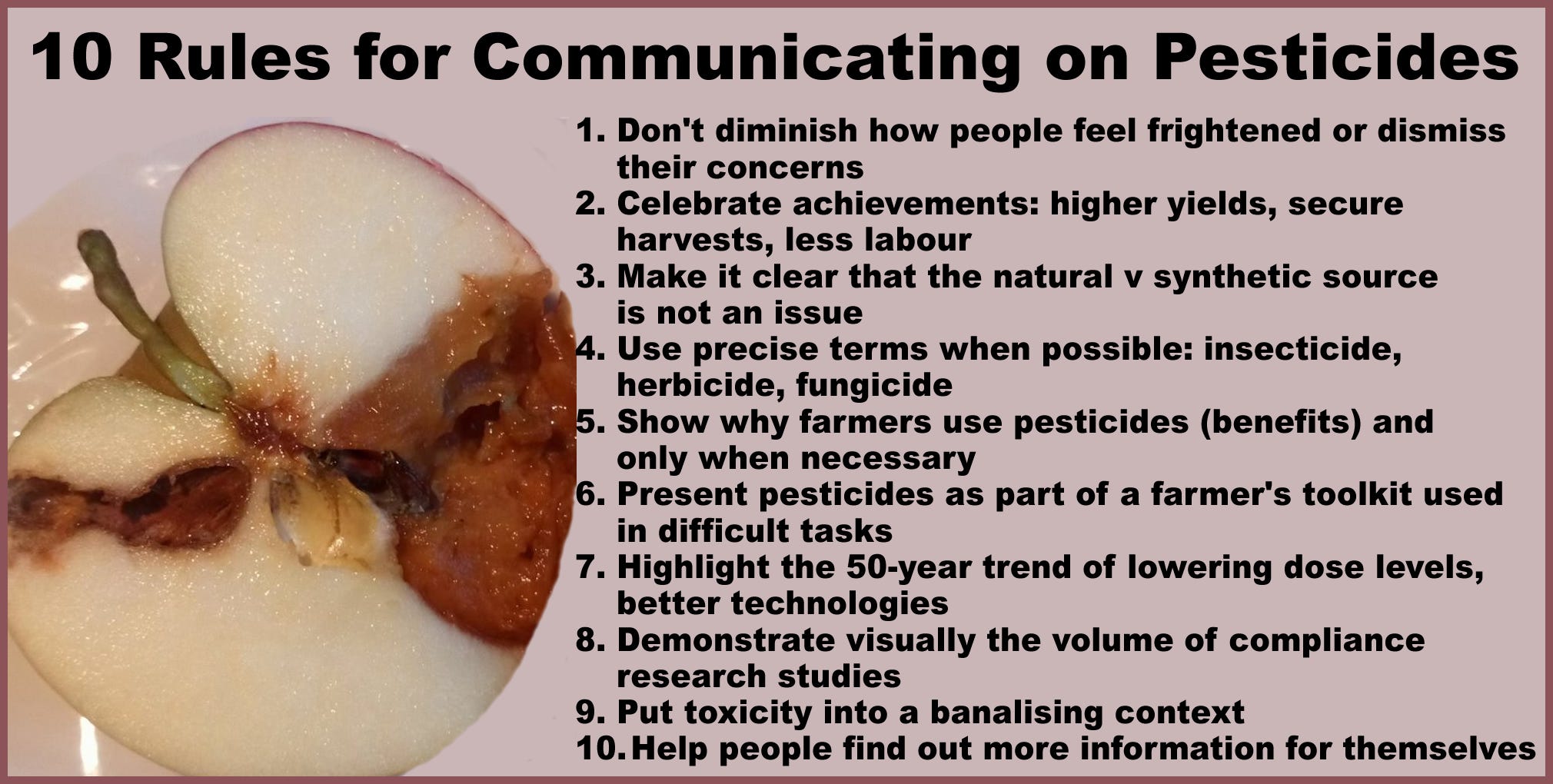
Allow me to share the top twelve messages I have used to try to reassure the public on environmental health risks.
Child’s Play
All of the messages need to be simple, clear, relatable and immediately reassuring. They have to be easy enough for a child to understand yet complete enough to assure trust and confidence. Aim for common sense reasoning that can stick in people’s minds. Most importantly, the messages have to be short and direct – people lose interest after 15 words. They also need to get at the misconception leading to the fear and doubt.
To this day, my greatest achievement has to have been a children’s book for scientists on risk communication I had written in 2005. Truth be told, it took me 45 minutes to write the “Do’s and Don’ts” down in a scrap piece of paper in a bar in Thessaloniki. Perhaps that is why it remains so special to me.
Please feel free to use these twelve messages in conversations with your friends and family who might be trying to spread fear and uncertainty with you. Don’t get angry with them – your goal is not confrontation but reassurance.
Some of them have been borrowed from others far smarter than me.
Twelve Messages for Science Communicators
Chemicals are not man-made. In fact, man is made of chemicals.
Just because it’s natural doesn’t mean it is good. Ebola is natural.
There are more carcinogens in a single cup of coffee than in the pesticide residues of an entire year’s consumption of fruit and vegetables. (Bruce Ames)
There are over 1000 chemicals in a cup of coffee. We have only tested 28, and 19 of which are carcinogenic to rats. (Bruce Ames)
There are around 10,000 chemicals in a single meal, causing the body to deal with the cocktail effect on a daily basis. That’s what the body does.
Contextualize numbers: A part per billion is like a drop of water in an Olympic swimming pool. Or: A part per billion is like 1 second over 31 years. Or: This is equivalent to the size of Belgium.
The dose makes the poison. (Paracelsus). One aspirin can do a lot of good; 100 … not so good. Or: To reach a minimum level of daily risk exposure, you would need to eat 20 boxes of cereal per day.
Correlation is not causality. The presence of a chemical does not mean that it caused a disease any more than the rooster’s crowing caused the sun to rise.
Risk management is part of daily life. When we cross the road, we are managing a large number of risks. Why? Because we want the benefits. Risks have uncertainties but they are also tied to benefits and opportunities.
This chemical is produced naturally in the body. Or: This chemical also exists in nature. Or: This chemical has been synthetically produced to remove impurities.
Science doesn’t care about how you feel or what you believe. It seeks to discover the truth. Or: Science isn’t democratic. It respects the facts and evidence.
If the science is proved wrong, it will adapt and test the next best hypothesis. Does your dogma or belief system do that?
I could go on, but I like round, established numbers (not very scientific, I know).
When you communicate with non-scientists, be patient and empathetic. They may be misinformed or ignorant, but most of all they feel vulnerable. These issues concern them and they are afraid. Open up, share your own feelings and listen to them.