

What follows is a translation of an article written by Thomas Frohnert and published in German on November 14. It not only shows how the European Commission’s war on tobacco harm reduction products has collapsed in the last two weeks, but also shows how the European Commission health officials will likely just ignore the reports by their own Regulatory Scrutiny Board and the Court of Auditors (and the EU Treaty). But Thomas then lays out the legal strategies to then overturn the European regulations. Hopefully pragmatic people within the European Commission will read Thomas’ brilliant analysis and restore some reason to the policy process.
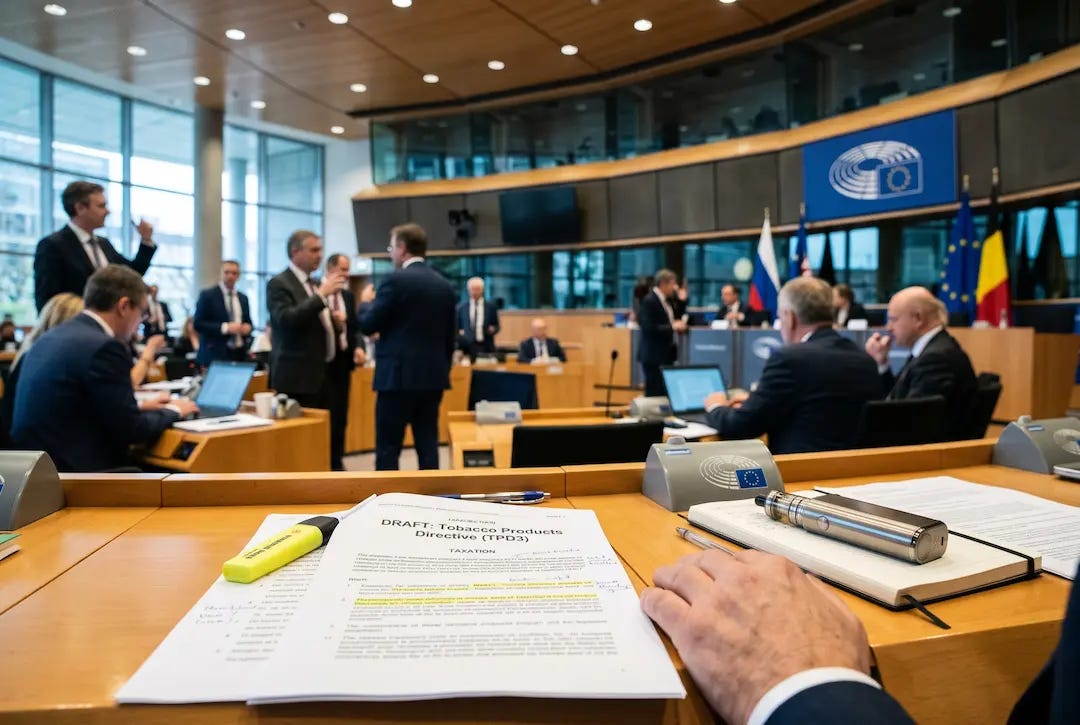
Within just a few days this month, the European Commission suffered two resounding defeats that shook its entire planned anti-vaping policy house of cards.
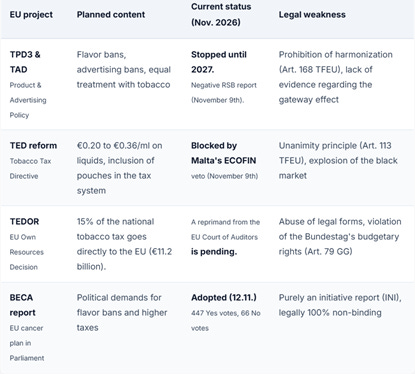
On November 9, Health Commissioner Olivér Várhelyi received a devastating verdict from the Regulatory Scrutiny Board (RSB), the Commission’s own independent oversight body. The auditors utterly demolished the draft of the new Tobacco Products Directive (TPD3) and the Tobacco Advertising Directive (TAD).
On the same day, the major tobacco tax reform (TED) failed at the meeting of EU finance ministers (ECOFIN) because Malta vetoed the EU tax madness at the last minute .
To save face, the European Parliament hastily approved the ambitious “European Plan Against Cancer” (BECA report) on November 12th, including demands for bans on flavorings and strict restrictions on e-cigarettes and nicotine pouches. But let’s not be fooled: this parliamentary report is a so-called own-initiative report (INI). Legally speaking, it’s just printed paper without any legal force. A pure smokescreen.
Something much bigger is happening behind the scenes. Anyone who opens the legal files quickly realizes: the Brussels cartel of prohibition ministers and bought-off NGOs is no longer concerned with your health. It’s about power, about billions for the indebted EU budget, and about a blatant, premeditated breach of the constitution.

What Does the EU Commission Intend to Do?
The plans from Brussels are divided into two major pincer movements, intended to affect vapers, users of heated tobacco products and consumers of nicotine pouches simultaneously:
The Product Stick (TPD3 & TAD): The Commission wants to legally equate harm reduction alternatives almost identically with deadly tobacco cigarettes. On the wish list are far-reaching flavor bans for e-liquids, a complete advertising ban, standardized packaging, and massive restrictions on tobacco-free nicotine pouches. Due to the negative opinion of the RSB (Regulatory Scrutiny Board), this legislative proposal is now delayed until at least 2027.
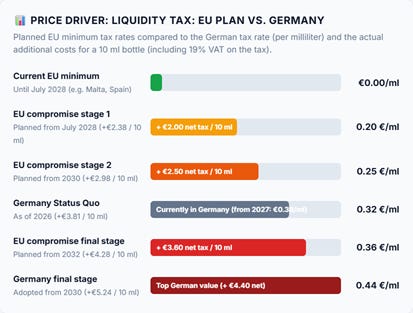
The Tax Stick (TED): Brussels intends to use the Tobacco Tax Directive to enforce Europe-wide minimum taxes on e-liquids (with and without nicotine!) as well as on nicotine pouches. The latest compromise on the table for finance ministers proposed starting at €0.20 per ml (or 20% of the retail price) from July 2028, increasing to €0.25 per ml in 2030, and then climbing to €0.36 per ml (or 30% of the retail price) from 2032.
For us in Germany, this sounds familiar. Here, the tax authorities are already digging outrageously deep into vapers’ pockets at €0.32 per ml in 2026, and just in October 2026, the Bundestag and Bundesrat decided on the next round of increases: from January 2027, the German e-liquid tax will rise to €0.38/ml and gradually climb to an absurd €0.44/ml by 2030. But for many other EU countries without an e-liquid tax or with moderate rates (such as Spain, Malta, or large parts of Eastern Europe), the Brussels plan means an immediate price explosion and the end for thousands of shops.
A Blow from Within: Why the TPD Revision was Derailed
The fact that the Commission’s Regulatory Scrutiny Board (RSB) gave the draft legislation a failing grade amounts to political bankruptcy. The RSB examines whether draft legislation is technically sound, scientifically substantiated, and legally viable. Not only did the draft for the new TPD3 fail, but the assessment of the currently applicable TPD2 also received a failing grade.
The Regulatory Scrutiny Board hammered home to the Commission the exact points that scientists and vaping associations have been preaching for years:
The myth of the “gateway effect”: The Commission justifies its ban fantasies by claiming that e-cigarettes would entice young people to later smoke cigarettes. The RSB dryly states: The evidence presented for this is not reliable. It is ideology, not science.
No clue about the economic consequences: Brussels wants to shrink an entire sector of the economy, but hasn’t even properly calculated what that means for thousands of medium-sized businesses, jobs, and the resulting flourishing black market.
Disproportionality: Measures must be proportionate to the goal. Those who discourage adults from vaping, which is significantly less harmful, will drive them back to cigarettes.
The most explosive point in the RSB report: The auditors openly doubt whether the EU even has the legal authority to issue blanket product bans under the guise of health protection.
Why the EU is Actually not Allowed to Do This
What was the European Union originally created for? As a peace project, a customs union, and for a free internal market where goods can be traded easily from A to B. It was not created to be a superstate dictating to its citizens which e-liquid flavor they are allowed to put in their vaporizers.
The EU operates under a fundamental principle: the principle of limited conferral of powers (Article 5 of the EU Treaty). In plain terms, this means that Brussels may only enact laws where the member states have explicitly granted the EU permission in the treaty.
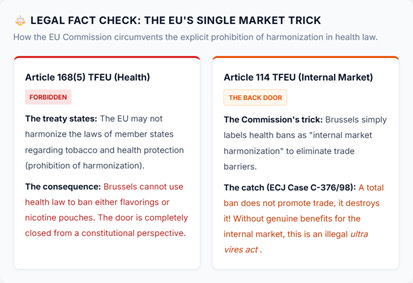
In the Treaty on the Functioning of the European Union (TFEU), specifically at the section concerning health: Article 168, Paragraph 5 states clearly that the EU may promote measures to protect against tobacco use, but expressly “excluding any harmonization of the laws of the Member States”.
Translated from legalese, this means: The EU has absolutely no legislative competence for Europe-wide bans in the area of health policy. It cannot ban flavorings. It cannot withdraw nicotine pouches from circulation. Health policy is a matter for nation states. Period.
Q - How does Brussels Get Around This?
A - Through the Back Door of the Single Market!
Because the door to health law is firmly closed, the EU Commission has been using a constitutional trick for decades. It simply doesn’t label its tobacco and vaping laws with “health,” but rather with “internal market” (Article 114 TFEU).
The excuse goes like this:
“If country A allows strawberry e-liquid and country B bans it, free trade in Europe will be disrupted. So we have to equalize the rules for everyone. And since we’re at it, let’s just ban strawberry e-liquid completely for everyone!”
This very trick is now backfiring on the Commission. Back in 2000, the European Court of Justice (ECJ) delivered its landmark first ruling on tobacco advertising (Case C-376/98), declaring the existing directive completely invalid. The judges made it clear: Article 114 is not a free pass! A total ban on products does not promote free trade within the single market; it destroys the market. Anyone who uses the single market as a guise for purely health-related policies is violating EU treaties and committing an ultra vires act (acting beyond their authority).
The Real Goal Behind the Minimum Taxes: Brussels Urgently Needs Money.
The game becomes even more brazen when we look at the planned minimum taxes (TED). Here, too, the principle applies: the EU has no right to invent taxes. It is not a state, it has no tax office of its own, and it is not allowed to directly extract a single cent from its citizens. Taxes are the cornerstone of national democracy.
But here, too, Brussels is exploiting a loophole. Article 113 TFEU allows the EU to “harmonize” excise duties if necessary to prevent distortions of competition in the internal market. Until now, however, these taxes have always flowed 100 percent into the coffers of the respective member state finance ministries.
Now the Commission’s true motive is coming to light: Since the gigantic Corona debt package ( NextGenerationEU ), Brussels has been sitting on a huge mountain of debt that must be repaid starting in 2028. At the same time, the Commission needs billions for new funding programs. Where will they get them?
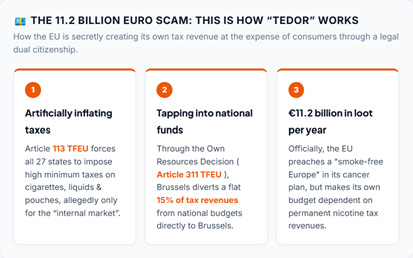
Even the European Court of Auditors had had enough of this hypocrisy. In its official statement 04/2026, the EU’s top auditors sharply criticized this plan: A tax intended to reduce consumption is not a suitable, stable source of revenue for the EU budget, unless the intention is to prevent people from actually cutting back. Furthermore, the whole thing is not a “new source of revenue,” but rather a covert raid on the coffers of member states, coupled with an absurd bureaucratic nightmare.
Legally, this linking of internal market tax law (Art. 113) to the pure purpose of raising money for Brussels (Art. 311) is called abuse of form.
What Happens if the EU Gets Away With it?
Our Legal Toolbox!
Currently, Malta’s Finance Minister Clyde Caruana is blocking the tax plans with his veto, and TPD3 is stuck in the RSB’s limbo. But Brussels won’t give up. At the next meeting of finance ministers on December 11, 2026, Malta is to be persuaded to compromise, and a new attempt at TPD3 is planned for 2027.
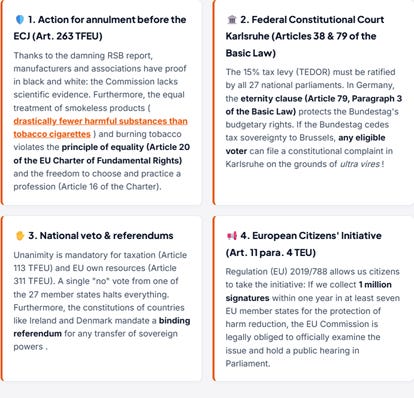
But what if national governments cave in and rubber-stamp the deal? Are we then powerless? Not at all. When politics bends the law, the courts and constitutions come into play. It is precisely for such disputes, that there are studies, legal opinions, and clarifications provided by the non-profit IUS Initiative for Independent Harm Minimization .
Here are the four sharpest tools that can be used to overturn these EU plans:
Brussels Has its Back to the Wall
November 2026 has shown that the EU’s prohibition machine is not invincible. The Commission has overstepped its bounds. Anyone who tries to secretly siphon off billions for their own budget under the banner of the “cancer plan,” sweeps scientific facts about harm reduction under the rug, and tramples on the clear limits of competence stipulated in the EU treaties, ultimately produces one thing above all: legal garbage.
The Commission’s internal control body, the Regulatory Scrutiny Board, the European Court of Auditors, courageous outlier states like Malta and increasingly also members of the conservative European People’s Party (such as Tomáš Zdechovský, who is finally calling for an “evidence-based policy according to risk profiles”) have smelled a rat.
For us in the vaping community, this means: remain vigilant, put pressure on national representatives, and don’t back down an inch. The law is on our side. We just need to ensure that Brussels also has to abide by it again.
—-
Thomas Frohnert – Steamshots
Thomas Frohnert has been providing independent information about e-cigarettes and tobacco harm reduction since 2014. He analyzes primary scientific studies, was a co-founder of the BVRA (German Association for Tobacco Harm Reduction), and is the founder and managing director of the non-profit “IUS Initiative for Independent Harm Reduction”.
More about the author · IUS Initiative · Steamshots TV on YouTube