


An ongoing lawsuit in Missouri was brought to my attention as a case that ticks many of The Firebreak’s boxes:
An activist news organization omitting facts to go after a company
A large number of left-wing professionalized foundations funding the news organization’s attack agenda
A rogue scientist who seemed to have lawyered up to try to extract a large settlement
A journalist with sharp scissors cutting corners to produce a story to fit her ideology
Just another day implementing the activist playbook? But this story contains one element rarely seen in this post-capitalist political agenda: a company standing up and fighting back, suing the news organization and its freelance journalist for deception and a series of unsubstantiated claims they have refused to retract. This is the story of the lawsuit filed by Averhealth against ProPublica for defamation.
The Parties Involved
Averhealth is the largest forensic drug-testing provider in the US, conducting roughly 2.5 million tests annually for courts, probation departments and child welfare agencies. Their test results have profound effects on people’s lives so accuracy is important.
ProPublica is a media group whose mission is to “expose abuses of power and betrayals of the public trust by government, business, and other institutions, using the moral force of investigative journalism to spur reform through the sustained spotlighting of wrongdoing.” But ProPublica doesn’t seem to expose the abuses of power of NGOs and foundations because, well, the non-profit is largely funded by many of the largest left-wing foundations (2025 income of $79 million with almost 90% of the grants being restricted to reporting on the earmarked special interests).
ProPublica had spent many years trying to “expose abuses” at Averhealth, but while they felt they had the “moral force” to claim malpractice at the testing company, their fact-checkers lacked any force. In January, 2026, Alice Hines, a freelance journalist contracted by ProPublica, published an article riddled with half-truths and omissions.
In her article, Hines tried to portray Averhealth as being:
more concerned with speed than quality and accuracy in their testing;
not forthcoming with their client (Michigan’s Department of Health and Human Services) about being audited or on probation;
a target of lawsuits and probation (at risk of losing its accreditation).
But it seems that ProPublica itself has been more concerned with speed than quality and accuracy in its journalism. So many facts were omitted or twisted to fit the narrative the journalist wished to weave, with cherrypicked claims and qualifications to Averhealth’s responses.
The claims Hines was making were strong enough to lead to significant client loss, threatening the existence of the company. Averhealth contacted ProPublica to contest the article’s claims, requesting that the media organization correct or retract the article. The messages were met with insolence leaving them no other choice but to sue ProPublica. On 26 August, Averhealth petitioned for defamation against ProPublica and freelance reporter Alice Hines in the Circuit Court of St. Louis County.

The Article Behind the Defamation
The ProPublica article was published on 20 January 2026 under the headline “A Child Welfare Agency Doubted the Accuracy of Drug Tests Used in Court. The Testing Company Dodged Questions”. The heart of the case begins with two Michigan vignettes: a foster care supervisor saying an Averhealth methamphetamine result conflicted with tests performed elsewhere; and a state child welfare supervisor writing that her office distrusted the company when deciding whether to remove children from homes.
The article then builds through several load-bearing claims:
that Averhealth’s accreditor placed the lab on probation;
that several former employees, speaking anonymously, described understaffing and pressure from management to work faster;
that it faced serious accusations from a whistleblower;
that the Justice Department investigated them and pursued a case;
that parents sued over false positives in litigation Averhealth had settled.
Across seventy-eight pages and twenty-four exhibits, Averhealth’s defamation filing lays out a documentary record that reads less like a complaint and more like an indictment of a ProPublica newsroom that had every fact it needed and published the opposite.
A caveat: ProPublica’s internal deliberations have not been made public (yet). Averhealth is a commercial company with a stake in protecting its reputation, and this filing presents its case, not a verdict. The sources, quotes and images for this article come from the court filing and include letters, deposition transcripts, court orders and government filings. The court filing can be tracked via the 21st Judicial Circuit (case number: 26SL-CC05899).
The Seven-Week Whistleblower
The entire ProPublica story rests on one person: Dr Sarah Riley, hired as a laboratory director in September 2020 and gone by 3 November, less than two months later, while working part-time. Four days before she quit, she emailed colleagues that she was “looking forward to working with everyone.” During her employment, she made no formal allegation that the results were inaccurate.
Then her attorneys sent a demand letter. It claimed wrongful termination (reminder: Riley quit her job after seven weeks), a claim she later conceded under oath was never filed and never paid. The demand asserted that Averhealth was producing “a 30 percent positive rate even where individuals had consumed zero drugs.” She demanded $1.25 million. Averhealth refused, and Riley sued the company.
If Riley’s claims were accurate, there would then be hundreds of thousands of erroneous results. This would lead to custody rulings, probation revocations and criminal sentences unraveling across multiple states. The company would have been finished. This is an extinction-level charge and Riley almost certainly knew that.
Questioned under oath in December 2024, Riley was asked about her claims. According to her deposition, she said she had “no idea” what the false-positive rate was for hair tests. “No idea” for urine tests. Her 30% estimate, it emerged, came from a single email involving only Michigan samples and only oral fluid — a tiny slice of the business — plus the reasoning that a laboratory using three calibrators has “a one in three chance on any given day.” She conceded the true figure “could be 0.” She could not name a single sample that had ever yielded a false positive. Confronted with her own lawyer’s “zero drugs” assertion, she answered: “I actually don’t know… I don’t know where this… I don’t know.”
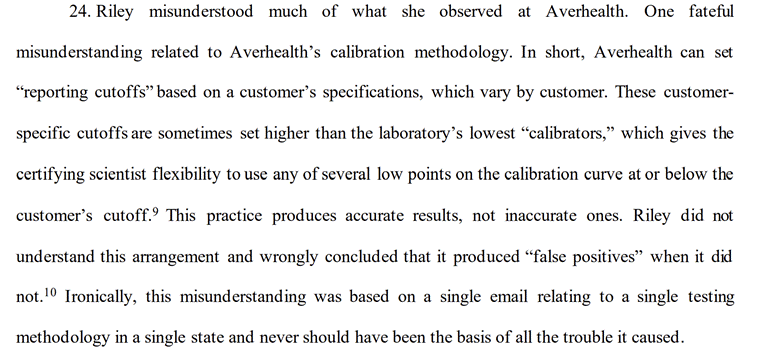
Any competent science desk in any serious news organization should also have caught the irony. The calibration practice Riley misunderstood — using a low point on the curve at or below a customer’s reporting cutoff — would, if it skewed anything, produce false negatives,in other words, missed forensic evidence of drug use and the reverse of the alleged harm. Averhealth explained this in writing to ProPublica in January 2025. Months later, Hines quoted that same letter back to the company.
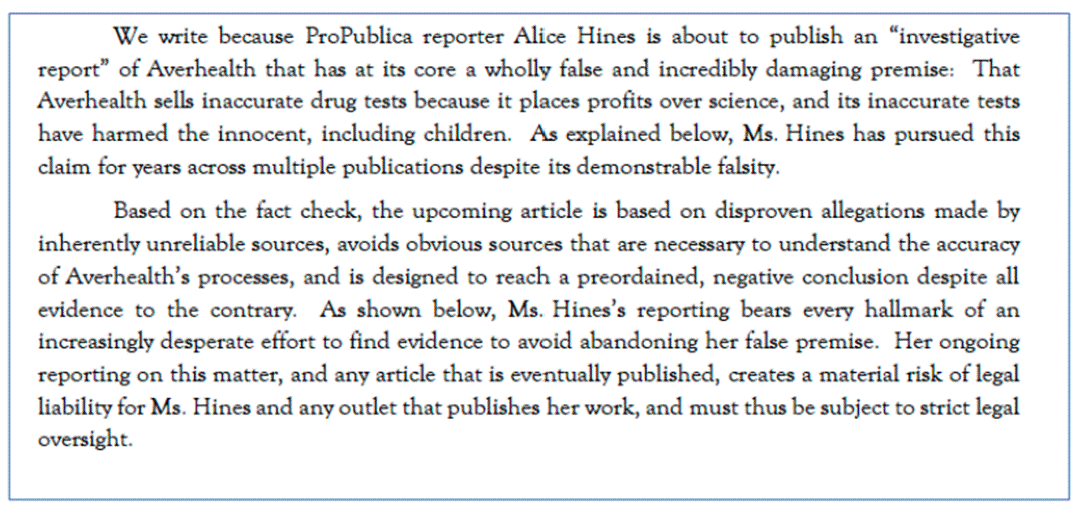
Averhealth warned ProPublica a year before publication to make sure to provide legal oversight on Hines’ claims. It appears they came up short.
A Litany of Omissions
The petition includes appended records demonstrating how ProPublica possessed evidence before publication they chose to withhold from readers.
• The Justice Department cleared the science. The DOJ issued Civil Investigative Demands, received millions of documents, and had every opportunity to uncover fraud. On 4 June 2024 it declined to intervene on every allegation of inaccuracy, choosing to pursue only one of Riley’s eighteen claims: whether Averhealth had billed Michigan for oral fluid results that were not confirmed by a separate mass-spectrometric method, as the contract required. In other words, a contract-performance question. The US Attorney’s own words were “nonconforming services.” Seventeen states, including Michigan, declined to join at all. The ProPublica article claimed the DOJ “investigated Riley’s claims and pursued a case.” Did Hines realize that the investigation of one out of 18 claims, and not a scientific issue, did not justify her conclusions?
• Michigan hired auditors, who cleared the lab. The state’s health department retained Wagner Toxicology Associates. The firm reviewed the data, spent two days on site, found Riley’s allegations unsubstantiated, and concluded the results could be “scientifically supported and forensically defended in court.” A Michigan family court judge also heard Riley testify in person and rejected her account as “speculative,” noting she “did not provide the Court with any specific examples.” ProPublica and Hines decided that none of this information was valuable for the narrative they wanted to spin.
The accreditor found no safety risk. The College of American Pathologists (CAP) put the lab on six months’ probation after Riley complained, then ended it following a non-routine inspection. ProPublica emphasized that probation but failed to mention that for CAP, this probation is the lowest level of disciplinary action, reserved for circumstances “that do not appear to pose a substantial risk of harm to patients or to laboratory personnel”. Readers were not told that CAP’s own published manual reserves the terms “Probation with Immediate Jeopardy” and “Probation with Suspension” for laboratories posing a substantial risk to patients — categories CAP did not apply to Averhealth. Thirteen months before publication, Averhealth spelled this out to ProPublica’s general counsel in bold and italics but the news organization ignored this.
• The parents’ lawsuit had collapsed. Foulger v. Avertest is quoted extensively in the article as evidence of families harmed by false positives. By publication, a federal court had granted Averhealth complete summary judgment on two plaintiffs’ claims, dismissed a third plaintiff’s claims outright as a sanction for what the court called “willful and bad faith conduct” after the plaintiff “lied repeatedly over a period of two years,” sharply narrowed a fourth’s, and limited a fifth to a three-month damages window. One plaintiff swore she had been sober since 2020, then admitted using methamphetamine, opiates and fentanyl as recently as 2024. Another claimed CPS took her son while she had voluntarily placed him under her own mother’s guardianship. Another plaintiff, deposed, took the Fifth. ProPublica’s readers learned only that Averhealth “settled the lawsuit in September” aware of all the implications such a claim carried, despite the facts.
• The star source’s personnel file. Jennifer Picker was ProPublica’s on-the-record chemist who said the lab valued speed over accuracy. But her claims needed to be considered in light of critical HR records supplied by Averhealth: documented attendance problems, an acknowledged “lapse in judgment” over a written warning and medication that made her drowsy on shift. Her continued employment was conditional on her “increased competence” with the same instruments at issue. The ProPublica article notes Picker’s denial that she had “disciplinary issues or struggled to meet her workload” and reduced Averhealth’s documented HR response to unattributed say-so.
• The corroborating witness was the roommate. After Picker’s file surfaced, Hines produced another former employee, Stephen Penn, who had worked there five months, made no complaint while employed and when he left, had told the company he had found work closer to home. It would seem odd then that grievances would have surfaced three years afterward. Penn and Picker had been roommates while they both worked at Averhealth.
• The false-positive victims who weren’t. ProPublica presented Averhealth with two named individuals who had signed HIPAA waivers. One tested positive for two drugs on three occasions and had signed a drug-court agreement accepting Averhealth results as prima facie valid. The other had one positive for alcohol metabolite, no evidence of error, and a family court record documenting parenting concerns unrelated to any test. Both individuals ProPublica had presented were tested after the CAP probation ended. Neither positive result made the article. Instead, ProPublica readers got the number “50”: 50 parents who say they were wronged, although they were unnamed and unexamined.
“We Decline”
On 13 February 2026, Averhealth’s counsel sent a detailed retraction demand and offered a statement for publication. ProPublica’s general counsel answered that Averhealth “[had] not identified anything inaccurate in the story,” and was instead asking ProPublica to “rewrite the Article according to [Averhealth’s] preferences.” To that, ProPublica’s counsel responded: “We decline.”
Then ProPublica did something extraordinary. Defending the article, its counsel pointed out that Foulger “proceeded past summary judgment on several claims and settled in September, which the Article also accurately reported.” The summary judgment history, including the sanctions, the perjury findings and the claims thrown out, is used as a shield in private correspondence but never appears in print. They knew it. They possessed it. They used it to defend themselves but kept it from readers.
Sometime after publication, the headline changed. “A Child Welfare Agency Doubted the Accuracy of Drug Tests Used in Court. The Testing Company Dodged Questions” (web archive) became “A Drug Testing Company Favored Speed Over Reliability, Some Ex-Employees Say. The Firm Says Its Work Is ‘Accurate.’” (present web version). Note the scare quotes. No correction notice was added and no explanation given. Newsrooms that stand behind their reporting do not quietly retitle articles. In any case, the story had already been syndicated and widely read.
The Standards They Wrote Themselves
What happens when a news outlet with institutional prestige and unlimited foundation funding prescribes beforehand their political narrative and then refuses to budge when evidence cuts against it?
ProPublica is not Vice, where Alice Hines first published this story in 2022 and again in 2023. Hines has been working on this single story for the last four years which would suggest she has invested too much to turn back. The news organization has more than 150 journalists, works with over 200 outlets and has a budget (2024) for personnel of over $30 million. You would think ProPublica would have sufficient funds to hire a few fact-checkers.
ProPublica’s Code of Ethics demands that its “facts are accurate and fairly presented,” that its analyses reflect “our best independent judgments rather than our preferences or those of our sources,” and that there are “no hidden agendas in any of our journalistic undertakings.”
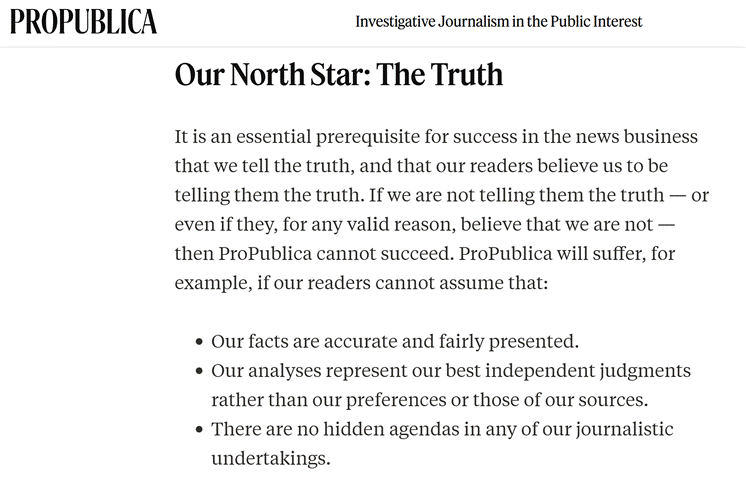
Perhaps the journalist behind this story, Alice Hines, as a contracted freelancer, did not have to sign this code of conduct.
Averhealth’s lawyers cited those commitments back to ProPublica in January 2025 and warned explicitly that this story needed “senior editors, experienced fact-checkers, and legal counsel — who are not invested in this story like Ms. Hines is.”
Final Thoughts
I would put four questions to ProPublica’s editors:
Why was Averhealth’s documented evidence about Picker, actual contemporaneous records, reduced to the company’s “say-so”?
Why did the two false-positive claimants you brought to Averhealth, whose accounts collapsed, disappear from the story instead of appearing as instructive failures?
Why does an article citing Foulger’s allegations omit Foulger’s outcome, when your own general counsel relied on that outcome in your defense?
And why was the headline radically changed without telling readers?
Whatever the verdict, the following points have already been established. A reporter working four years on a story was soliciting sources on TikTok. A newsroom received government filings, audit reports, court orders and deposition transcripts contradicting its thesis, then printed that thesis anyway. When asked to correct it, the institution declined.
The story ProPublica actually had was better than the one it published:
a rejected seven-figure demand from an employee who had worked in Averhealth for seven weeks;
her demand was turned into a national accusation;
a federal investigation finding nothing;
a lawsuit coming apart under oath.
ProPublica decided to run with the wrong story.
The courts will now determine whether any of this is actionable. Actual malice in a defamation lawsuit is a demanding standard, and ProPublica has capable lawyers and deep foundation-based support. Should Averhealth win a substantial settlement (beyond the news organization’s means), I am curious if the anti-industry foundations funding ProPublica could be held liable.
But discovery cuts both ways. A newsroom that devoted four years and two employers to pursuing one story may find its email archive more revealing than its published work. The Firebreak believes there is public interest reporting on the strategic messages exchanged within a news organization claiming to provide journalism “in the public interest”.
Watch this space!