


We have been told for years that every forest fire, every flood, every storm and every warm day or cold winter was caused by climate change. We are only now discovering the degree to which these relentless media claims and climate influencers were directed by communications organizations funded by special interest groups and foundations. And we are also learning the extent to which these groups are directing scientists to feed into their wider political strategies. This has become evident with the National Academy of Sciences, Engineering, and Medicine’s recent report on climate attribution.
As long as there has been a profession known as environmentalism, there has been the objective of blaming mankind and human activity for the defilement of Mother Nature. By the late 1990s, as concern for polluted rivers, soils and skies did not move the needle enough for the activist community (laws and behaviors had evolved), campaigns shifted towards creating fear of planetary destruction due to climate change and biodiversity collapse.
This shift created more media sensation (and donations), but it also created challenges in the emerging field of environmental litigation. While soil or water pollution could be pinpointed to a particular emission source upon which a lawsuit could determine liability and damages (polluter pays), the litigation industry still required clear evidence of a particular malfeasance to prosecute lawsuits on the damages caused by climate change. This prompted the creation of an academic field known as climate attribution science to link proposed climate-related weather damages to polluters.

But it is not so easy to attribute liability for damages from a weather event like a flood or forest fire on one particular industrial emission source. The evidence for any jury decision needs to go beyond a reasonable doubt, so the climate attribution experts needed to get creative.
Part 1 of this short series on climate attribution science will look at the factors leading to the need for this new scientific field. Part 2 will look at how this emerging scientific specialization (particularly source attribution) has tried to develop the necessary link to successfully prosecute the large number of cases against the fossil fuel industries for the damages from climate-related weather events.
Prima Facie Nonsense
It seems absurd for a law firm to even think they could go into a courtroom and successfully argue that one oil company needs to pay damages for a particular weather event attributed to climate change that the company has directly contributed to. There are a wide number of factors that would cast doubt on such claims, namely:
Global greenhouse gases claimed to influence changes in climate move at atmospheric levels far beyond particular emission points
Other countries and regions (especially China and, soon, India) are emitting more greenhouse gases than the United States
Other industries (like electricity, textile and food production) emit more greenhouse gases than the oil industry
The lawsuits focus on damages from weather events but there are so many variables that affect storms and temperatures. There is a reason weather forecasts are often wrong
Since the early 2000s, after a series of cold winters, the IPCC has been rightly reminding the public that climate is not weather
The severity of damages from floods and fires are influenced more by poor planning, a failure in environmental management and human error or wrongdoing
When Boulder County, for example, wants to charge Suncor and ExxonMobil for the weather event damages due to climate change they allegedly caused, their lawyers have to go beyond these six reasonable doubts.
Any lawyer with common sense and a desire for a successful career would walk away from any “plaintiff” wishing to prosecute an oil company for damages from climate change. But the courts are clogging up with such lawsuits and one case, Suncor v Boulder County, has even reached the Supreme Court, to be heard next month. What gives?
Ambitious tort lawyers (Predatorts) can only keep their Gulfstreams in the air and pay off their litigation finance loan sharks if they can raise revenue streams via large payouts or out-of-court settlements. Persuading them to allocate valuable resources to dedicate years on climate lawfare cases that have a low likelihood of ever being heard in a courtroom requires a complete reimagination of the Predatort Playbook.
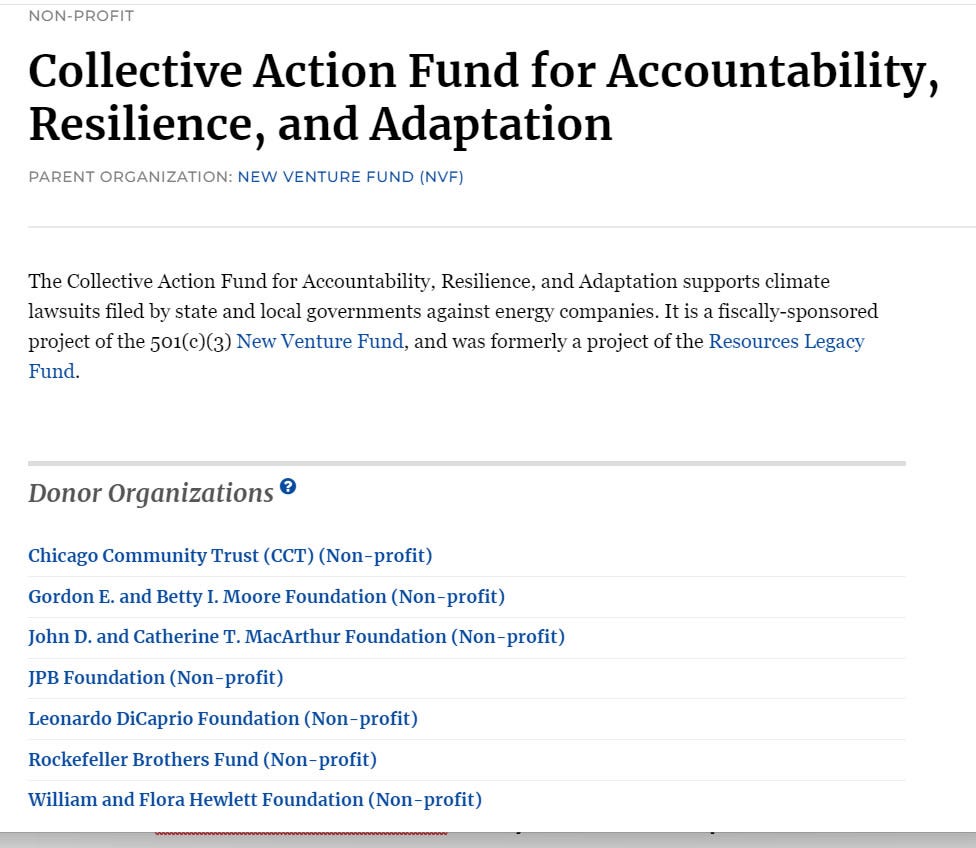
Enter the billionaire philanthropists (or rather their activist fund managers controlling the purse strings), to coordinate fiscal sponsors or strategic litigation NGOs to discretely underwrite all of the law firms needs, regardless of their success or quality of service.
La Jolla’s Missing Link
As my last article on adversarial regulation demonstrated, the US tendency to “litigate to lawmake” meant that any changes in industry behavior could only be obtained under the knife of relentless litigation. This was articulated in the summary document of the 2012 Climate Accountability conference held in La Jolla, California. This so-called La Jolla Playbook, the brainchild of Naomi Oreskes following her 2010 book, Merchants of Doubt, argued that like the tobacco industry, Big Oil will not change their ways unless they are overwhelmed by an existential litigation onslaught.
The La Jolla tobacconization strategy had several fatal weaknesses (article on this to come), including the naïve assumption that lawyers were charitable creatures willing to contribute large resources towards saving the planet. In any case, the foundations were brought in to fill that little timesheet funding gap, but Naomi must realize this free money won’t last much longer.
More importantly, Oreskes, a lifelong ivory towerist with no experience in industry, sadly overlooked important differences in culture and product between the tobacco and fossil fuel industries. Naomi saw both industries as rich, powerful, causing harm and lying and that was enough for her to justify the conflation. But she was dead wrong on so many counts.
Western economies could continue to function if tobacco companies ceased to exist tomorrow, but not if we litigated out of existence the providers of the main feedstocks for transportation, energy, textiles, industrial production and home heating. This is not just another attack on a supposed health-harming industry - it was an attack on capitalism and our industrial foundation.
Worse, Oreskes failed to understand the level of attribution needed to litigate the oil industry. It is fairly easy to attribute liability if a smoker for 40 years develops lung cancer or COPD and the only challenge for a jury is to determine damages. And while economic damages from weather events may be easier to establish, the six factors noted above makes it impossible to attribute liability from global climate evolutions upon a single oil company.
The entire La Jolla Playbook would fall apart if the link between damages from alleged climate-related weather events and the fossil fuel industry were not established beyond a reasonable doubt. No problem, Naomi must have thought: “We could just fund some scientists to provide a link that could be sufficient for a jury to deliver its sentence.” And with this quick fix, the field of climate attribution science was born, to serve the litigation industry in its strategy to tobacconize the fossil fuel industry – a political-spawned scientific field. (Part 2 will look at how the climate scientists tried to deliver to this lawfare requirement.)
What Oreskes wanted was not an accountability or a just redistribution for the consequences of climate change. As a post-capitalist activist, she wanted to see the oil industry brought to its knees, and with it, the Western capitalist model. Her naïve assumptions were built on hatred and vengeance rather than logic and reason. With such fatal flaws, I have to wonder why people still bother to interview or give speaking slots to Professor Oreskes.
The Willy Sutton Strategy
If these activists funding the law firms litigating these countless lawfare cases had any integrity or commitment to their declared goals of protecting the environment, they would be going after the more likely guilty parties in their alleged climate accountability lawsuits. We need to ask why the strategic litigation activists aren’t suing:
the Chinese companies and factories emitting far more CO2 than the US fossil fuel industry?
the regulators who had been aware of the possible threats since the 1990s and chose to do next to nothing to protect the public?
the other industries emitting more CO2 than the oil companies (power generators, the food chain, the textile industry…).
There is no doubt a political objective in targeting the fossil fuel industry. As a main driver of the industrial revolution and capitalism, nothing would make these anti-industry neo-Marxists happier than to eliminate what they believe to be the cause of all human evil. But this is mere ideology and dogma – success depends on something far greater.
In this case, it is important to follow the money. Big Oil has the deepest pockets, hence the target is on its back (rather than the coal industry, which is practically on its back … except in emerging economies in Asia and Africa). They have the most to lose so they’ll be the first to give in and pay up.
There is no point suing the regulators for decades of inaction – there is no money there. The Chinese won’t pay either and the other industries emitting more CO2 will quickly fold into bankruptcy trusts faster than you can say “asbestos”. As Big Oil has the money, they have the litigation problem. There is no ideology or integrity here, just greed mixed with vengeance. And winning. In order to win their billions in the courtroom, they actually created a scientific field known as climate attribution science.
Activists like Naomi Oreskes must be thinking like petty thieves – it’s all about the money. It reminds me of the bank robber, Willy Sutton. When asked in prison why he robbed banks, Willy replied: “Because that’s where the money is!”
So Naomi, why have you been going through so much trouble to sue Big Oil?
Part 2 will look at how the climate scientist community succumbed to the money and fell into bed with the litigation industry to provide them with the climate attribution link needed to sue the oil companies. The La Jolla Playbook depends on them succeeding in providing a believable link that could hold up in court.