



Flipping through the glossy reports of EarthRights International, I feel emotionally pulled to commend their social justice goals, how they present themselves as saving indigenous peoples from the evil exploits of Western capitalism and stand on the frontline as a force for good in the fight against global corporate oppression. This emotional comfort is intended to blind me from their marketing strategy, campaign opportunism, massive budgets and political ambitions.
It is worth taking a closer look at EarthRights International within the context of the most recent evolution in professionalized philanthropy through foundation funding and implementation of a strategic litigation tactic managed by a closed group of shrewd political activists. As they try to hide in the shadows, the Suncor v Boulder case is shining considerable light on them.
Strategic Litigation
The term “strategy litigation”, as an activist campaign tool, has only come into widespread discussion in the last few years. NGO-like groups have been formed via foundation-led fiscal sponsors to coordinate a cascade of lawsuits against corporations, states and other representatives of the capitalist system. The “strategic” part is to ensure that lawsuits are filed in coordination with wider campaigns and stakeholders in order to make the greatest impact. It is not about one person seeking justice, but rather about using the justice system to seek vengeance.
Lawyers can be bought, that has never been an issue. But with professionalized philanthropy, activist consultants within these foundations now have access to sufficient funds to afford the lofty timesheets of these opportunists. If $10 million dollars can kick up a lot of dust in a courthouse, buy substantial media time, attract lobbyist and policymaker attention, just imagine what $100 million can do. These lawsuits though are not about righting wrongs and achieving justice, but rather about making significant impact within campaigns, effecting reputational damage and harassing industry actors.
If you can tie these lawsuits to loftier terms like justice, habitat or health protection, retribution and a defense against capitalist exploitation, it will sit well in a foundation’s annual report and please its board members.
The Firebreak has already covered a series of strategic litigation cases within the context of developing how professionalized philanthropy is changing the nature of environmental health campaign management.
The salmon aquaculture debate in Chile has recently been influenced by a group of large foundations coordinating to create a “litigation infrastructure” in a remote region in Patagonia.
Sher Edling is a tort law firm created by a fiscal sponsor on behalf of seven large foundations with the sole purpose of filing lawsuits against fossil fuel companies for the damages from climate change. From their dozens of lawsuits, they have yet to win a case but the funding keeps coming.
EarthJustice is a law firm funded by foundations to be the activist NGO’s litigator ($207 million raised in the last financial year). Income from settlements is extremely low but the reputational harm and bad PR that industry receives from their lawsuits makes it worth every penny.
But these Firebreak case studies looked more at the graft, exploitation and lack of integrity behind these fiscally-sponsored “projects”. They mostly file nuisance lawsuits done by inhouse lawyers (and thus carry high overhead). What if you could create an NGO without any deep legal expertise that functions as an aggregator, identifying potential plaintiffs that align with a political objective and then raise funds from a wide network of activist consultants working within 20 to 30 large foundations? This NGO could then pay external law firms to file cases that fit within the foundations’ wider campaigns.
You would have the strategic litigation approach of the NGO called EarthRights International.
The NGO Behind the Lawsuits
Most people have never heard of EarthRights International for good reason. They wish to serve as the strategic litigation invisible hand, identifying victims that play into their activist ideology and then arranging the funding to hire law firms, the NGOs and reporters to amplify the cases and the lobbyists to pump their intended objective. But this invisible hand slings a lot of mud.
EarthRights is not a law firm, they do not have deep legal expertise and do not try the cases themselves. They target industry actors and governments to implement their post-capitalist activist agenda and then hire law firms to litigate. Their website provides glossy reports on cases in developing countries, with indigenous peoples and minorities fighting capitalist oppression, but most of their work takes place in the US from their K Street offices and in US courts. It is not about change for a better world, improving regulations or ensuring justice; the campaigns EarthRights International are running are about annihilating companies and industries.
I learnt about EarthRights as the instigators and co-counsel behind the climate nuisance lawsuit coming before the US Supreme Court next month: Suncor v Boulder. Their claim is that Suncor and ExxonMobil knew their products contributed to climate change and now need to pay their “fair share” for the damages. This is the strategic litigation Holy Grail, set out by Naomi Oreskes at La Jolla in 2012, and after dozens of failed attempts, Boulder is the first court to actually attain the authority to have the case heard (hence the appeal to the Supreme Court).
On behalf of Boulder County, EarthRights has engaged Kevin Hannon and Yohania Santana of Singleton Schreiber, LLP, the Law Office of Marco B. Simons, and Kevin K. Russell of Russell & Woofter LLC, but now that the Supreme Court is hearing the case of whether state and local courts can override federal law, everyone and their dog is getting involved.
Beyond the “fair share“ rhetoric, the goal of Earthrights in filing this case has always been to impose a “carbon tax” to ultimately put the fossil fuel industry out of business. That is their definition of justice.
The Foundations Behind the NGO
While details are, as usual, scarce, EarthRights International does list its funders for 2024 and it’s a Who’s Who of the big post-capitalist foundations often seen in Firebreak exposés (see image), including Schmidt, Bloomberg, Soros, several Rockefellers, Waverly Street and Wallace.
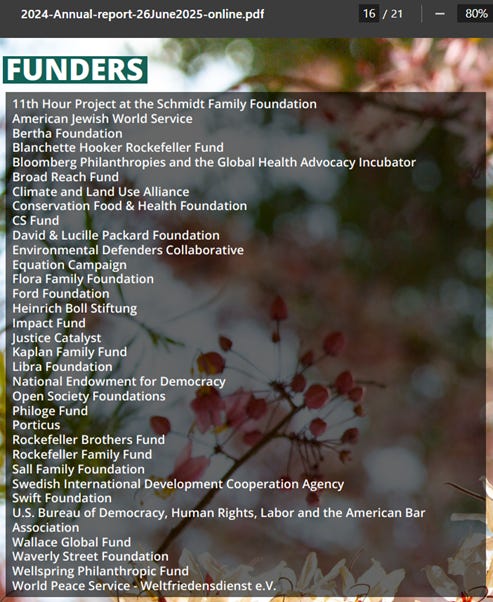
The NGO has declared funding in 2024 of over $11 million from more than 32 of the largest global foundations. Most of it is restricted funding, meaning it is earmarked to specific campaigns. They are managing 41 ongoing legal cases (which may help explain the 32 foundations).
Thanks to the size of the professionalized philanthropy networks, EarthRights doesn’t have a large fundraising budget. They design campaigns that fit within the keywords and objectives of the foundation strategies, tick all of the boxes and, by relentlessly filing lawsuits, provide foundation fund managers with deliverables (regardless of the success rate). After Suncor v Boulder, they are going to need bigger offices.
Many innate EarthRights keywords these foundations want to hear include: “social justice”, “climate change”, “corporate accountability”, “environmental litigation”, “indigenous peoples”, “resilience”, “dignity” and “equity”. Most of all, EarthRights International serves as an implementer of these foundations’ green colonialist strategy, applying an affluent Western ideology on developing countries (via the American legal system).
This is the new activist business model in the age of professionalized philanthropy.
Whatever Happened to Sher Edling?
The Firebreak has been reporting on how seven large foundations, via a fiscal sponsor, had created and sustained Sher Edling as their climate nuisance law firm for the last decade. After pumping tens of millions into Sher Edling and its tort law firm budgets, with absolutely nothing to show for it, the relative success of EarthRights in Suncor v Boulder (ie, not getting their case thrown out before a hearing) would seem like a slap in the collective foundation face for the millions wasted.
To try to appear relevant (and up its foundation-funded timesheet), Sher Edling filed an amicus brief in Suncor v Boulder, but it would seem like their days are numbered. It is far too expensive for foundations to write off all of the expenses of tort lawyers (while removing their incentive to win) when a lawsuit aggregator like EarthRights can achieve more for pennies on the dollar simply by contracting law firms on the ground.
The reality is that the very idea of strategic litigation against fossil fuel companies for the global effects from the rise of atmospheric CO2 emissions is a rather flimsy limb to have hung tens of millions of dollars on. Did they actually expect to be able to attribute damages from the global consumption of fossil fuels (not to mention other greenhouse gas sources) to a single county in Colorado? I don’t believe these countless climate nuisance lawsuits were ever meant to be successful, but rather served more as a flanking tool, a reputational assault, within the wider climate campaigns (that have also since lost their sizzle despite billions of dollars in foundation funds).
Should the Supreme Court rule as expected, that such cases fall under federal jurisdiction, this should put an end to the decade-long strategic climate litigation tactic. History will show that companies, like those in the fossil fuel industry, that stand up to long-term, foundation-funded strategic litigation campaigns and Predatort MDL extortion rackets rarely get sued again. Companies that have a winning card but roll over and settle out of court, like Bayer, Syngenta and J&J, only encourage further litigation harassment.
The back of my envelope would estimate (very conservatively) that foundations have wasted more than $250 million funding these hopeless climate lawfare cases (including groups like EarthJustice). That’s $250 million that could have helped the homeless, eased malnutrition and supported global education. That the professionalized philanthropy consultants don’t see the disgraceful misuse of these charitable funds for their own political ends indicates how far foundations have fallen from their noble roots.