


The Salmon Wars investigation has allowed The Firebreak to highlight the various strands of our research and analyses. This four-part series has shown: how foundations hide their funding sources through different mechanisms like fiscal sponsors and donor-advised funds (Part 1); how professionalized philanthropy coordinates and choreographs a dark network of captive journalists, researchers, lobbyists and NGOs to more efficiently make an impact and control the public narrative (Part 2); how governments can join the foundations (and use their same tactics) through international bodies (Part 3). The most important research area The Firebreak has been investigating, and the subject of this concluding chapter, is how foundations are augmenting their campaigns by funding and directing law firms, lawfare attacks, strategic litigation and public nuisance lawsuits.

A recent development in professionalized philanthropy is how foundations are financing legal costs, often via third parties, to advance campaign goals. Litigation is effective, it gets results and it threatens the viability of targeted industries. But if litigating salmon farmers out of existence is a legitimate strategy for these ruthless activists, then the foundations need to provide their front groups in the local communities in southern Chile with the appropriate resources.
This is an emerging field of professionalized philanthropy known as strategic litigation where foundations are creating or funding NGOs (often via fiscal sponsors) to identify lawsuit targets, employ law firms and coordinate the PR. The most well-known case and the benchmark for this recent strategy, was the creation and funding of Sher Edling. Tens of millions in foundation funding have been channeled through a fiscal sponsor to have this tort law firm file nuisance lawsuits against the fossil fuel industry claiming damages from climate change. The main strategic goal is not to win but to create reputational harm of an industry, and while Sher Edling has yet to succeed in any of their dozens of lawfare suits, the foundation money keeps flowing in. A similar strategy in the war against Chilean salmon aquaculture is emerging.
Part 3 of the Salmon Wars looked at the interventions of the Norwegian state aid agency, NPA, to lawyer up activists in local indigenous groups But that is small beer compared to what the foundations have done to disrupt the southern Chilean economy. This concluding chapter will demonstrate how they have built and funded a litigation infrastructure to harass and interrupt the ability for Chilean salmon farmers to make a living. This is more than just one further strategy by the professionalized philanthropists and foreign state actors in southern Chile; it is intended to be the fatal blow.
Building and Financing an Anti-Salmon Litigation Infrastructure
One tool commonly used by the law firms is to manipulate the 2008 ECMPO classification. ECMPO stands for Espacios Costeros Marinos de Pueblos Originarios (Indigenous Peoples’ Marine Coastal Spaces), a policy framework that allows indigenous populations to claim protection of coastal areas that have been used for traditional practices. With little legitimacy, lawyers are flooding the courts with ECMPO claims and tactics to stymie or hold up salmon farm concessions.
The Norwegians and the foundations are not only funding the lawyers, but also the groups communicating on the lawsuits, the networks connecting the (indigenous) plaintiffs with the law firms and the technical support for the caseloads. They have built, coordinated and financed a litigation infrastructure to strangle salmon aquaculture. Keep in mind this is foreign funding designed to obstruct local economies in southern Chile and that some of the donor parties have evident conflicts of interest in the potential results coming from funding these legal challenges.
Some examples of foundation-funded strategic litigation:
Packard has given $836,100 across four grants (2024–2025) to FIMA (Fiscalía del Medio Ambiente), the Chilean environmental litigation NGO responsible for five rulings in the Environmental Tribunal against salmon farms in the Kawésqar Reserve and for a salmon project permit revocation. One 2025 grant for $300,100 was designated for a ‘civil society communications campaign’. In other words, Packard is also financing the accompanying public relations campaign.
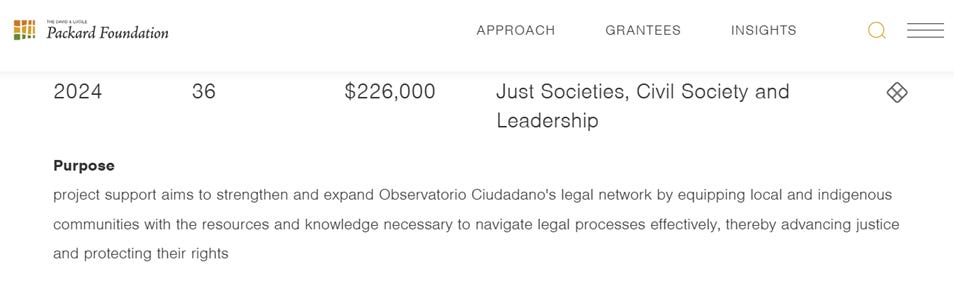
Like the Norwegian state agency, NPA, Packard has also funded Observatorio Ciudadano with a series of ten grants, giving the anti-salmon NGO more than $3 million from 2023 to 2026. One grant, for $226,000, is intended to fund the legal network that connects FIMA-type litigators to indigenous-community plaintiffs (see image). These funds were largely used for ECMPO claims.
Pew has funded technical support (through the Universidad Austral de Chile’s “Austral Patagonia” program) for ECMPO claims. Such applications can hold up the awarding of salmon aquaculture concessions for years.
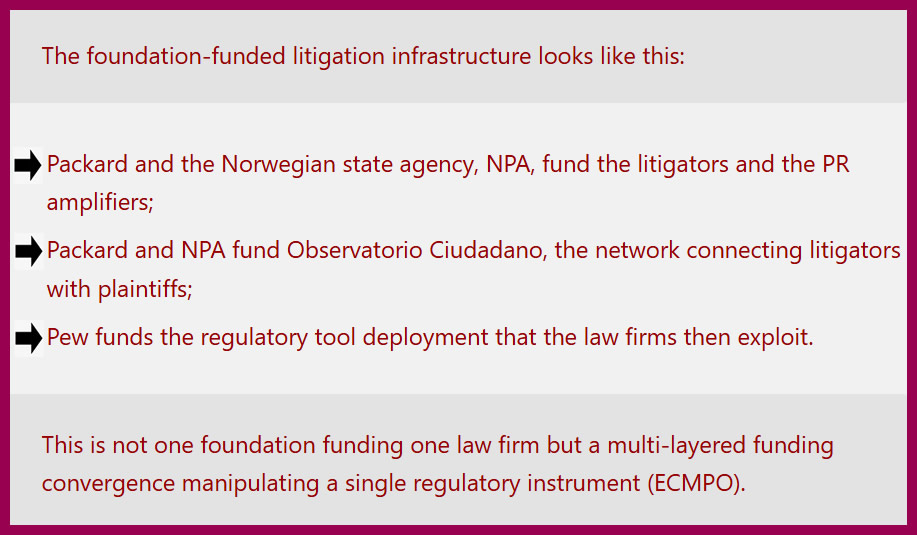
The millions in strategic litigation funding are designed to decimate the salmon farmers. But as they are foundations, perceived to be virtuous, most look away and pretend nothing illegal or unethical is going on. The Norwegians don’t have similar lawfare assaults obstructing their salmon farmers (perhaps the Chileans should set up some foundation front groups to obstruct salmon aquaculture in Norway).
The Philanthropic Nation State
Is it fair to compare interventions by Norwegian state agencies with philanthropists? In Part 3, the state agencies were portrayed to be acting as quasi-charitable foundations. At the same time, it is difficult to not notice how multi-billion dollar foundations working on campaigns in lower and middle-income countries are behaving like foreign governments.
Some examples of how foundations are now acting like, and in place of, governments:
When the US left the World Health Organization, the next largest contributor to the WHO was not Germany or Japan, but the Gates Foundation. Governments are no longer ready to spend the billions required for intergovernmental development programs but billionaires are welcoming their UN Global Ambassador titles.
Bloomberg Philanthropies is running the WHO‘s Framework Convention on Tobacco Control’s MPOWER program. Michael Bloomberg has contributed or committed around $2 billion to a group of NGOs that implement the WHO strategy while adding their own political biases against tobacco harm reduction strategies. The WHO does not have the resources and is powerless to intervene as low income countries pass regulations against the use of health prevention tools.
The Food and Agriculture Organization (FAO) is promoting a large agroecology program. Agroecology is a Marxist-based agricultural philosophy that promotes subsistence farming techniques as an alternative to modern agricultural technologies. The FAO is doing this because of the influence of the Agroecology Fund, a project of a fiscal sponsor that raised $100 million from a group of large foundations. It seems tech billionaires were convinced peasant farming is the future of food production.
The main difference between governments and foundations is that most governments have to be accountable to their populations for their actions while foundations are run like dictatorships, imposing the will of a billionaire on vulnerable communities. And such is the case in southern Chilean coastal communities, where a small group of professionalized philanthropists have been spending hundreds of millions of dollars to fund law firms and lobbyists, pay off the media and academics, form activist front groups and fiscal sponsors, while pulling the strings from the shadows.
Accountable governments or organizations with ethical codes of conduct would never be able to execute such beautifully ruthless strategies to manipulate large populations and win campaigns. The professionalized philanthropy motto: To make an impact, you must take total control.
Green Colonialism
The salmon farmers are fighting valiantly against the unlimited resources of these political activists, trying to ensure a continued economic future for these remote regions while providing consumers with healthy, affordable protein. But it is becoming a difficult struggle against organizations with no financial limits, no transparency and no accountability.
This is a new form of “Green Colonialism” where affluent Western political dogma is imposed on vulnerable populations. But in this case, the policies are environmental and the colonizers are the foundations managed by a network of politically active consultants. See several analyses of this green colonialism by Marc Gunther and The Firebreak.
The foundation-driven climate crisis was the benchmark of how professionalized philanthropy could control a narrative, drive policy, disrupt trade and development and impose an affluent green ideology on populations with more basic concerns (food, energy, jobs, welfare...). After the bottom fell out of the catastrophic climate collapse campaign, populations are beginning to see how they were deceived, how the media was funded, how scientists were paid, how net-zero campaigns were run by foundation-driven interest groups, and yes, how even Greta was stage-managed.
Following the Norwegian People’s Aid investigation, there have been calls in Chile for legislation demanding transparency of foreign funding of NGOs. This needs to include foundations who have created such complex webs of fiscal sponsors and front groups, organizations that have thrived in running their campaigns from the shadows. As they tend to operate as extra-legal, transnational forces, this scrutiny needs to be made at a global level.
Foundations should take the initiative on transparency, but every tool they use has been designed to deceive: from dark donor-advised funds to fiscally sponsored “projects” or “initiatives” covering up non-existent entities.
This professionalized foundation capitalism playbook is being executed in other environmental issues now (microplastics, PFAS, tobacco harm reduction, ultra-processed foods...) where hundreds of millions in foundation funds are flowing in via fiscal sponsors, activist front groups, lobbyists and litigators. Chilean salmon aquaculture has provided a good case study of how these dark, deceptive forces are operating.
But after the climate ruse was discovered, the public is starting to wake up to the dark side of professionalized philanthropy. After foundations like Packard or the Norwegian government tried to manipulate indigenous populations to speak out against salmon farming, they did not expect the opposition and the anger. Maybe Packard and other foundations should take a closer look at what their consultants and fiscal sponsors are actually doing and question whether “winning at all costs” is a good public image for a philanthropic foundation.
This investigation will close with a quote from one of the local leaders who was not appreciative of the imperialist foundation dogma being imposed on his community.
“We have seen how imperialism shows its trinkets in our territories. Now its form is more surreptitious and typical of our time. It is no longer about putting the boot on top, but about meddling in the communities, creating some [indigenous people] on demand, acclimatizing them and, then, beating the cloths through social networks and … media to legitimize them as the only and authentic [indigenous people] because they are friends of the settler. … The new Yanaconas are now digital and globalized by the hand of the green colonialists … It cannot be that we are at the mercy of organizations of which we know little or nothing about their interests and for which Chilean citizens have not voted to govern our destinies as they are doing … Today we demand that the Government of Chile set its territorial policy in Magallanes, not that it be dictated by these organizations and their local allies.” Original text
Juan Carlos Tonko Paterito
Kawésqar Indigenous Community
Puerto Edén, Chile