


Salmon is a healthy source of protein in high consumer demand. Often as expensive as the finest beef cuts, salmon has a special place on the global dinner plate. It wasn’t always the case. In the 1800s, wild salmon was so abundant, cheap and widely eaten that legend has it that it was considered inhumane for Scottish households to feed their staff this fleshy seafood more than twice a week. But overfishing and poor coastal management led to a dramatic decline in wild salmon stocks, government restrictions and market collapse. In my youth, I rarely recall eating fresh salmon (unless my brother-in-law visited us from British Columbia).
To address this decline, a salmon aquaculture industry emerged over the last 50 years and this wonderful food returned to our plates. Norway became the leader in farmed salmon with their aquacultural techniques spreading to other salmon coastlines around the globe: Scotland, British Columbia, Russia, Iceland, Tasmania, Argentina… But nowhere was the rise in salmon farming as spectacular as in southern Chile, soon becoming the second largest farmed salmon producer in the world, capturing a large part of the US market and becoming the nation’s second largest export. This threatened the Norwegian aquaculture industry’s dominance and foreign trade revenue. Something had to be done.
This is Part 3 of the Salmon Wars investigation. Part 1 measured how political consultants acting on behalf of large, mostly US-based foundations were coordinating and pumping hundreds of millions of dollars into anti-salmon farming campaigns in Chile. The second part examined how the professionalized philanthropy strategies, developed during the last decade of climate campaigning, were implemented in a choreographed onslaught against Chilean salmon farmers via the use of dark fiscal sponsors, regranting front groups, lobbyists and their paid-off media to control the public narrative and dictate policy to Chilean regulators. Part 3 will look at how foreign interests are working beside these foundations to fund researchers, lobbyists and law firms in an attempt to dominate the Chilean salmon policy debate.
Norwegian State Interference
The Norwegian farmed salmon industry is massive: an $18 billion industry selling half of the world’s Atlantic salmon, providing almost 60,000 jobs and exporting over 1.4 million tons of salmon yearly. It would make sense for the Kingdom of Norway to then protect its interests. But protecting Norwegian salmon farmers is not the same as aggressively attacking other nations’ farmers from having a right to market or a right to exist. This is where Norway’s engagement with, and funding of, foundation-based political activists crosses innumerable ethical boundaries.
Of course the Norwegians wouldn’t want to foment activist outrage to the point that their useful idiots would succeed in banning all farmed salmon. Their first goal is to spread consumer fear about the safety of Chilean salmon in order to capture their export markets as a safer aquaculture alternative. Then, once these competing farmers are weakened, the Norwegians would fund the local litigation industry to bankrupt them. What’s not to like about such a ruthless strategy?
And with that, the third chapter in this investigation begins.
Not Just Billionaire Philanthropies
Norway is a peculiar place. Having accumulated a massive sovereign wealth fund, Norwegians tend to think of their government as a collection of philanthropic entities endowed with the objective of doing good (from a particular political interest).
It is not surprising then to see strategic government objectives, like promoting Norwegian salmon exports, being carried out by its agencies in a quasi-charitable context.
There are at least three separate Norwegian state entities — the Research Council of Norway, Norad, together with Norway’s International Climate and Forests Initiative (NICFI), and Norwegian People’s Aid (NPA) — who are each independently funding organizations or projects that threaten the existence of Chilean salmon aquaculture and Chilean exports.
State Donations to Journalists
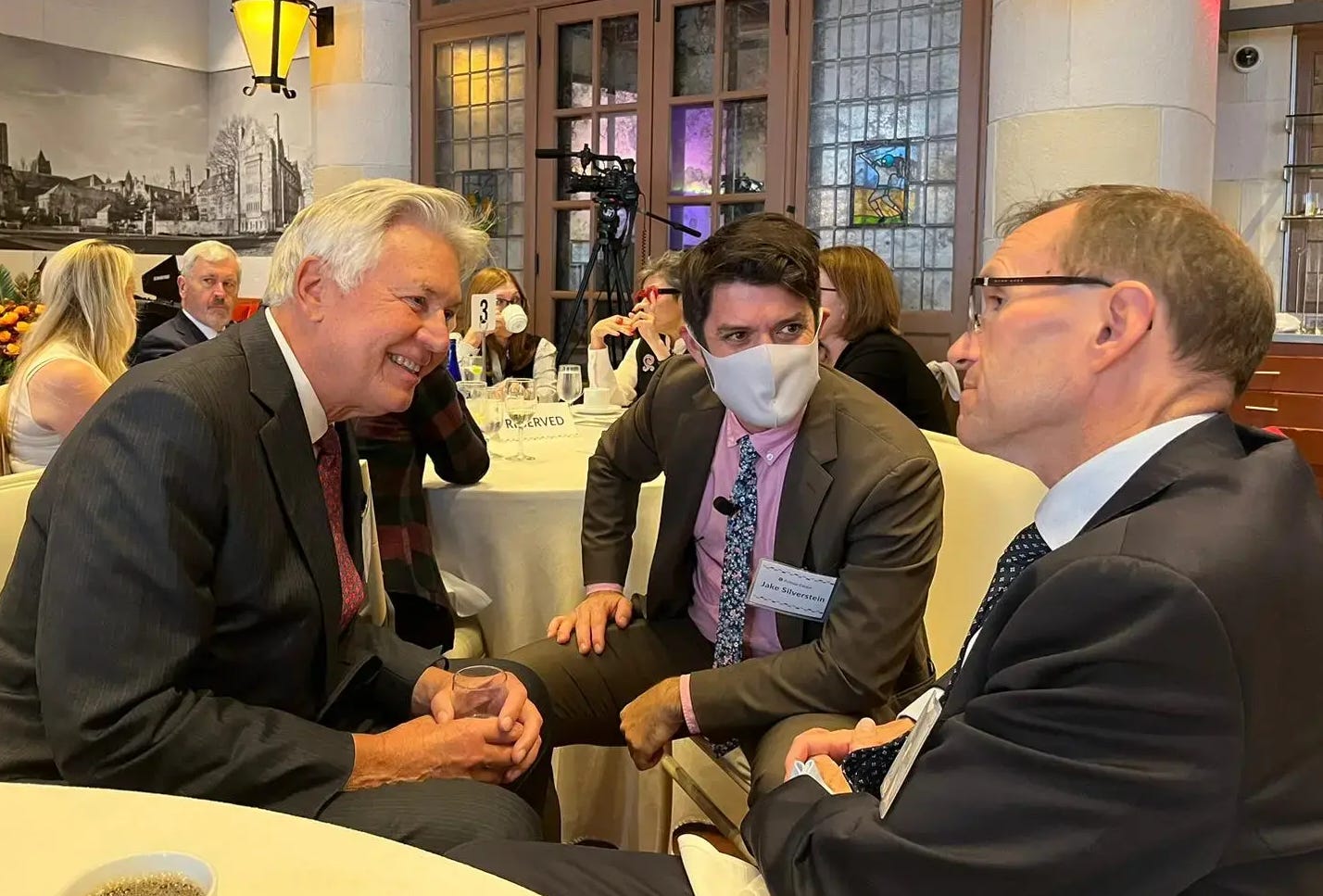
The Norwegian Agency for Development Cooperation (Norad), together with Norway’s International Climate and Forests Initiative (NICFI), made a $18 million / NOK 170 million five-year joint commitment (2023–2028) to the Pulitzer Center, co-financed alongside the Walton family’s Builders Initiative. The Pulitzer Center program produced the ‘Patagonian Paradise Lost‘ piece on Chilean salmon farming in 2023. The author, Jessica McKenzie, is a Pulitzer Grantee on a project starting in 2023 asking: “Is Chilean Aquaculture a Climate Solution or Crisis?” Her funding, writing and involvement with local NGOs would suggest she considers it a crisis.
NICFI describes the Pulitzer Center grant as part of a NOK 500 million partnership with civil society organizations to:
“reduce deforestation, address environmental crime, strengthen environmental defenders and the rights and livelihoods of Indigenous Peoples, and local communities, and advancing sustainable agriculture production and trade in some of the world’s most valuable and vulnerable forest regions.”
What is remarkable here is that NICFI is a Norwegian government initiative dedicated to protecting tropical forests. The last I checked, Patagonia is not tropical. But there are indigenous peoples in southern Chile that the Norwegians have been trying to portray as environmental defenders (see below).
The Curious Case of the Humanities Professor
Ernesto Semán, Associate Professor at the University of Bergen Humanities Department, got interested in the story of Chilean salmon aquaculture, so he applied for a grant from FRIPRO, the Norwegian Research Council’s funding scheme for basic and applied research. Ernesto received NOK 12 million (almost $1.3 million) from 2025 to 2029 for him to study the past and future history of salmon farming in Chile and hopefully earn a PhD. “The goal is to show what consequences the rise of the salmon industry has had and continues to have, both for the economy, society, environment, nature, and the salmon itself.” It is called Project DARKLAX (lax or laks is the Scandinavian term for salmon).
In Part 2 it was noted that Semán received support from the anti-salmon farming NGO, Ecoceanos, to write an article against Chilean salmon farming in the New York Review of Books. It was a poetic look into the life of a salmon with insightful remarks like: “Salmon don’t talk. Their experience isn’t available to us in words.”

Semán is conducting the research alone. It seems all you have to do is go the Norwegian government these days and tell them you want to attack Chilean salmon aquaculture and they will shower you with cash.
Supporting the People or the Activists?
Norwegian People’s Aid (NPA) is a Norwegian state aid agency with its Latin America program operating on a budget of around $90 million annually, 82% of which is Norwegian state funded. In March, 2026, a Chilean national news channel, TVN 24 Horas, broadcast an investigation documenting how NPA provided approximately CLP 500 million ($550,000 USD) directly to the Lafkenche indigenous communities in Los Lagos and Magallanes between 2004 and 2014.
The purpose of these funds was to enable these communities the legal costs to try to hold up salmon farming concessions. NPA’s Latin America head, Beathe Torensen, confirmed the figure on camera and stated NPA sees no conflict of interest (even though this was clearly a competitor-government-funded operation with the Norwegian authorities trying to block salmon projects in Chile).
The TVN broadcast triggered an immediate political reaction: Deputy Alejandro Bernales, president of Chile’s Fisheries and Aquaculture Commission, announced a formal summons of the Norwegian authorities and warned of potential legal liability. Deputy Mauro González, also a member of the Fisheries and Aquaculture Commission, stated “that legislation may be needed to require NGOs to disclose funding received from abroad”.
NPA has also funded Observatorio Ciudadano, the policy-lobbying-lawfare NGO discussed in Part 1 of this investigation, and while the amount remains unquantified, the government agency is given prime position on the funder’s list (even above Packard who donated over $3 million).
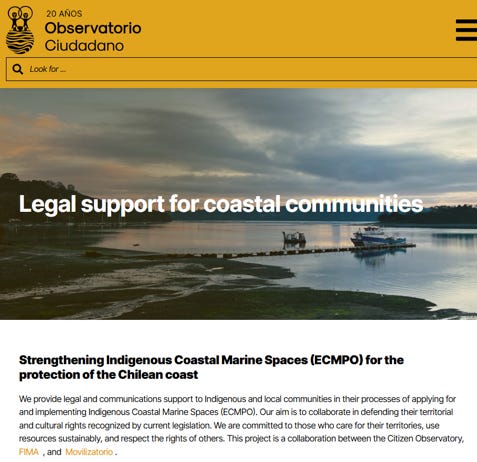
Foreign government bodies intervening to influence internal policies of a sovereign country raises multiple issues of concern. When these policies may benefit the foreign government’s industry and exports, this raises ethical issues of concern.
Strategic Litigation: A Professionalized Philanthropy Weapon
The Norwegian interference in Chilean aquaculture follows the typical routes of professionalized philanthropy campaigns: funding journalists, funding academic research and funding lawyers. Financing the litigation costs to implement a campaign strategy via the courts (strategic litigation) is perhaps the most effective means to intervene and effect impact, as neither law firms nor foundations show much regard for transparency or accountability.
But is it fair-play? Is it ethical? These are questions professionalized philanthropy consultants don’t ask themselves; it is only about impact and winning.
Building on the evidence that Norwegian state entities are funding lawyers and legal support NGOs to interfere with salmon aquaculture concessions, this investigation will conclude with an assessment of how state agencies are working together with foundations with the objective of litigating salmon farming in Chile to its ultimate demise.