


The Firebreak has been documenting the rise of foundations as a major player in the environmental-health policy domain. One term that has recently come into the discussion is the professionalization of philanthropy. But what does that mean?
A stereotype of a foundation is an organization built around some philanthropist who had a bit of luck during his or her business career putting a substantial amount into a fund, hiring a few people to answer the phone, reply to email applications and present dossiers for funding to an outside board. The billionaire would then show up at the opening of a self-named university wing, an art exhibition or a hospital in some developing country and everyone would feel good about making the world a better place.
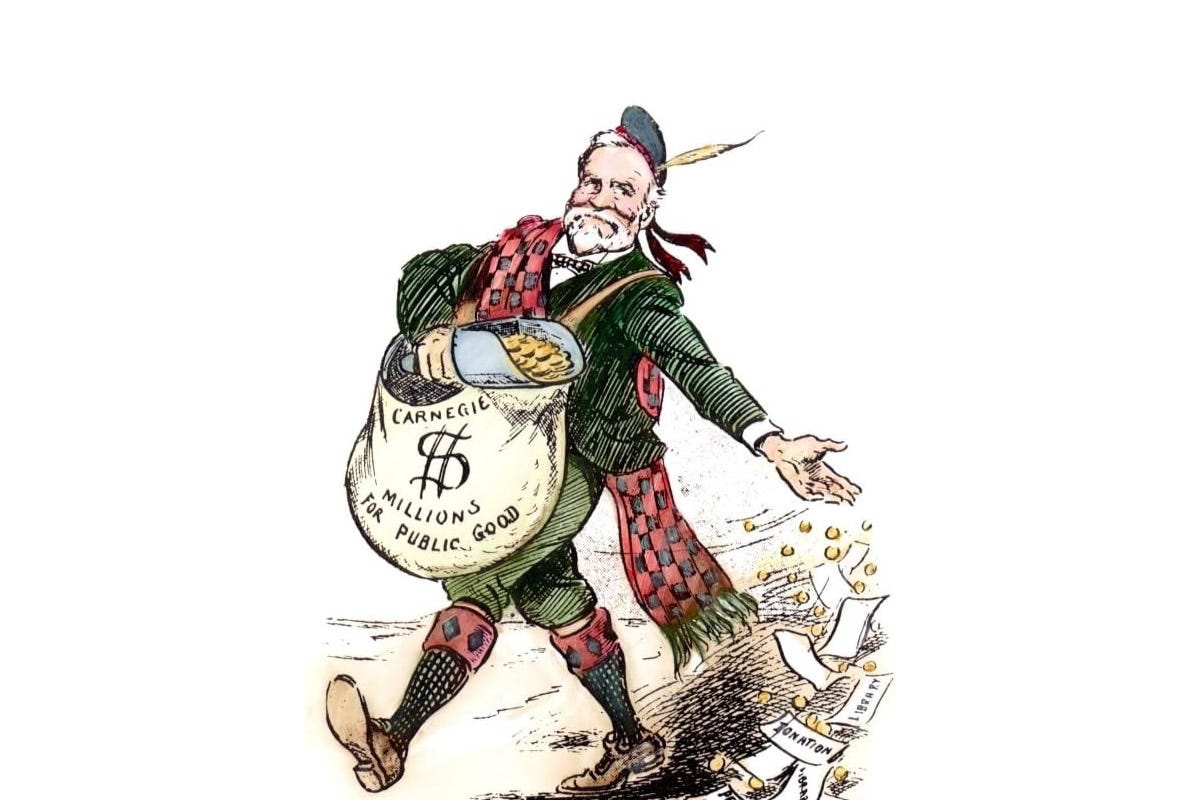
That romantic image of a philanthropist doing good has been erased by political opportunists and the growth of an ecosystem that has not only learnt to follow the money, but also how to manipulate it. Perhaps the best sentence to mark the demise of philanthropy is posted on foundation websites: “We do not accept unsolicited requests for funding”. This does not mean that they have run out of money for this year (their available capital growing in investment funds usually run into the billions) but rather that these groups have their own strategy, their own network and their own interests.
A Recent History of Wealth Creation
When we think of philanthropists, names like Rockefeller, Carnegie or Ford come to mind. These industrialists accumulated their wealth before or during the Roaring 20s (the 1920s) but during the Great Depression the wealth inequity was too great to ignore. There was no other significant wealth creation moment until the “dot-com” era and over last 25 years we have seen four periods (Internet, Web 2.0, crypto and AI) that produced an avalanche of new wealth. For perspective, the recent SpaceX IPO created more than 4,400 new (employee) millionaires and 400 cent-millionaires in one day. These wealth creation periods have been followed by a proliferation of new foundations.
Philanthropy changed though. It is no longer defined by a retired industrialist seeking redemption, but a passive (young) tech donor too busy solving problems and developing the new technologies. They leave a good part of accrued wealth to an office of opportunistic consultants with political interests, seeking a return on investment in terms of impact, change and measurable campaigns. In the last 25 years, billions have poured into the activist policy campaign arenas from these tech-based foundations.
While entrepreneurs, this new tech generation of philanthropists don’t understand industry, business or the capitalist mindset (those things are offshored) so they tend to lean to the post-capitalist, degrowth ideology in their giving. It is important to note that most foundation funding did not go to NGOs that have dominated the environmental-health debates for almost five decades – they were too idealistic and difficult to manage. These professionalized consultants were setting up their own organizations to implement their strategies.
Venture Impact Funding (Foundation Capitalism)
Many tech entrepreneurs’ first meetings as adults were with venture funds where throwing large amounts of money at them seemed normal. All they had to do was show how their projects would make an impact (and make some money). Fast forward a decade, and as philanthropists, they will only fund projects that make an impact. This caused an important shift in trends in giving. Feeding the homeless or delivering healthcare to developing countries is not as impactful as saving the planet from catastrophic climate change.
You could give away a billion dollars in an afternoon if all it took was to identify the needy. But if it means trying to get the best philanthropic return on investment, then funding programs need to go through an intensive tender process. A professionalized foundation is not about helping the most people, it is about making an impact, curing a disease, bringing lasting development or stopping climate change. The legacy of a billionaire is about the legacy of the achievements his or her foundation will be able to nameplate. This takes time and a sustainability of abundant funds.
This is, for lack of a lexicon, a new form of capitalism. The Firebreak has a series of investigations into Foundation Capitalism that looked into the structures, processes and evolution in philanthropy, away from giving and toward capitalistic opportunism. It is about controlling a narrative, dominating a debate and successfully implementing a strategy. As the space is professionalized, it is difficult to distinguish a foundation from an entrepreneurial enterprise.
Providing pots of unlimited funding within the civil society sector is also creating an attractive environment for opportunists. Some NGOs are designing their programs to appeal to impact-oriented foundation funding objectives. EarthRights International, a strategic litigation NGO, has declared funding in 2024 of over $11 million from more than 32 of the largest global foundations. Most of it is restricted funding, meaning it is earmarked to specific campaigns. Does EarthRights have a efficient fiscal sponsor? No. They simply design projects that tick all of the boxes on the foundations’ strategic objectives … and then back up the truck.
The money is there, waiting to be married with the right keywords. But the structure of these professionalized foundations does not favor funding passionate people committed to their cause, but with no time for complex application processes. Instead, they are rewarding abstract analysts and consultants adept at saying whatever is needed to be said. Once in a foundation’s sphere, renewing program funding takes a few minutes a year … and even less time to answer to any internal accounting scrutiny.
Attracting Top Talent
Part of the professionalization strategy is to pay above-market rates to attract and keep the best management available.
Like venture capital firms, the priority for professionalized foundations is to grow their pot, not to dissolve their operations through charitable donations. The Chan Zuckerberg Initiative investment page looks like a hedge fund prospectus with more information on its website over its investment team (and their 24 in-house financial directors and analysts) than on its grantmaking activity. Packard, a foundation that does not draw much attention anymore outside of its ocean programs, spent $52 million in 2024 on operating and administration expenses (staff), with substantial payouts to its investment directors. Marc Gunther put this into context:
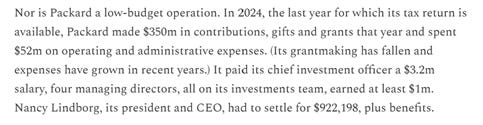
This is not uncommon in the philanthropy world, and similar salaries are paid to the NGOs and fiscal sponsors down the foundation value chain. A Firebreak exposé showed that the top ten managers in each of the Bloomberg-created tobacco and nicotine control non-profits, where transparently disclosed, receive a minimum salary of $25,000 a month. When the foot soldiers are bought and paid for at that level, compared to market rates for normal non-profit staff, they fall in line pretty fast.
Many foundations operate as hedge funds with a small, charitable front office. The Skyline Foundation, set up by the founder of Yahoo!, David Filo, has grown its reserves from $800 million to $1.2 billion in three years while outsourcing its non-investment operations to Pacific Foundation Services, a professionalized philanthropy bottom feeder. Skyline is not only aware that the consultant is using its funds in combination with money from other foundations they manage, but proudly promotes it.

But without transparency and regulatory scrutiny, how can insider trading and conflicts of interest be avoided when these investments are made beside large political, legal and social lobbying campaigns. Keep in mind, as well, that foundations are considered as non-profits so not only do they enjoy considerable tax advantages, but the taxpayer is subsidizing their largesse.
The Climate Philanthropy Playbook
Two decades of narrative control promoting an imminent climate catastrophe (and the transition to special interest alternatives) did not just happen. The climate movement was fed by billions of dollars consistently donated by a large group of professionalized foundations choreographing campaigns through a series of well-endowed fiscal sponsors. The public was too naïve to realize the control and manipulation of these political actors, but as the veil of ignorance is being pulled away, we are beginning to understand how foundation consultants were pulling all of the levers from the shadows.
Well choreographed campaigns need to take on the issue across a wide variety of fronts: legal, media, scientific research, NGO campaigns, government lobbying (often transnational groups like UN agencies), and alternative special interest groups and business communities. Two decades of climate campaigning had sufficient funding and networks to dominate on all fronts, creating a new power base in the field of public policy management.
The Firebreak has been trying to reveal just how deep these professionalized actors’ tentacles had dug into our perception of climate change.
We published a translation of the excellent research by Florence Autret into how the European Climate Foundation (not a foundation) was receiving €275 million a year from a basket of tech billionaire foundations to control the climate narrative. They paid off a large flotilla of NGOs (literally every NGO acting on climate issues) to support them in their net-zero campaign, they ran Davos from the shadows (and even brought Greta to the WEF shortly after she was “discovered” and then managed the media for her yacht trip to America), had a dark communications arm (having poached key Brussels lobbyists) that managed the media at all of the UNFCCC COPs. We also saw how this secretive regrantor that pretends to call itself a foundation only needed to submit a two-page balance sheet to the Dutch authorities.
We also observed how foundations fanned out to form fiscal sponsorships to create and fund tort law firms like Sher Edling that only exist to file climate nuisance lawfare cases against fossil fuel companies for damages due to climate change. This is known as the La Jolla Playbook – Naomi Oreskes’ strategic attempt to relentlessly sue industries until they either change their policies or go bankrupt (the tobacconization of industry).
Foundations created regranting fiscal sponsors like Covering Climate Now or the Solutions Journalism Network to fund journalists to report on climate issues (claiming that all news is climate news). I put this into context in 2024.
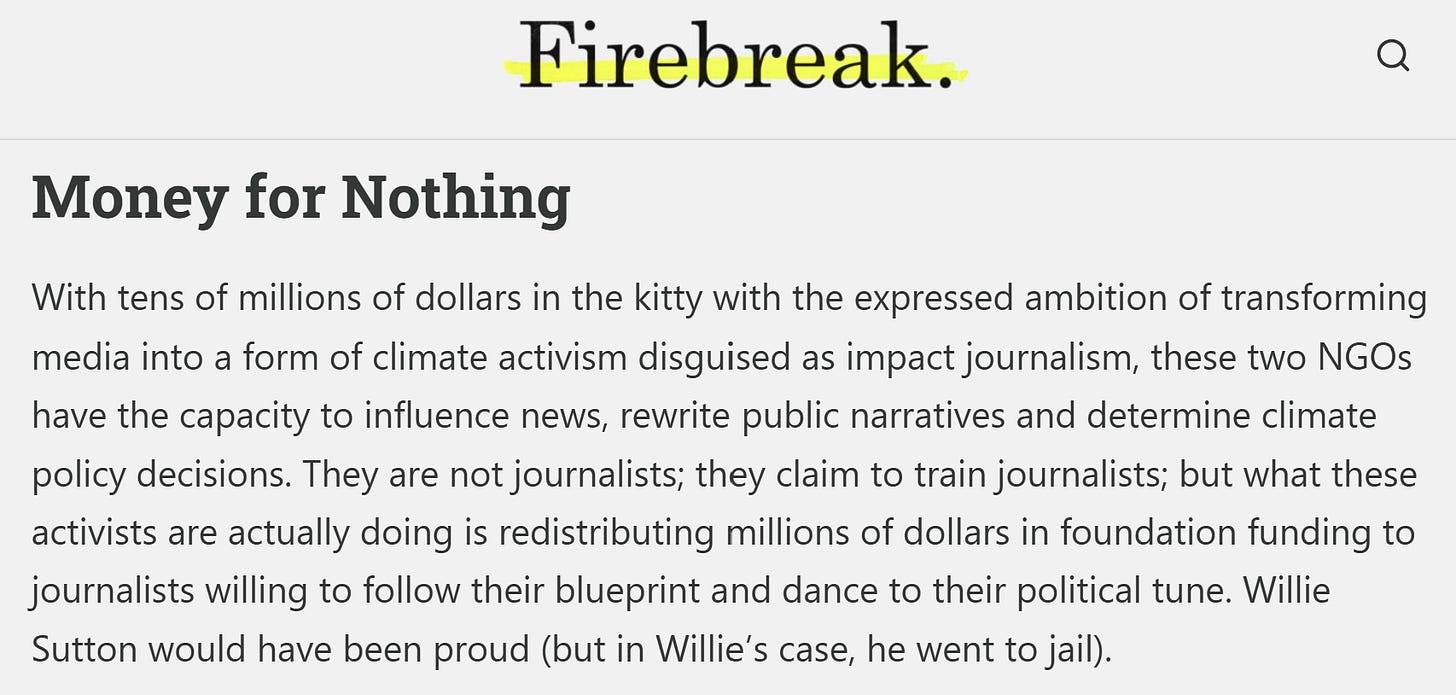
Given that foundations are also funding a large part of the operational budgets of news groups like The Guardian or setting up their own investigative reporting news organizations, there was no difficulty getting their climate campaigns onto the front page. Few people look at the fine print to realize their news is controlled by special interest consultants operating being the foundation veil.
There were other Firebreak case studies of how foundations directly controlled and manipulated the climate narrative.
The Canadian province of Alberta had to conduct a public inquiry with a forensic accountant to learn how years of relentless activist campaigns against their fossil fuel industries were coordinated from the shadows by a group of large US-based foundations donating at least 1.28 billion CAD to disrupt the Albertan economy.
The Agroecology Fund was only raising a couple million dollars a year until they changed their fiscal sponsor, who then claimed agroecology could enhance climate resilience (it doesn’t), and within a year of tapping into Silicon Valley foundations, they were able to raise over $100 million to lobby against conventional agriculture and run agroecology programs within the FAO.
This is not spare change tossed into NGO airport drums. The climate campaigns have spent hundreds of billions manipulating how we perceived the climate issue in the secretive consultants’ strategy to dismantle capitalism. It was not that we were too stupid to see how these professional consultants had played us (as well as the philanthropists). We had just never experienced such corruption of the foundation world before.
As the climate shine has worn off the public narrative, the consultants influencing the foundations are moving into new stories to dominate the policy arena: microplastics, ultra-processed foods, pesticides and chemicals like PFAS. Will we continue to be naïve to their manipulation and control?
What do Philanthropists Want?
Every philanthropist is different and puts his or her stamp on not just the objectives and the projects of the entity, but also the definition and operation of the organization within the foundation ecosystem. So what they want depends on who they are, who is influencing them in the charity space and what had shaped them to arrive at that point in philanthropy.
In the 2010 film, The Social Network, Mark Zuckerberg was portrayed as a naïve puppy with no idea what do with $100, let alone $100 million. Now the Chan Zuckerberg Initiative has been outsourced to consultants and investment managers to operate and they are treating it more like an investment fund. Meanwhile, Mark is still busy solving the last hack and building the next big thing.
Many tech billionaires became accidentally wealthy and are too caught up with changing the world of technology (that they see as changing humanity). In 2017, when Jeff Bezos first became the world’s richest man, many noticed that his only charitable donations went to a project known as Blue Origin. Under pressure to be more like Bill Gates, he noticed how the foundation world seemed broken, unproductive and out of touch so the perpetual problem solver consulted his social media followers for their ideas on how to innovate philanthropy. While most of the contributions were followers suggesting how Bezos should give them his wealth, the idea that philanthropy needed innovation was not misguided.
The Internet generation’s philanthropist’s poster-boy, Bill Gates, took the venture investment model to the next level. Committed to giving away almost all of his wealth during his lifetime, his goal was to make as much of an impact as possible (a return on philanthropic investment). So vaccines, food supplements, water and sanitation projects, nuclear and geothermal energy technologies and agricultural innovations like GMOs cleared the stringent Gates Foundation impact assessment process. His promotion of technology also made Gates the most hated man by pro-nature activists. Or maybe they were still annoyed about losing Netscape.
However people may think it was earned, it is still Gates’ money and he can do with it what he wants. But to donate to get the greatest return on investment, to solve the greatest problems, is a far way away from helping the needy. He could give his billions away in an afternoon, but there would be no legacy achievement to show for it.
But the greatest philanthropic vanity project has to be Michael Bloomberg, who has used his foundations for title and vengeance. With commitments of over $2 billion, he has taken over the WHO’s tobacco control program and shaped it to reflect his prohibitionist political ideology. As he is pushing for the same influence on global food and diet policy, one cannot help but wonder how bitter Bloomberg must still be about his failure as New York City mayor to succeed with his proposed bans and taxes on sugary drinks. He puts his name on every activity, program and donation and lauds titles like WHO Global Health Ambassador or UN Special Envoy on Climate Ambition and Solutions. Philanthropy, however, should not be a consolation for a failed bid to become president of the United States.
If vanity projects are built into the philanthropic sector, nowhere is that more evident than with the rise of groups like Effective Altruism and the School for Moral Ambition. They are built around the appeal of charity and having an impact, concepts quite attractive to millennials and Gen Zs. Effective Ventures’ strategy is built around how best to capitalize on the business of charity, with fund managers taking in donations to redistribute minus significant investment fees. These bottom feeders have carved a niche in the philanthropy world, staining it with fee siphoning, misappropriation, manipulation, sex trafficking and theft. Sam Bankman-Fried did not take six billion dollars from investors out of personal greed but because he was convinced that the more he could give, the more good he could do. No one gave the money back to shareholders or returned the fund management fees.
As Bezos noticed, the world of philanthropy does need innovation but it must first come from the outside.
There needs to be more regulatory scrutiny to control the misuse of funds and groups.
The sector needs to be transparent and detail the special interests using tools like dark donor-advised funds to run campaigns.
There needs to be a delineation between relief, aid and societal support NGOs (like those funding food kitchens, development and health programs) and those Alternative Policy Enterprises (APEs) that function more as lobbyists, consultancies and law firms.
When foundations give to the APEs, they should not enjoy tax deductible status or accountability shortcuts.
Fiscal sponsorships (consultants running activist campaigns under the guise of a project while receiving third-party funding from multiple foundations) should be abolished. The ability to amass hundreds of millions of dollars into non-declared, unaccountable entities is a recipe for abuse and corruption.
If foundations are now professional organizations, then professional regulations should apply to them. This weekend, The Firebreak will launch a series on the number of foundations coordinating and choreographing campaigns against Chilean salmon aquaculture. It’s a David vs Goliath story, with stealth networks of foundations pouring hundreds of millions into a professionalized campaign to extricate a small group of fish farmers providing an affordable and healthy source of protein. We have to break out of the bias, spread in their well-funded media, that foundations are inherently good and righteous in their attacks on industry (which they have portrayed as evil).
A Darker Storm Approaching
2026 saw (briefly) humanity’s first trillionaire. But there is no Elon Musk Foundation and surprisingly, given the hype of the bully-pulpit Giving Pledge, there is no expectation that Elon will direct his wealth towards “good”. Rather, there is a fear that Elon will direct his wealth towards expanding power. A few hundred million channeled into a political campaign fund will not even scratch the surface of Musk’s overall wealth but it can certainly interfere with the democratic process in the US, the UK, Germany and France.
But should it only be Elon’s trillion that frightens us? Are we afraid because we disagree with his right-wing politics and how it can influence democracy? That dark storm is already above us and why The Firebreak has been trying to draw attention to such special interest manipulation. Billionaires and their consultants on the left equally direct their donations to promote anti-capitalist, degrowth campaigns that lobby against industry and innovation. Their lightning bolts should be equally feared.