


The first part of the Salmon Wars showed how large philanthropic foundations have invested hundreds of millions of dollars into programs that take aim at Chilean salmon aquaculture. These massive multi-billion dollar organizations coordinated and choreographed strategies while sharing funding, programs and networks to reach their political goals. Part 2 will examine the tactics and strategies these stealth (mostly US-based) political operatives are using to dominate the issue, destroy salmon aquaculture, hurt national economies and deny consumers access to an affordable, healthy source of protein.
This investigation into the Salmon Wars serves as an illustration of professionalized philanthropy, where political activist consultants can move into an issue via a foundation and use unlimited resources to manipulate the narrative, the stakeholders and the policy outcomes.
The Wrong Objectives
Every world leader loves to coddle up to a billionaire philanthropist, but are they aware how these titans of wealth and business success have merely become the passive onlookers to a network of political activists running campaigns from the shadows of their foundations, controlling the narrative and creating quagmires that these leaders might struggle to recover from?
Any campaign should have an objective. But what do the professional, political consultants running the foundation programs actually want from their anti-salmon farming campaigns?
These operatives want to ban salmon farming (first in Chile, the second largest global market). The alternative they often cynically propose is more wild salmon, but that sector has been so over-fished, with stocks depleted and incapable of meeting a fraction of global market demand. The rise in aquaculture was in response to restrictions and quotas on wild fishing practices.
What these American idealists are actually trying to impose on other countries and consumers is their anti-industry, post-capitalist dogma and they have muscled into the philanthropic community to execute their strategy. Salmon aquaculture is just the latest line in the sand.
After a rapid expansion to meet an insatiable consumer demand, no one will argue that salmon aquaculture is without challenges, but the industry is addressing them, innovating and solving problems (without support from the campaigners who simply want no salmon instead of better salmon).
How do you spend hundreds of millions of dollars and not only get the world to believe that farmed salmon is bad, but also make the industry unprofitable and get policymakers to impose bans, restrictions or limitations? The foundation capitalism playbook (used so successfully in engineering the two-decade long climate campaign) will require relentless funding of media groups, lobbyists and allies in the litigation industry in an all-out onslaught of activist manipulation, fear and lies.
For these hardened foundation consultants, salmon is not their first rodeo.

The Fiscal Sponsor Veil of Secrecy
Manipulating the media, paying off expensive lobbyists or filing endless nuisance lawsuits (lawfare) may not reflect well on organizations trying to pretend that their philanthropy is noble and values based, so the first step in any campaign built on deception and subterfuge is to create a filter between the funders and the executors. The creation or use of fiscal sponsors to act as front groups for their activism is now a standard operating procedure.
The concept of a fiscal sponsor was originally intended to help an organization or a potential movement by providing them with infrastructure, funding and technical assistance (like an incubator), but this is rarely the case now. Often fiscal sponsors have been recruited to set up phantom organizations to implement campaigns without transparency or accountability. The Firebreak has shown how organizations like Beyond Plastics or the Agroecology Fund might look like NGOs but they do not exist apart from their fiscal sponsor, do not disclose their finances, and cannot be held accountable for the consequences of their campaigns … but that does not stop them from spending or regranting large sums of money on campaigns that the outside world believes are legitimate, grassroot political movements.
Fiscal sponsors don’t consider themselves as bottom-feeders living off of fees and foundation premiums but rather as an essential part of the circle of good the world of philanthropy still pretends to. There are several important fiscal sponsors and front-group regrantors active in the Chilean salmon campaigns.
The Resources Legacy Fund (RLF) describes itself as a “special interest campaign foundation” and feeds foundation money to Chilean advocacy NGOs and groups like the Sustainable Fisheries Partnership. The fiscal sponsor was founded in 2000 by Packard, a leading foundation in the Salmon War. The front group is no stranger to The Firebreak as it served as the original fiscal sponsor on behalf of seven large foundations for Sher Edling’s climate nuisance lawfare campaigns.
Rockefeller Philanthropy Advisors (which is not a Rockefeller associated foundation) is a fiscal sponsor managing more than $4 billion in funding. They call themselves a “philanthropic service organization” that “accelerates philanthropy”. As a fiscal sponsor for both Oceans 5 and ORCA, the executives at this slick Manhattan firm claim to act as a co-decision-maker in grant approvals guiding funders in their impact investing, and not merely as back-office support consultants.
ORCA (The Ocean Resilience and Climate Alliance) started with a founding pledge of more than $250 million from twelve foundations (including Packard, Bloomberg Philanthropies, Lukas Walton’s Builders Vision, the Gordon and Betty Moore Foundation…). ORCA is the most recent iteration of this pooled-funding architecture, referring to itself as a “bold philanthropic collaborative”. From the outside, ORCA looks like a constellation of independent environmental groups but it is actually a purpose-built campaign funder (a regrantor), providing strategic direction to campaigns without any accountability or transparency. ORCA is becoming the face of the backroom dealings and campaign strategy of a number of professionalized and politicized philanthropic consultants. They aim to redistribute $500 million to campaign activism within five years.
The Greenpeace Problem
Instead of pumping hundreds of millions of dollars into new purpose-built vehicles like ORCA or Oceans 5 to manage the funding and campaigns against Chilean aquaculture, shouldn’t these foundations just donate to existing NGOs with large oceans and fishing campaign infrastructure in place? Greenpeace comes to mind as a group also actively campaigning against Chilean salmon farmers. Packard has donated millions to Greenpeace’s Beyond Seafood campaign, but this seems to be a sideshow and a relic of a past activist campaign model.
The problem with giving a loud, angry NGO like Greenpeace a large amount of money is that the foundations then lose some control of the campaign. Such is the case with Greenpeace. Chills must have spread through the philanthropic world when the Greenpeace Chile Director, Matías Asun, boasted to the Chilean Senate’s Environment Committee that his organization has resources sufficient to ‘easily stop projects of industries like salmon for up to 2,000 days.’ That claim risked drawing the philanthropic funders out from the shadows. Greenpeace had to be isolated.
No foundation, no philanthropist, would want to be associated today with such a vulgar group of opportunists who celebrate fighting dirty, let alone be seen as writing the check for illegal or openly unethical campaign tactics. Perhaps that is why a communications director from Oceana contacted me to demand that any association between Oceana and Greenpeace be removed from a Firebreak report on a what was clearly reported as a joint Greenpeace-Oceana campaign.
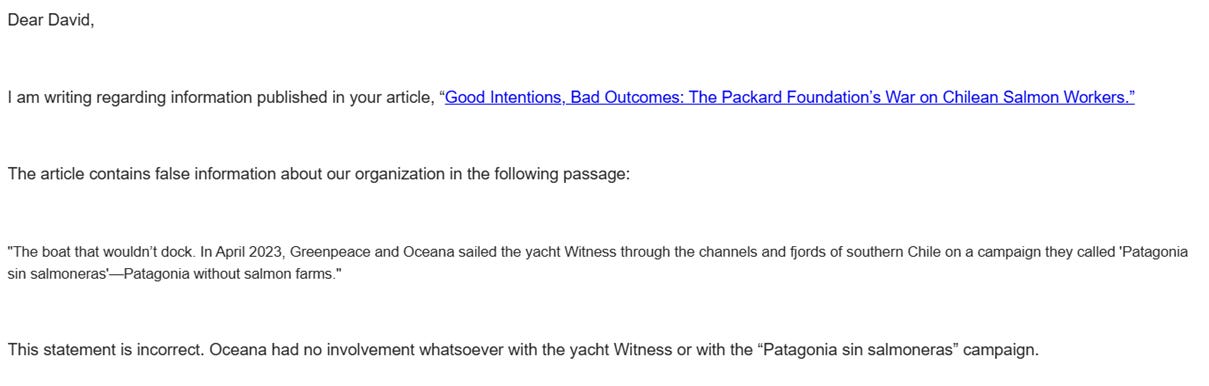
The problem is that the original story, from reporters on the ground in southern Chile, observed the Oceana activists working with Greenpeace in their anti-salmon aquaculture stunt, so we stood by our claims (as did the Chilean news organization).
But what is remarkable is that in this Firebreak article that condemned Oceana and Packard (their foundation funder pulling the strings) for unethically trying to manipulate Chilean indigenous groups in a type of green colonialism, Oceana were only contacting The Firebreak to object to us tying Greenpeace to them. In Part 1 of this series, we saw how Oceana was founded and funded by large US foundations so it seems that one of Oceana’s paymasters (Packard) was not at all pleased to see their donations being associated with the vulgar and the unethical of the campaign world. Given Oceana’s poor record of success, perhaps the foundations will need to get together again to create a new front group for their oceans campaigns.
As in past issues where Big Change foundations muscled in with their own fiscal sponsors to take control of the activist campaigns (climate, tobacco control, plastics…), we can expect these groups to offer idealist NGO activists from organizations like Greenpeace large salary packages to join some well-funded multi-sector project. While integrity may be the core to self-worth, six figure salaries are hard to resist. Why struggle on a broken-down boat for peanuts and little media coverage when you could cash in and enjoy a luxury office in Manhattan or San Francisco?
… I suppose idealism doesn’t pay the rent.
Lawyers and Lobbyists
One of the key elements in any multi-sectoral professionalized campaign is to lobby governments and influence policy. American foundations don’t question the ethical ramifications of their funds interfering with foreign government legislation or the lives of people living far from the US shores. Foundations have followed the climate campaign playbook, creating policy and intelligence platforms, stakeholder astroturf groups and campaigners speaking on behalf of indigenous tribes or other vulnerable groups. If you hide behind fiscal sponsors, regrantors and local front groups, no one will question the legitimacy of your tactics.
Packard has “invested” $3 million in Observatorio Ciudadano. This human rights group has produced, among other outputs, a real-time congressional monitoring platform — OLMar (Observatorio Legislativo para Comunidades Marino-Costeras) — that presents one side to the salmon aquaculture policy debate with congressional intelligence and technical briefing capacity that the industry and Chilean state agencies do not have in any equivalent form. Packard’s money and network are publishing two legislative briefings per week to the anti-industry anti-aquaculture coalition.
But in order to control the regulatory narrative and the information legislators are allowed to receive, the foundations also need to fund and control the media narrative, creating outrage at the grassroots level.
Bankrolling the Journalists Against Salmon Aquaculture
The Firebreak has been reporting on how foundation money has been systematically buying large media groups and developing funding mechanisms to finance journalists directly in order to control the public narrative and advance their campaigns (see here, here and here).
The billions behind the professionalized philanthropy climate programs effectively saved mainstream media groups like The Guardian and the Associated Press at a time when their old economic model ceased to exist. So it comes as no surprise that almost every news story against Chilean salmon aquaculture to have reached the Western media has some degree of special interest foundation funding behind it. These journalists for hire cannot pretend to be objective.
Some examples of how foundation-funded reporting against Chilean salmon aquaculture has helped to shape the public narrative and support the philanthropist-driven campaigns include:
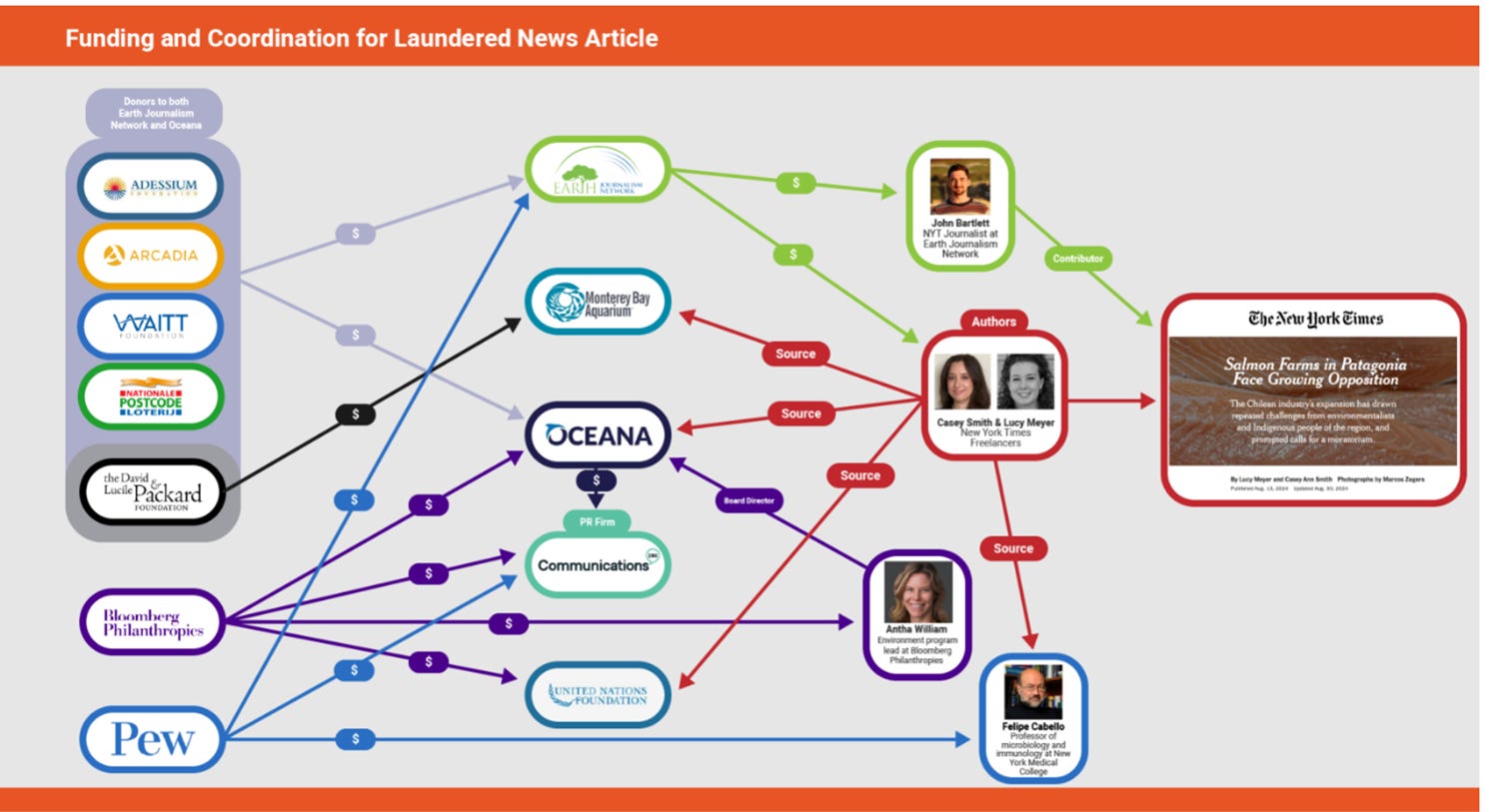
The Earth Journalism Network (EJN), a project of the nonprofit Internews, funds and trains journalists reporting on aquaculture and ocean issues, and is itself funded by Packard, among others. EJN’s own public materials describe a structured program that recruits journalists, funds their travel, and works with them to develop story angles before publication — a model EJN has publicly described as producing pieces later placed in major outlets, including a collaboration with the New York Times.
An anti-salmon farming article in the New York Times was written by two EJN freelance journalists. So the article was not only funded by Packard, but also supported the Oceana campaign (also funded by Packard). An assessment by the Chilean salmon trade organization suggested that large parts of the New York Times article had been lifted from an Oceana website. As the image below shows, there was a choreography between the foundations, their activist intermediaries and the journalists producing the article. The article was researched five years earlier but published to coincide with debates over salmon farms in the Chilean legislature. (Not the New York Times finest moment for objective journalism.) See The Firebreak’s critique of the undisclosed conflicts of interest and the weak editorial capacity at the New York Times.
The chairman of the Chilean Salmon Council USA, Ricardo Garcia Holtz, claimed: “The Times might call all this “support”, but a better word is corruption, since it violates basic journalism principles of objectivity and independence.”
JournalismFund Europe — which funded The Guardian’s 2025 attack piece on Chilean salmon — publishes grant terms requiring applicant journalists to submit a working hypothesis for their story before any research or reporting is conducted, and offers to cover logistics, legal support, and data-access costs. JournalismFund Europe’s own donor disclosures list the Open Society, Arcadia, and Adessium foundations as major funders, several of which have separately funded anti-aquaculture advocacy groups active in Chile.
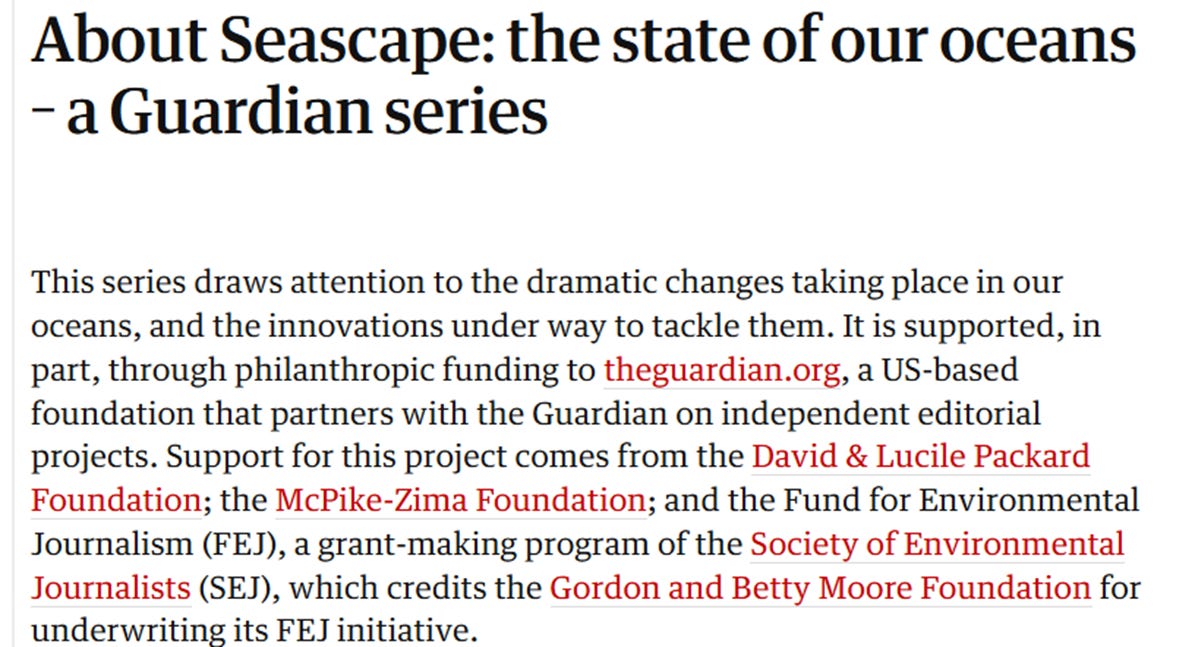
Packard has made multiple disclosed grants (2021–2024, totaling roughly $2.1 million) to Guardian.org, the U.S. nonprofit arm that funds The Guardian’s environmental reporting series. The Open Society funded the 2025 Guardian article against Chilean salmon farming. The Firebreak was one of the first to cover how The Guardian is relying heavily on foundation funding to survive, revealing how they trade ink for at least $20 million in special interest donations.
The Walton Family Foundation funded the Pulitzer Center reporting grant that produced the 2023 “Patagonian Paradise Lost“ piece against Chilean aquaculture. This project was cofunded with the Norway’s development agency, Norad, and Norway’s International Climate and Forests Initiative (NICFI). More on this in Part 3 of this investigation.
Centro Ecoceanos is an activist organization that was used as a source in both The Guardian’s 2025 Chile salmon story and the New York Review of Books piece by Ernesto Semán (more on Ernesto in Part 3). Centro Ecoceanos has received at least one documented grant from the Marisla Foundation ($25,000 for lake and river protection work in Chile).
These are some of the declared cases of journalists being paid foundation grants to produce articles, but there are many more regrantors paying out smaller amounts ($5,000 to 10,000) to freelance reporters to use their networks to shape the salmon narrative. Good money to a freelancer for a project that might take a couple weeks to put out an “investigative report” … even sooner if the script and the key campaign information is provided in advance and if the funder is also paying off the news organizations.
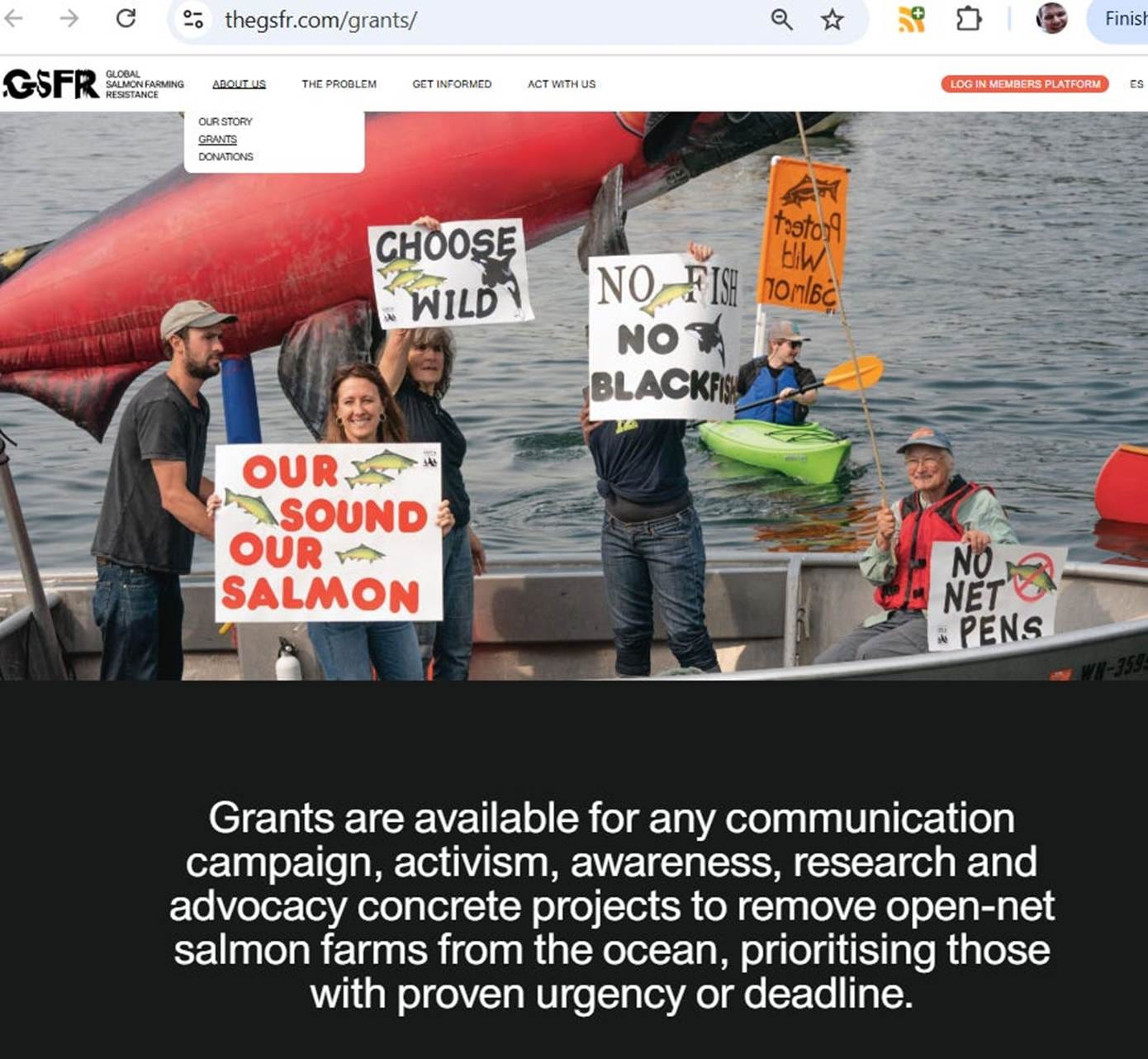
Sometimes the goal is just to move the cash to the journalists and influencers as fast as possible to get the stories out. The Firebreak reported on one curious, ragtag organization called the Global Salmon Farming Resistance claiming to protect wild salmon but the small group only seems to exist to hand out cash to anyone who will write against salmon aquaculture. Looking at the rough edges of this group, it is puzzling why most of the anti-salmon foundations fund the “Resistance” either directly or via their fiscal sponsors.
Fighting Back
Oceana and Greenpeace received a hard dose of reality against their carpetbagging campaign against salmon aquaculture when the Chilean communities who rely on aquaculture for their local economy, jobs and livelihoods rose up against them. There have been several protests in southern Chile against the political and philanthropist/NGO campaigns to ban salmon farming. At one event, drawing over 6000 people to a remote region to protest a law that would make it nearly impossible to renew farming licenses, Chilean Senator Fidel Espinoza stated:
“I hope the government realizes that these are the people who, thanks to this industry, have a source of employment and resources for their families. I am an environmental advocate, and I have always overseen salmon farming, but that doesn't mean we will approve a project of this kind, which clearly puts thousands of jobs at risk.”
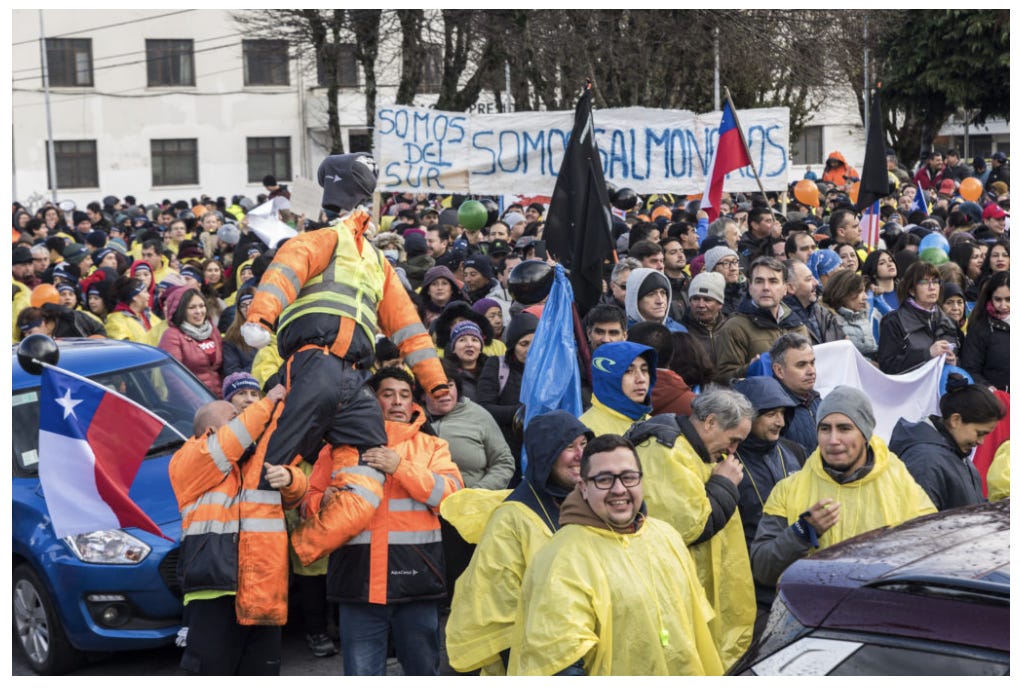
70,000 families in southern Chile are directly affected by campaigns to ban salmon aquaculture. But they are not being consulted as the US-based foundations methodically implement their political strategy.
How do local communities feel about the ocean conservation campaigns these foundations are running? In a study into philanthropist campaign tactics in Fiji and Palau, local residents were scathing about these political activists. One remark perhaps should garner some reflection from the philanthropists on how their professional consultants are behaving:
“Packard doesn’t have the stigma that a few others have. Some have been absolutely outrageous in their approach to marine conservation. Particularly, I’ll be specific in the sense and say that some of these philanthropies have actually dictated to communities what they should do without proper consultative processes without listening to the actual needs on the ground.”
It is a pity that philanthropists aren’t democratic nor listen to the interests of those communities they are harming. Such is the case in southern Chile where the livelihoods and local economies have been ignored by these coordinated, monolithic foundations. While the protests of the local communities are impressive, I fear, like so many other campaigns, they do not have the resources, the network or capacity to stand up to these bottomless activists.
Professionalized Philanthropy
Consultants managing these foundation projects are paying consultants in fiscal sponsors who set up regranting projects where those consultants are then funding consultants who pose as freelance journalists to publish reports on the foundation’s campaigns.
This is the world of professionalized philanthropy where mountains of cash are strategically directed to win campaigns that will make an impact. The consultants operating from the shadows are not idealists who believe in the goals of the campaigns, they are not working to improve salmon aquaculture, public health or the environment. Not in the slightest. They are simply an interwoven ecosystem of rent-seeking operatives filling out their timesheets with whatever opportunity they can manipulate for themselves. Today it is salmon. Tomorrow it might be microplastics, vaping or fossil fuels.
The most cynical thing about this emerging lobbying force is that the operatives continue to wield power under the pretense of virtue – they hide behind the noble gesture of representing the interests of philanthropists who are charitably donating their wealth to make the world a better place. These billionaires have either long passed or are passively unaware of how a network of political activists have moved in to take over the foundation’s granting operations. And they are using this public perception of the good foundations fighting to make the world better against an image of some monolithic, all-powerful industry and careless capitalism.
But the David v Goliath narrative is the inverse. These local entrepreneurial salmon farmers from these small communities are struggling to survive and provide consumers with affordable, healthy food while an army of activists, lawyers, lobbyists and reporters parachute in with unlimited funding to define the issue and control the debate.
Why doesn’t the media report on this dark alliance of fiscal sponsors behind the anti-salmon campaign, being fed hundreds of millions of dollars from foundations managed by political activists? Perhaps given the foundation media funding strategy, their editors could not afford such objectivity.
These salmon farmers are fighting a manipulated narrative, a well-funded political machinery and a seemingly unlimited number of NGOs mysteriously mushrooming up around small ports in southern Chile with more money than common sense. What could possibly be worse for these struggling farmers? Perhaps only if other governments (with competing salmon operations) joined in on the Chilean aquaculture onslaught.
That is the subject of the third part of this investigation.