


Aquaculture has always been a curious activist campaign arena. While environmental NGOs have entered their third generation of campaigns on ocean protection and over-fishing, health NGOs have regularly extolled the virtues of seafood as a healthy, less carbon-intensive source of protein. Thus aquaculture or fish farming has grown to address these issues, in particular, salmon farming. Today salmon is only abundant and affordable to consumers thanks to innovations and investments by the aquaculture communities.
It should come then as no surprise that there are a growing number of campaigns against fish farming. Health activists now are questioning the health benefits of farmed fish and highlighting unknown risks from vaccines, antibiotics or GMO feed. Animal rights groups protest the conditions in the fish ponds, tanks or cages. Meanwhile environmental activists have taken aim, particularly at the impact of salmon farms on the seas and shorelines. All of these groups do agree on one issue: their contempt for big business, technological investments and capitalism.
Although these campaigns have been running for decades and most consumers remain largely ignorant of the activists’ issues, something important has recently changed. With hundreds of millions of dollars of foundation funding now flooding into the anti-salmon activist campaign coffers, into media groups and into the courthouses, attacks on salmon farming are now gaining attention.
Will this expensive narrative shift improve the state of the oceans or lead to better salmon on your plate? Of course not. It will merely demonstrate how activist consultants who have professionalized the philanthropy world can wield control and power in the policy-activist-media arena. See a recent article on how philanthropy has professionalized over the last two decades.
This Firebreak series will show how the campaigns against salmon aquaculture, particularly in Chile, have been professionalized by large, mostly American, foundations. It will be important to see how these foundations have taken over the execution, coordination and content of the anti-salmon farming campaigns. Part 1 will survey the foundations funding the anti-salmon campaigns. The second part will look how the foundations will use fiscal sponsors to fund anti-aquaculture lobbying and media campaigns against salmon farmers. The Part 3 will look at foreign government interference in the Chilean aquaculture industry while the Conclusion will look at foundation funding of relentless lawfare and a new brand of American philanthropic colonialism (funding opportunists from indigenous tribes to speak out against local Chilean salmon groups).
From Rags to Riches
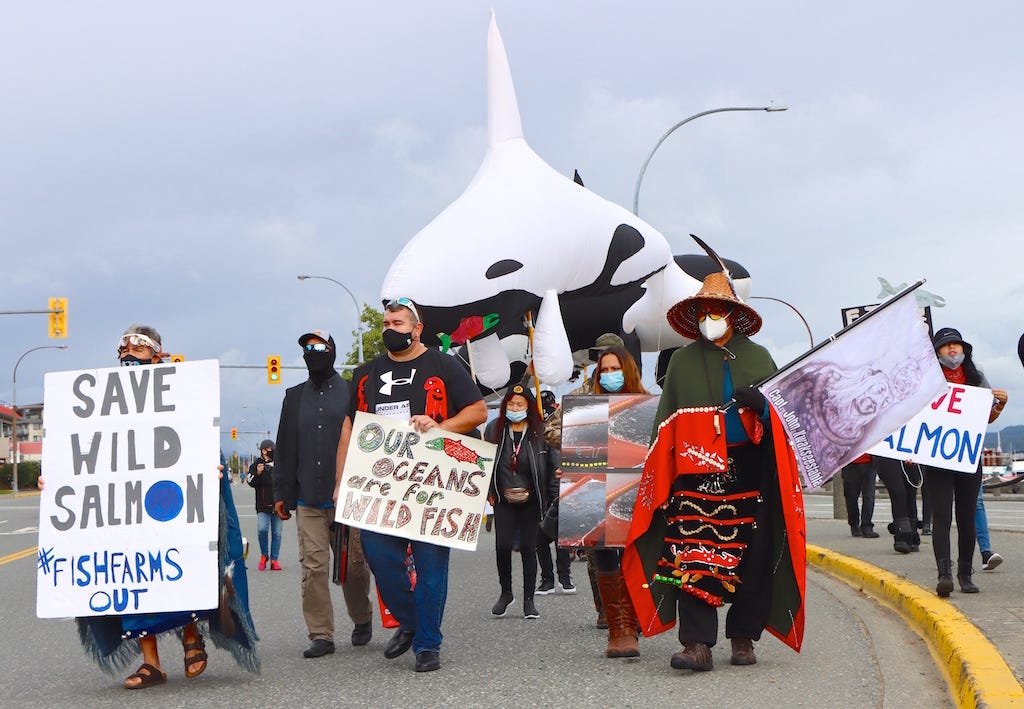
In the 1980s, small local groups started to protest salmon farming by sending a few volunteers in dinghies or kayaks to unfurl banners along the shoreline. The early issues were namely about their concern over escaped salmon and a preference for wild, caught fish. They made their point (but not an impact) on the growing business of aquaculture as a response to regulations to protect wild fish stocks from over-fishing. These protestors were passionate, but they did not have funding, political networks, influencers, media access or legal support.
The NGO campaign model in the 1990s-2000s was built on public donations. So if the public wasn’t interested in the consequences of the activism, like restricting car use or air travel, they wouldn’t donate and without money to fuel the campaigns, there would be no impact. People were not interested in paying double the price for wild salmon so the anti-aquaculture campaigns did not raise sufficient contributions to get off the ground. But with the four wealth creation waves of the last generation (providing a large number of Internet, Web 2.0, crypto and AI billionaires), new foundations, professionalized along venture capital models, started to coordinate impact campaigns. Without much effort, these tie-dyed hippie anti-salmon campaigners were suddenly swimming in cash.
Less than a decade ago, when a professionalized group of foundations entered the debate, particularly in Chile, they brought with them their captive media, lawyers, influencers, consultants and an unlimited pot of money. Almost instantly, the salmon farming debate evolved from a question of providing an affordable, sustainable source of healthy protein to an industry fighting for its survival.
Limitations
Before this series gets into the ethics of the foundations’ tactics, the first part will survey the key foundation actors and the funding they are pouring into a campaign that should never have been given the time of day. While there has been evidence of large philanthropic contributions shifting the narrative against salmon aquaculture in areas like Tasmania, Scotland and British Columbia, this series will focus on the campaign tactics used against the Chilean industry. Half of the farmed salmon sold in the US comes from Chile, with 90% of all seafood sold in the US being imported (a $20 billion trade deficit according to the US government).
Much of the data in this series comes from IRS Form 990 filings, foundation grant databases, published grant documentation, Chilean congressional records, Norwegian government agency disclosures, and public reporting. But the numbers are likely gross underestimations given how foundations are rarely transparent about their funding programs and the consultants driving the operations often try to hide the level of their involvement in campaigns by creating fiscal sponsor front groups or channeling special interest spending through dark, donor-advised funds. Also there are often three or four foundations working together combining funds and resources into larger programs further distorting the money trail.
So while the Firebreak exposé will only be scratching the surface of philanthropic intervention to destroy an industry and harm consumers’ access to healthy food, it should be enough to put into perspective how billionaires have been willing and able to let those activists who have moved into their circles distort markets and economies. The reader is invited, at every million dollar figure quoted in this section, to ask what good this money could have done if it had been donated to organizations truly in need and capable of actually doing something beneficial for humanity.
The Foundations Spawning Dissent
Here is a quick overview of the different (mostly US-based) foundations that have been actively interfering with Chilean salmon aquaculture.
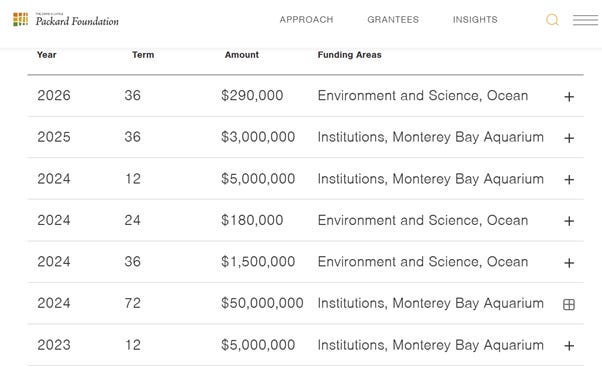
The David and Lucile Packard Foundation (between $26 and $480 million): the Packard Foundation has publicly characterized its Chile ocean conservation spending since 2008 as $26 million. But as an article by Marc Gunther in Inside Philanthropy has pointed out, that clearly is an understatement. Their real commitment includes a significant part of their $480 million ten-year (2023–2033) Ocean Initiative strategy. Chile is named as one of four global priority countries (alongside the United States, Indonesia, and China).
Packard has also contributed $81.8 million across 26 grants to the Monterey Bay Aquarium Foundation, an organization that has actively supported groups campaigning against Chilean salmon farmers. Monterey Bay is so much more than an aquarium; it acts as a lobbying force and also operates the Seafood Watch consumer ratings program, which has repeatedly assigned ‘avoid’ ratings to Chilean farmed salmon.
In 2019, the Packard Foundation set up the Chile Marine Strategy stating:
“The total annual philanthropic investment for marine conservation in Chile approached $8 million in 2018, including a long-established program of Marisla Foundation and new investments from the Walton Family Foundation and Pew Charitable Trusts, among others. The Chile Marine Strategy is designed to complement much of these existing investments.”
On salmon in particular, the Packard Chile Marine Strategy report states: to “help address the expansion of salmon aquaculture in Patagonia, the Foundation facilitated development and use of new platforms for improved civil society access to information related to the salmon industry’s activities.”
Their position on salmon aquaculture is clear: “Salmon production’s expansion into southern Patagonia and its associated impacts are a primary environmental concern: dozens of concessions are in various stages of development and approval.”
Veteran reporter and philanthropy researcher, Marc Gunther, recently wrote about Packard’s interference regarding Chilean salmon aquaculture.
Packard also work with the Gordon and Betty Moore Foundation and again with the Walton Family Foundation in the SALT program: A Global Alliance for Sustainable Fisheries. But the Moore Foundation is more active in campaigning against salmon aquaculture in British Columbia (again with Packard) where Leonardo DiCaprio offended a large number of first nation tribes with his carpetbagging ignorance.
A curious side note: Christy Walton (daughter-in-law of Sam Walton) owns the aquaculture investment group Cuna del Mar whose portfolio includes Innovasea, Blue Ocean Mariculture, and Open Blue Sea Farms. Walmart still needs its fish.
A new player in the debate: Re:wild: The Leonardo DiCaprio Foundation was wound down in 2021, joining the Global Wildlife Conservation and rechristening themselves as Re:wild (2025 IRS 990 Form declares a revenue of $75 million). Tompkins Conservation has joined Re:wild via the Global Rewilding Alliance and has been rebranding its operations. The Tompkins Donate page states:
“The teams in Argentina and Chile with whom Tompkins Conservation has worked for decades are now independent organizations: Rewilding Argentina and Rewilding Chile. ... Tompkins Conservation continues to be a strategic collaborator of both organizations.”
Re:wild is now managing Tompkins donations as its fiscal sponsor.
The Tompkins family has had close ties with Patagonia: Kris was the longtime CEO and co-founder of Patagonia Inc, and Doug was co-founder of The North Face and Esprit. Doug died in southern Chile in 2015 following a kayaking accident while Kris has remained president of Tompkins Conservation where she has been campaigning to remove salmon farms from the Chilean coastline. Rewilding Chile is a partner with the Blue Marine Foundation campaign to rewild the fjords in Southern Chile and is involved in many other anti-salmon aquaculture actions (including with Oceans5 - see below).
The Fog of War: Coordination Vehicles
It would be reasonable to expect just one foundation funding one of the large NGOs campaigning to stop Chilean salmon aquaculture. To the contrary, the main NGOs are sidelined while the foundations run coalitions of campaigns: intertwined and expansive. It gets even more complicated when the foundations set up coordination vehicles to operate in concert. The funders themselves describe it as “coordinated, strategic grantmaking”.
There are three such organizations focusing on campaigns affecting Chilean salmon aquaculture.
Biodiversity Funders Group (BFG) defines itself as a place “where experienced philanthropists from around the globe share ideas, hone their strategies, and find partners and mentors.” They set up the Chile Conservation Funders program where Packard has paid $370,000 across three grants (2020, 2022, 2024). The Walton Family Foundation separately funds the same BFG program, contributing $122,000 across two grants in 2023. They use the BFG to meet to coordinate their campaigns.
Patagonia Mar y Tierra coalition: The Pew Charitable Trusts launched an nine-organization working group in December 2018 to align conservation strategy across funder and grantee lines in Chilean Patagonia. Three coalition members — Melimoyu Foundation, Terram Foundation, and WWF — have been actively campaigning against Chilean aquaculture.
Bloomberg Philanthropies’ Ocean Initiative: Launched in 2014 as a $53 million, five-year commitment (then known as the Vibrant Ocean Initiative), the program named Chile as one of its three original priority countries — with Brazil and the Philippines — for fisheries-policy reform, marine protected areas, and fishing-transparency legislation. In 2019, the initiative was expanded with a budget of $260 million. Like other Bloomberg Philanthropy initiatives, they fund or create NGOs/foundations to implement their strategy.
Bloomberg’s initial Chilean implementing partner is Oceana which was itself created in 2001 through the coordination of The Pew Charitable Trusts, Oak Foundation, Marisla Foundation, Sandler Foundation and the Rockefeller Brothers Fund. Oceana’s latest IRS 990 form shows that it had raised $53 million in 2024 with an undisclosed amount regranted to other NGOs. It now receives funding from 23 large foundations, including all of the foundations mentioned in this section. (Part 2 of this series will look at one of Oceana’s anti-aquaculture campaigns in Chile and ask if this was money well spent.)
It should be added that one of the groups receiving Bloomberg funding is Oceans 5, a collaborative regranting foundation set up by 14 large foundations, including all of the foundations mentioned in this section. Their fiscal sponsor is Rockefeller Philanthropy Advisors which raises $20 million a year from 30 foundations for this activist construct to regrant for activist campaigns. They worked, for example, with Rewilding Chile to try to stop salmon aquaculture.
These coordination vehicles, with multiple foundations working in tandem, makes it difficult to gage just how much foundation funding and networks are finding their way into campaigns to stop salmon aquaculture, but it is safe to assume it is in the tens to hundreds of millions of dollars. When philanthropies professionalize and coordinate strategies, their goal is to win, not to be transparent.
Part 2 of the Chilean Salmon War will look at how these foundations use fiscal sponsors to further distort their level of influence and how their campaigns use the millions pledged to broaden into media campaigns, lobbying and lawfare activities. In seeing the magnitude of the foundations’ relentless David vs Goliath onslaught, it will become clear that salmon aquaculture, particularly for Chilean farmers, never stood a chance.