


Activists, environmental campaigners and social NGOs used to fall under a class of stakeholders representing the non-commercial, non-governmental population. But in the last decade, with increased funding and influence, they have become a powerful movement controlling Western societal narratives, driving change campaigns beyond anything their founding activist idealists could have ever imagined.
With tens of millions in foundation funding and fiscal sponsor participation, with programs coordinated with the litigation industry and with a disproportionate influence on the media, academe and regulators, these change leaders could no longer be called NGOs. I coined the term: APEs (Alternative Policy Enterprises) to reflect how they have become a big business and could not be considered like other humanitarian NGOs and civil society groups committed to helping others. And to reflect their excessive size, like Big Pharma, Big Tech, Big Tobacco … this movement should be called: Big Change.
What follows is a three part series on Big Change. This article will introduce the term. Part 2 will look at how Big Change grew out of the climate change campaign, and why that campaign had failed. The conclusion will look at whether the Big Change campaign for a food system transition will meet the same fate as the climate campaign demise.
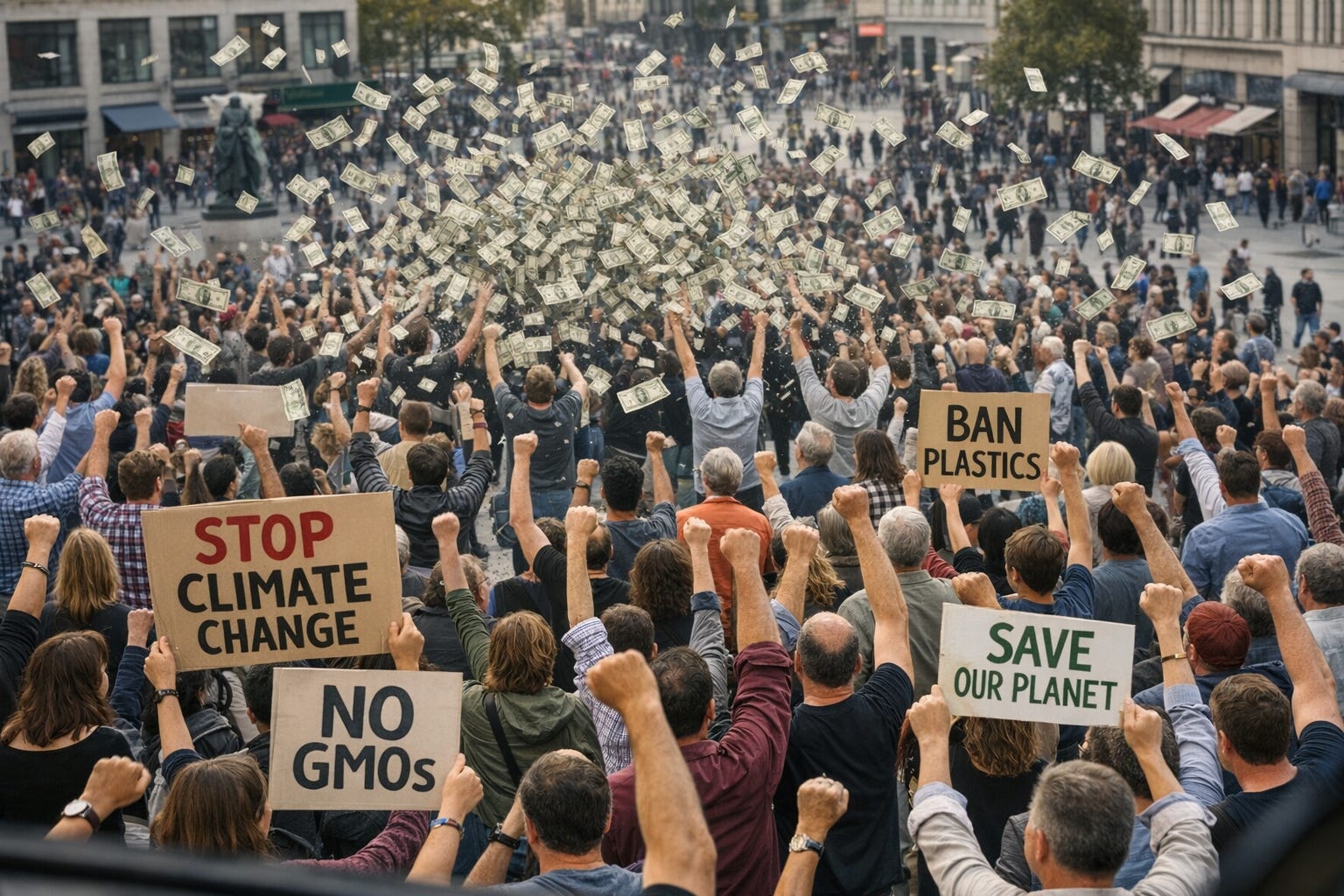
Big Change
Big Change refers to an industrial-grade complex of activist forces and interest groups that implement continuous transition strategies to attain massive social, economic and political disruption. It has become a force seeking to dominate and control human behavior through their transformation of society. As a movement, Big Change does not seek consent, but rather, out of a sense of urgency, it imposes restrictions upon its publics.
They used to be a fringe movement of a handful of environmentalists climbing smokestacks and shouting outside of offices, but then, shifting to a foundation-funded model, their budgets increased exponentially, allowing them the cash to integrate media and academics into their campaigns. Activism is always about change and as the activist movement grew more powerful, more influential and more wealthy, it became Big Change. Now, standing beside their foundation billionaires, law firms and interest groups, they give speeches at UN conferences, Davos forums, US Congressional hearings and European Parliament meetings.
The narrative of Big Change is continuous transition away from the societal norms and laws, and it purveys most policy dialogues today. The world is changing at an incredible pace so we need to change or die. These campaigners are not looking at incremental change, but always revolutionary, systemic change.
“Transition” is the keyword used by Big Change campaigners.
On energy, they have attempted to impose a transition away from fossil fuels.
On chemicals, Big Change have used fear campaigns to transition toward “nature-based” alternatives.
Conventional farming is coming under intense pressure from Big Change, working with Big Organic to restrict farmers’ ability to use synthetic pesticides, fertilizers and gene-edited seeds. A transition to agroecology is their only solution.
Big Change wants to impose transitions away from livestock farming as well as putting arbitrary llimits on most food processing technologies.
On economics, Big Change wants to see a transition from growth, global trade, capitalism and industry.
We need a “happiness index” instead of a GDP growth metric, they argue, and Big Change won’t be happy until capitalism is dead and their degrowth strategy is adopted. This is extreme-left socialism – Marxism without the proletariat. The wealth and technology that capitalism has produced will be redistributed: industry without factories, produce without production, work without labor… I once called this “Foundation Capitalism” but it is something far larger than just the inside influence the activists have on a handful of billionaires.
This is no longer a movement of tree-huggers with clipboards seeking donations from passersby on sidewalks or telemarketing for membership dues. That 1980s financing model is long gone. The Firebreak has been cataloguing some of the revenue streams Big Change has been non-transparently amassing.
We translated an investigation by Florence Autret on the European Climate Foundation, an NGO that earns over €270 million per year they then quietly redistribute to almost every European NGO working on climate change campaigns.
The Firebreak showed how the Agroecology Fund spends over $100 million a year advocating (ie, lobbying) against conventional farming practices. We had to go to the foundation pages to track the amounts as the Agroecology Fund a) does not exist as a legal entity, and b) does not, therefore, have to disclose its balance sheet.
Bloomberg Philanthropies has created a flotilla of Big Change NGOs to fight, on behalf of the WHO, against tobacco harm reduction products like vaping and nicotine pouches. With $1.6 billion in funding (plus an extra $400 million committed) this is a classic textbook case study of how these Bloomberg NGOs are no longer merely stakeholders.
Michael Bloomberg has also created operations like Beyond Plastics and Beyond Petroleum to lobby against plastics and fossil fuels. He has reportedly donated at least $85 million, with more from other foundations, but as he set them up via fiscal sponsors, where neither campaign operation is a legal entity, the actual income and campaign expenses remain in the dark.
Big Change prefers to operate with Big Secrets.
Idealists and Pragmatists
Idealists speak of values to guide their decisions. Pragmatists look for the best practical answers to solve the problems we face. Nature/natural is a strong value for the activist community, so these idealists will impose preconditions like:
farmers only being allowed to use natural-based pesticides even if synthetic alternatives are more efficient and better for the environment.
Natural products like steel and glass are favored over plastics even if plastic alternatives have been found to be more sustainable in almost all applications.
Solar and wind are seen as nature-friendly forms of energy regardless of the horrible environmental impacts of their production and the limitations to their power generation.
The values guiding Big Change are held as immutable, regardless of the negative consequences of their implementation. In other words, Big Change is a movement run by zealots more concerned with winning (imposing their changes) than making progress or improving human well-being or the environment. Transparency and honesty are not important values for Big Change activists.
While it is clear that pragmatists should have long-term goals supported by a commitment to shared values, they serve as guidance more than diktats. Where situations change, as they often do, or alternatives prove to be less efficient or appropriate in certain conditions, then the values of flexibility and pragmatism should influence the decision-making process.
As discussed in an earlier article, there is a significant difference in how Big Change understands transition compared to industry.
For the idealists and activists, transition is certain and urgent, with change to be implemented as soon as possible. It is not a process for improvement but a euphemism for revolution. And once Big Change launches a transition campaign, there is no going back, no room for discussion and no compromise.
For industry, transition is a progressive evolution of change built on innovation, development and continuous improvement (product stewardship). Like activists, industry is very interested in reducing energy costs and pollution, but this does not mean they force an arbitrary transition to meet some ideological dogma. They are pragmatic and seek progress and evolution rather than disruption.
Change as progress is a force for good providing societal benefits. Change as a political strategy is a force for power demanding societal sacrifice. Big Change is about power and control.
The next article will look at how Big Change met hard reality on their climate and energy transition campaigns. It will examine some of the main integral failures of Big Change.