


Summary
Strategic litigation is the latest evolution in the collusion between NGOs, journalists, foundations and the litigation industry.
It allows special interest groups to fund and participate in anti-corporate campaigns without transparency or accountability.
The Lighthouse Reports Poison PR investigative report is a case study of the vicious underhanded tactics used by these special interests to attack industry.
An author of the Poison PR report will be presenting this case study next week at a public webinar on the benefits of strategic litigation.
Ten years ago, when I started writing SlimeGate, many in the activist NGO world felt uncomfortable about getting into bed with these slimeball tort lawyers. While the “enemy of my enemy may be my friend”, some activists were having misgivings about cooperating with a faction of the legal profession that would use NGOs to help them extort companies, not for justice for plaintiffs, but for massive wealth accumulation, private jets and personal excess. How far were these idealists willing to look the other way in order to score a victory against industry, raise funding and enforce positive change for the environment? In the last decade, the answer became clear: Very far!

I have watched the evolution in the activist-Predatort nexus, particularly during the glyphosate saga.
Early on, groups like Corporate Europe Observatory were using activist scientists like Chris Portier to write reports for them on the risks of glyphosate, knowing full well his services were paid for by the law firms suing then Monsanto and later Bayer.
Then NGOs like Friends of the Earth started coordinating their glyphosate lobbying efforts with key beneficiary law firms like Wisner Baum.
It didn’t take too long after for the US litigation industry to start paying off NGOs, reporters and filmmakers to do their bidding, via non-transparent donor-advised funds, as in the funding behind the Into the Weeds campaign.
Funding activist scientists like Philip Landrigan and Chuck Benbrook to produce court-ready evidence was seen in the financial malfeasance of the Heartland Health Research Alliance, a non-profit set up by the US litigation industry to channel millions into fabricating research to be used in NGO campaigns and further lawsuits.
At this point no one in the civil society movement had any qualms about receiving Predatort millions via foundations functioning as pass-throughs. The passion for the planet was taken over by the passion to win, and these modern-day Machiavellians were wickedly efficient. The money was too good for any ethical introspection and without transparency or public scrutiny, activists found they could say and do whatever they liked.
But if it had only stopped there…
Strategic Litigation
Two years ago, the deepest moral decline of the environmental activist profession was put in evidence, and next week we will be witnessing the instigators boasting about it. The Lighthouse Reports affair showed law firms working directly with journalists, NGOs and foundations to put one of their political adversaries out of business in the hopes of advancing a lawsuit on paraquat. This is an example of strategic litigation, and one of the perpetrators is presenting it as a case study at a webinar next week to train other activists.
Strategic litigation (also called “impact litigation”) is the weaponization of the litigation industry to effect change on industries, governments and public perceptions. Born from a La Jolla conference in 2012, the brainchild of Naomi Oreskes’ tormented mind, the strategy was to circumvent the regulatory process (seen as poisoned by lobbyists) with their alternative, later referred to as adversarial regulation. This approach was built around a litigation-led campaign attacking a targeted industry or product. The goal is to use relentless lawfare assaults to effectively tobacconize other industries, destroying their reputation, market and business model (suing them out of business or into submission). There was no need to engage in the messy (albeit democratic) business of regulatory change. Some people call this extortion; Naomi referred to it as “progress” (and personally lucrative).
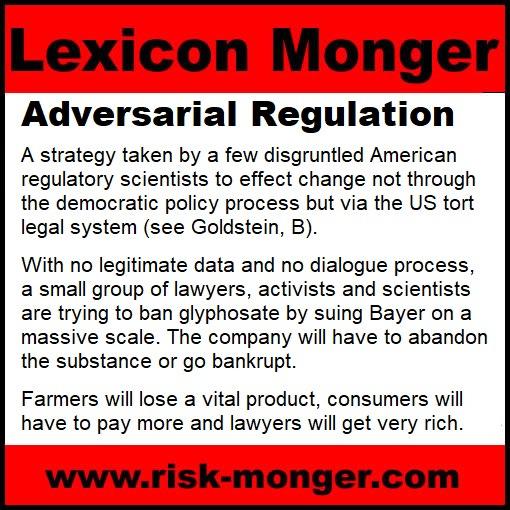
Fourteen years after La Jolla, it is no longer a convenient coincidence when activists, foundations and law firms have the same goals. Now these campaigns are coordinated with clear strategies and gameplans from the outset. Imagine an activist consultant working for a foundation (or developing a dark fiscal sponsorship organization from a group of foundations), coordinating a multi-pronged attack on a company or regulatory body via a group of NGOs and law firms.
The collusion can take many forms.
Dark subterfuge
These campaigns would usually go under the radar as none of these groups feel the need to be transparent or accountable. Consultants who have worked their way onto foundation boards can act like generals stealthly commanding a flotilla of NGOs. A good example was when the provincial government in Alberta, Canada had to conduct an inquiry with a forensic accounting expert to learn how far these dark forces had gone to obstruct economic affairs in the province (NGOs spent at least 1.28 billion CAD in foundation funding that had “lost its character”). The media, mostly funded by these same foundations, ignored the government’s findings.
Fiscal sponsors
The fiscal sponsor may create its own NGO-like organization to spearhead the campaign (ensuring that the campaign group is not filed as a legal entity to avoid transparency and accountability requirements). The law firms will share their network of scientists, serving as highly-paid litigation consultants, to publish papers to raise doubt about the issue at hand. This was Glyphosate 101. These papers as well as the overall campaign are then amplified by foundation-funded media groups and investigative reporters.
Dark, donor-advised funds
Depending on the potential for payouts, law firms may fund the campaign via dark donor-advised foundation funds (as in the Heartland Health Research Alliance) or the foundations may fund multiple dead-end lawfare assaults on targeted industries, not to win but to merely extract reputational damage to feed into a larger campaign (as seen with Sher Edling or Earthjustice).
Global, transnational reach
As an added touch, this unholy alliance can foster its influence (scientists or foundation funding) into UN bodies to drive another regulatory angle (seen with IARC, the FAO, UNEP and the WHO). The UN conference mill is now captured by the foundations, activist scientists, NGOs and specialty media groups.
Strategic litigation has delivered dividends for a wide range of activist campaigns like those against glyphosate, plastics and microplastics, fossil fuels, salmon farming but the playbook is rarely openly discussed by its perpetrators. That is why next week’s webinar on Strategic Litigation will be interesting.
The Lighthouse Laser Beam
The Lighthouse Reports’ Poison PR investigation is a case study of the backhanded dealings of the NGO, media and foundation special interests covertly working with the US litigation industry in a coordinated assault on a small communications firm. It was driven by law firms attempting to create public outrage of corporate malfeasance as they launched a large number of paraquat lawsuits.
This jury priming tactic (creating anti-industry outrage) was used successfully with the release and promotion of the Monsanto Papers during the glyphosate lawsuits and attempted with Oreskes’ Exxon Knew campaign to link the fossil fuel industry with the consequences of climate change. But this story has an ethical taint that makes the perpetration of the Poison PR campaign even more repugnant.
The Lighthouse-Predatort alliance started when a group of US tort law firms, including the Miller Firm, obtained a series of documents in discovery from Syngenta related to their paraquat activities. They leaked the confidential documents to the Environmental Working Group activist and self-proclaimed “journalist”, Carey Gillam, who claimed she woke up one morning and discovered 10,000 files in boxes outside of her front door.
The Miller Firm has had a longstanding relationship with Gillam, using her to amplify the release of the Monsanto Papers during the bellwether glyphosate case, to which both parties profited handsomely. She also orchestrated a character assassination of Tim Litzenburg when he was challenging their glyphosate evidence (as not actually the main cause of the plaintiff’s cancers) so she has proven to be very efficient at hiding the knives. Gillam promptly published the leaked documents on the EWG website, calling them the “Paraquat Papers” (evidence enough that Carey had exhausted any remaining creative inspiration).
The documents themselves had limited value for the class action suits being gathered against Syngenta, but they revealed a relationship between the company and a small communications firm, v-Fluence. The firm, with 28 employees, was known for its daily Bonus Eventus newsletters that documented activist strategies and campaign events, offering ag-tech and food industry actors a window on their tactics and advice on how to manage the issues.
The story from the leaked documents was not about paraquat (the evidence of a link to Parkinson’s was very weak) nor about Syngenta (who had followed their ethical codes of conduct), but instead focused on how v-Fluence had been internally sharing some of the negative published media about activists, including Ms Gillam.
Gillam took the confidential discovery documents to Lighthouse Reports, a Dutch non-profit mercenary group producing investigative reports at the behest of any special interests that would fund the NGO’s publications. (They call it “collaborative journalism”.) In other words, Lighthouse Reports is another one of those “Reporters for Hire” groups feeding off of foundation funding to publish bespoke investigative journalism attack pieces. For their Poison PR investigation, they assembled a group of reporters from across the globe (essentially eight freelance journalists who had been sharing each others’ anti-industry hit-pieces).
Lighthouse secured funding from the Oak Foundation for this campaign, totalling at least €800,000. Oak has a clear strategy of funding campaigns against industry, promoting agroecology and attacking conventional agricultural practices. The foundation also provides a dark donor-advised funding mechanism (a funding pass-through) so we really cannot say which special interests were behind this report. Needless to say, Lighthouse Reports activists were drunk with cash as both Carey Gillam and Margo Gibbs (based in Amsterdam) had offered to fly to St Louis to personally interview the v-Fluence managing director (see mail below). They even hacked into the closed Bonus Eventus website.
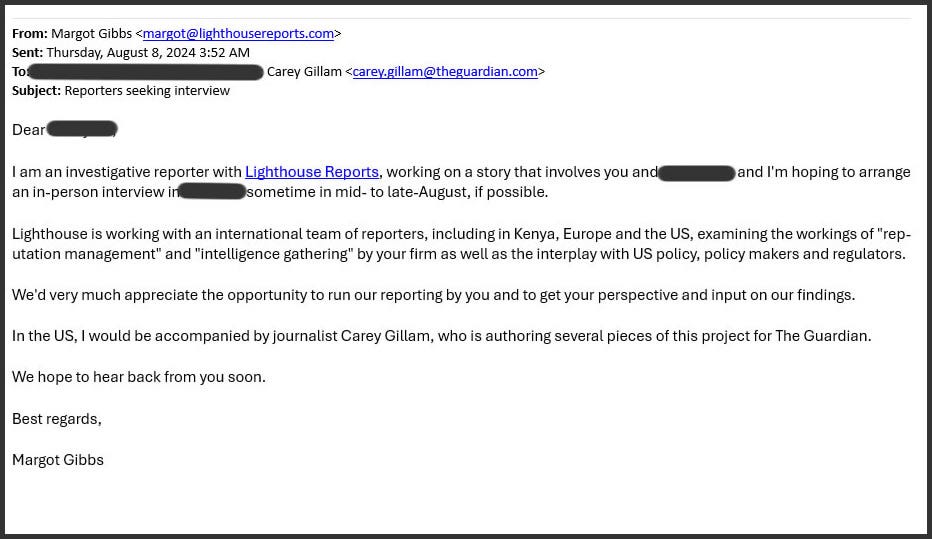
The Lighthouse Reports investigation into this small communications firm was merely the first step in this strategic litigation exercise. Law firms from the US and Europe then started to file lawsuits against v-Fluence, demanding disclosure of all correspondence and documents. Cases were then filed against their clients, ensuring an exodus that would bankrupt the firm. The efficiency of these relentless attacks on a small firm like v-Fluence was brutal, vicious and vindictive.
Meanwhile, the network of journalists amplified the investigation for several months, hoping to snowball the claims against this small organization into a mass global outrage event as the paraquat bellwether lawsuits were being heard in the US. Domiciled in Brussels, I was on Le Monde activist, Stéphane Content’s dance card (but I ignored his correspondence as he had broken at least eight of Le Monde’s ten ethical codes of conduct).
Celebrating Failure
This was definitely not a Monsanto Papers success story. The Lighthouse Report investigation did not reveal any large exposé of corporate corruption. They spent a lot of money and made a lot of noise, but the then ongoing paraquat bellwether cases were thrown out on the basis of bad science. The judge not only dismissed the poor research, she referred to how the litigation consultant “required several methodological contortions and outright violations of the scientific standards he professed to apply”.
Unlike glyphosate, the law firms could not use outrage as a substitute for scientific evidence. The only thing the law firms, working in tandem with the reporters, activists and foundations, had achieved was bankrupting a small communications company (and a reminder, if we needed one, of how weak and cowardly industry trade associations like CropLife America have become).
Despite its failure and evidence of a tired gameplan, the Lighthouse Reports’ tactics show the dark underbelly of activist collusion with the litigation industry. See my critical analysis of the Lighthouse Reports investigation here. There was no transparency (essential for reporters) but rather a concerted effort by law firms, foundations and the journalists to hide their sources, funding and evidence. They hacked, lied and cheated to get their story out.
But their story was a nothing burger.
The intention of creating another ExxonKnew or Monsanto Papers campaign to cultivate jury outrage to augment court payouts and increase the chance of settlements (extortion) in tens of thousands of paraquat lawsuits were weak when the only case they had was a communications firm that was sharing published documents of activist tactics. If vengeance is a measure for success, then Carey should be proud.
Strategic litigation is one more weapon in the activist arsenal to spread distrust, outrage and disinformation against industry. When law firms hire activist zealots to do their dirty work, they are getting value for money. When NGOs get in bed with these slimeball Predatorts, they surrender all integrity and self-respect. It is a toxic activist tool that should only be exercised out of desperation. But now NGOs and foundations seem to use it as their main campaign strategy.
Next week, one of the authors of the Lighthouse Reports Poison PR publication, Thin Lei Win, will proudly present this case study at a webinar on strategic litigation. I’m looking forward to learning how she sleeps at night.
You can register for the strategic litigation webinar here.