


This is Part Two of a three-part series on the Plastic Fear Complex looking at how plastics are being positioned to be the next global crisis, following the climate change playbook of controlling the narrative and fabricating fear. Part One looked at how media groups are starting to finally wake up to the nonsense published by activist scientists about the faux risks of microplastics. This section will look at one case of a large foundation pumping millions of dollars to fund activist science publications, NGO campaigns and media reporting against plastics. Part 3 will be a review of a foundation-funded anti-plastics lobbumentary just released on Netflix as a case in point of how facts don’t matter when emotional, anti-industry campaigns have unlimited funding to control what the public perceives.
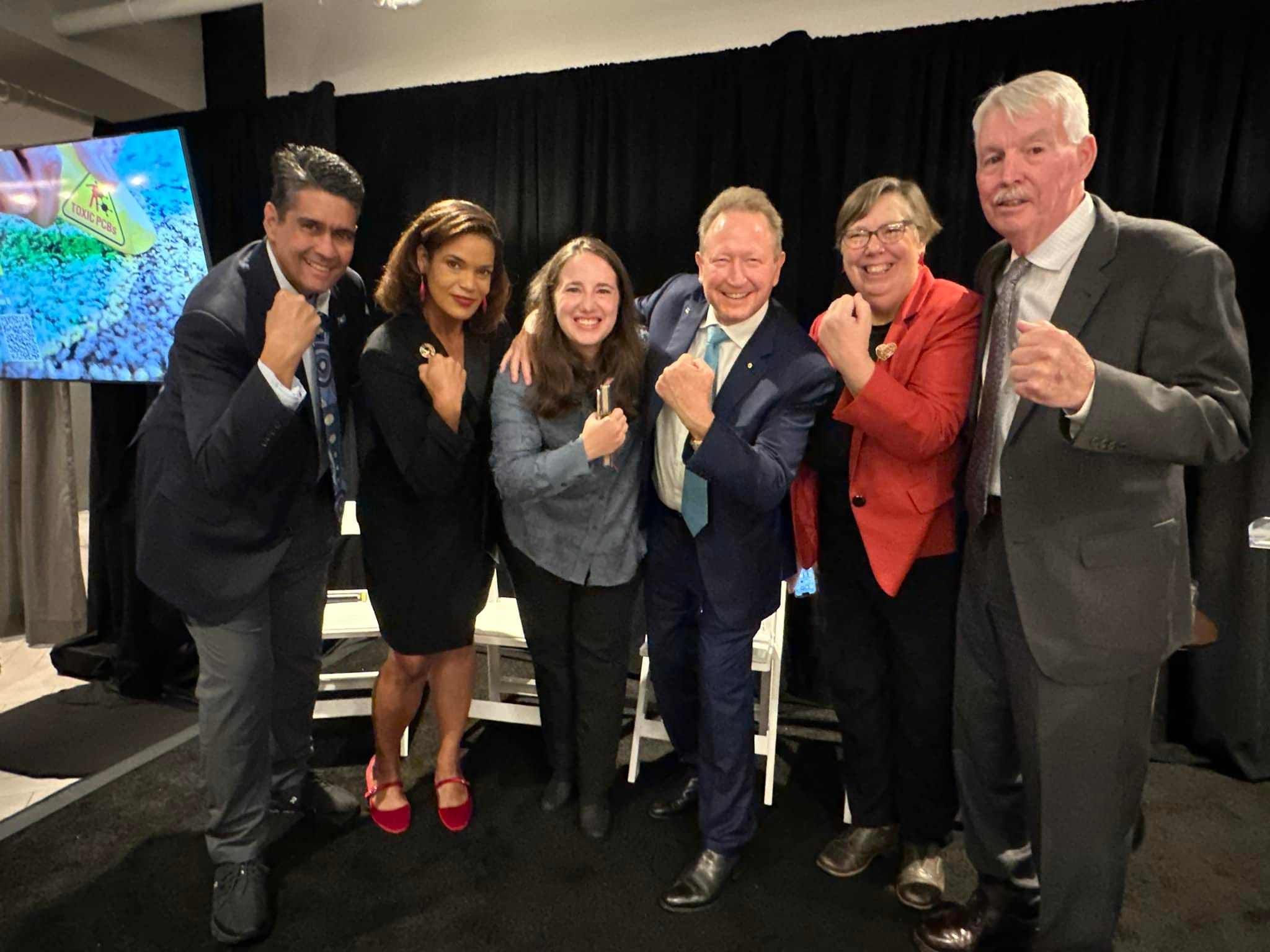
To lead an environmental health crisis campaign today, you need to create an academic body or group of scientists, gather them together to declare a consensus and actively demand a list of solutions. This is the basis from which media, NGOs and ad hoc international committees in the UN can be formed to demand this change. As scientists don’t come cheap, this costs money and relies today on foundations willing to commit long-term funding and engagement in pursuit of change and some idealized transition. The Plastic Fear Complex has all of these elements.
Many large US foundations have been bankrolling the activist scientists publishing poor research questioning the safety of plastics, connected media reports, NGO campaigns and international organizations like UNEP’s Ban Plastics conferences. These NGOs include the Rockefeller Foundation, Ellen MacArthur Foundation, Pew Charitable Trusts, Bloomberg Philanthropies, Oak Foundation … But there is a new, scrappier Australian foundation now financing the Plastic Fear Complex and this article will focus on the quality of their activism.
Whenever there is a large academic commission or conference on an upcoming environmental health “crisis” (often promoted by predatory opportunistic journal editors like Richard Horton at the Lancet), it doesn’t take much searching to find a trail of C-notes from some foundation or specially designated fiscal sponsor to these activist campaigners. The Firebreak did an exposé showing how Bloomberg Philanthropies has been pumping millions into Beyond Plastics, a project managed through a tiny Vermont liberal arts college acting as a non-transparent fiscal sponsor. The Plastic Fear Complex campaigners are celebrating the recent arrival of unlimited special interest funding from Australia’s Minderoo Foundation, the political plaything of Fortescue Metals Group’s outspoken executive chairman, Andrew Forrest.
From Minderoo to Monaco to The Lancet
The first part of this series showed how Philip Landrigan cited the Lancet Countdown on Health and Plastics as a source to refute the futility of the microplastic fear publications. But the Countdown is not actually a research work. There isn’t any new “science” on plastics in the “Countdown” (which is probably why the Lancet didn’t honor it with the title of a “Commission”). Rather it is a source for campaign literature from a pool of activist scientists using their network to increase their publication base, peer review and cite each other, and attend conferences and symposiums funded by a number of foundations seeking to be identified with the greatest environmental campaign since the glory days of catastrophic climate change fears.
The Lancet “Countdown” article used text and strategy that was disturbingly similar to another article published by Landrigan and a large number of anti-plastic activists entitled the Minderoo-Monaco Commission on Plastics and Human Health which used much of the same text as Landrigan’s 2022 announcement of the Minderoo-funded project. I suspect those interns and post-grad ghostwriters need a course on research integrity.
The Declaration of Interests section for the Lancet Countdown anti-plastics report amounted to 95 lines of interest groups supporting and funding the academics and researchers involved. This section of funding declarations is the longest part of the article and is a clear demonstration of the forces behind the Plastic Fear Complex. See image below. Take a moment to take this in: 95 lines of “declared” special interest funding behind the scientists and academics involved in this Lancet campaign against plastics.
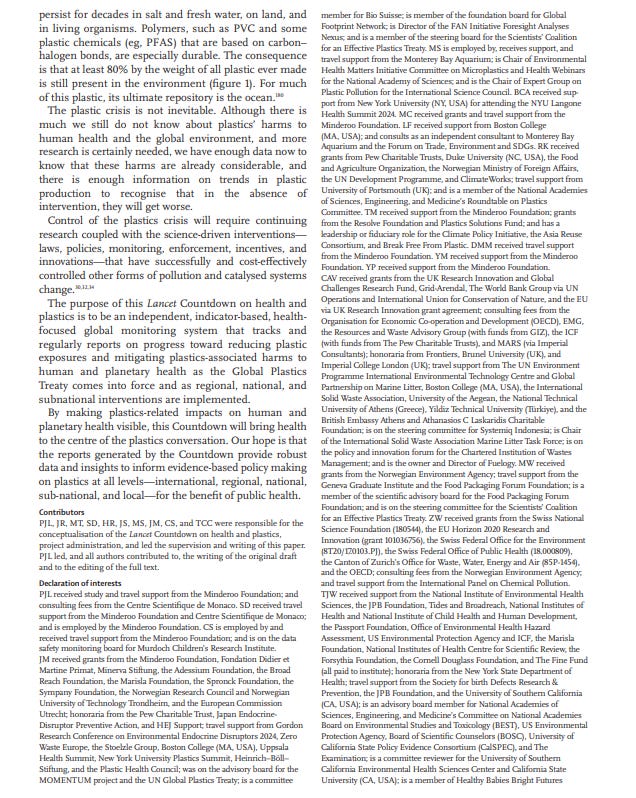
The main funding for the Lancet Countdown research came from the Minderoo Foundation. The Lancet project developed from the Minderoo-Monaco Commission on Plastics and Human Health. Not only did a large number of scientists involved declare funding from the Minderoo Foundation, but the project had a direct involvement of many Minderoo Foundation staff. As Minderoo was not very active in plastics issues prior to this, the question remains: Who brought them together for this campaign?
All roads seem to go back to the Lancet Countdown’s coordinator and report lead author, Philip J Landrigan.
A Jack of All Trades
Philip Landrigan is best known for his campaigns against GMOs and herbicides like glyphosate. He was head of the Scientific Advisory Committee at the Ramazzini Institute, active in their Global Glyphosate Study, and the chair of the Scientific Advisory Board of the Heartland Health Research Alliance, an organization designed to funnel dark funding from the US litigation industry to researchers publishing papers against herbicides like glyphosate.
Landrigan is also, strangely, the health advisor to the Evangelical Environmental Network. Paying the rent or are there health issues with the Rapture?
The Firebreak has published articles on Landrigan, including his secret, unethical and legally suspect transfer of one million dollars from the Heartland Health Study budget to the cash-strapped Ramazzini Institute via his school, Boston College, so the Italian research institute could continue its glyphosate study. There were also articles (here, here and here) on the abuse of Landrigan’s board position to have forced the American Academy of Pediatrics to give its members unscientific guidance to advise parents to feed their children organic food.
Landrigan had a long career going back to the 1970s, but he had not been involved in any research on plastics or had his name on any significant plastics publications until 2022 when he was recruited to lead the Minderoo-Monaco Commission on Plastics and Human Health.
Given how lucrative the Heartland Health Study payola was, there must have been some serious money involved to get the long retired Landrigan to switch horses and, so late in his career, suddenly become an “expert” in plastics. As expected, the Minderoo Foundation does not reveal the level of their funding to this anti-plastics campaign (foundations don’t need to be transparent), but it seems to be making up a considerable part of the $300 million commitment made in 2019 to a new plastic waste initiative (Sea the Future).
Minderoo also gave €5 million to the ReOcean Fund in 2019, run by the Fondation Prince Albert II de Monaco to focus on ocean health and plastic pollution. Landrigan has been involved with ReOcean since 2019 (although it seems COVID interrupted this cooperation as nothing developed from this project until the Minderoo-Monaco Commission on Plastics and Human Health was launched in 2022).
This Minderoo-Monaco Commission on Plastics and Human Health is coordinated by the Global Observatory on Planetary Health at Boston College whose Program Director is none other than Philip J Landrigan. As well, Boston College’s Global Observatory has a program called Plastics Health Aware that provides a basic checklist of all of the diseases caused by plastics and their chemical additives. You did not have to look too far to see that this project is managed by Philip J Landrigan and funded by … the Minderoo Foundation. There are only two scientists working at the Global Observatory on Planetary Health, Landrigan and his Ramazzini confrere, Kurt Straif, whom Landrigan employed when he suddenly had to leave his post as head of the IARC monograph program.
Interestingly, the Global Observatory on Planetary Health website does not acknowledge any funding from the Minderoo Foundation. Was it all funneled through Monaco?
No wonder the Heartland Health Study was archived around this same time. Philip found another Sugar Daddy with deeper pockets and less taint than the US litigation industry.
Pot, Kettle, Plastic Alternative to Steel
The Minderoo Foundation is founded and funded by the outspoken Andrew Forrest, an excessively loud-mouthed Australian billionaire who has taken his definition of saving the planet as his calling and personal salvation. Someone should remind this Davos Darling that he is the executive chairman of Fortescue Metals Group, a mining company extracting iron ore from that planet he loves in order to produce energy-intensive iron and steel. The fact that the metals industry stands to gain massively from any success from Forrest’s Ban Plastics campaigns and his mudslinging orations seems to be considered even less important than the scientific facts working against his activism.
Forrest’s tactics are as dirty as his money. Battling ExxonMobil on the green energy front, he has secretly financed an NGO to fund lawsuits claiming Exxon lied about their plastics recycling program. He channeled $500,000 via his Minderoo Foundation through a front group NGO called the Intergenerational Environment Justice Fund. While the NGO claims no affiliation with the Minderoo Foundation, that is not what the law firm’s FARA declaration said. The Minderoo front group worked with US NGO proxies to fund a law firm suing Exxon who in turn donated $39,000 to the California Attorney General, Rob Bonta, who also simultaneously filed a lawsuit against Exxon’s plastics recycling.
Who needs ethics or integrity when you are on a mission to ban plastics?
The plastics industry has a choice. Either start to play as dirty as their self-interested adversaries who are willing to lie, cheat and delegitimize a competing industry, or just stop producing plastics. The Plastic Fear Complex is well funded and will stop at nothing to eliminate their industry.
It is a pity this unethical activity was yet again done in the name of professionalized philanthropy. That $500,000 could have done so much to further rural development in Western Australia if Andrew had just shut up and stayed in his lane.
As long as Andrew Forrest keeps pumping his Minderoo millions into his pointless anti-plastic campaigns, there will be those signing up to amplify his nonsense. Maybe his Minderoo Foundation should start funding journalists because, as Part 1 demonstrated, many of them are waking up to the hypocrisy of his activism. Or even better, maybe Andrew can go to Hollywood and create an organization called Minderoo Films to produce an anti-plastics lobbumentary that they can then use to buy their way onto the Netflix platform.
A review of Minderoo Films release: “The Plastic Detox” is the third part of this Plastic Fear Complex series.