


How did environmental-health activism shift from NGO communication campaigns to multi-pronged foundation-coordinated policy onslaughts?
Are the new fiscally-sponsored projects the same as NGO campaigns?
If they are fighting for the same “causes”, how are they different?
What is the future for NGOs in this new activist ecosystem?
Mapping the Philoligarch Playbook is the most important part of this series, and the most detailed. As it analyzes the evolution in environmental-health activist campaign management, this mapping is divided into three subsections:
The old NGO campaign model and the transition to the foundation multimodal process.
The two elements of the philoligarchic ecosystem and the main players.
The four key policy actors that the philanthropic machinery has moved in and taken over to manipulation and control the issues.
This section lays the groundwork to understand how different, and how formidable the new philoligarchic campaign structure is and how it left the old NGO model behind. While maps don’t always follow straight lines and can look chaotic, I will try to make it as clear and simple as possible. Chapter 2 and 3 will develop the context via case studies, but first the big picture needs to be delineated.
Campaign Evolutions
In the early days of environmental campaigns, in the 1970s and 80s, activists were driven by passion and ideology. Greenpeace has accounted its history as symbolic of how campaigns were motivated: chasing whaling ships, obstructing nuclear test sites, lying down on train tracks outside of factories, shimmying up smokestacks and trees. These were often low budget stunts to raise awareness by grandstanding, charismatic individuals. These flash-in-the-pans were driven by idealism and outrage at the effects of industry exploitation on the environment.
In the 90s, campaigns began to mature into policy initiatives as their campaigns were making an impact on the dismal state of the environment. Lakes were dying (or catching fire), smog was choking populations, and unmanaged pollution was flowing into aquifers. Laws were strengthened to limit air, water and soil emissions, global initiatives to address the depletion of the ozone layer or ban nuclear testing led to international treaties while governments were addressing deforestation and over-fishing.
Some like one of the founders of Greenpeace, Patrick Moore, wrote a letter arguing that the NGO had achieved their goals and it was time to move on rather than run campaigns driven more by fear than science. Other founders in the movement wanted to fight harder, like Paul Watson, who broke away in 1977, setting up Sea Shepherd to run more militant campaigns against whalers.
By the late 90s, stakeholder dialogue divided the environmental movement between those in groups like WWF willing to engage with industry to help them to adopt greener processes and more militant actors like Friends of the Earth or Greenpeace who identified industry as the core of the problem. As these NGOs grew, funding their administrations and infrastructures started to guide their campaigns, either with corporate sponsorships, green label schemes, increasing membership donations or seeking government support to be able to engage in the dialogue process.
During the 90s, issues evolved from environmental clean-up and accountability crises (from Bhopal to Love Canal) to more risk and uncertainty stories creating public fear. Environmental campaigns were focusing on headlines that were scary but not scientifically convincing, like GMOs, pesticides, MMR vaccine safety, BSE, endocrine disruption or dioxins. With the rise of the Internet as an information source, activist campaigners were more adept at getting their stories and campaigns into the news.
Sustainable development was the new policy focus with a wide range of interpretations of how to develop and innovate with people, planet and profit in mind. Industry started to try to present themselves as good corporate citizens sharing in the activists’ concerns (where market opportunities prevailed).
By the millennium, science communication and the science-policy nexus started to be pushed forward as a risk management strategy. Climate change and biodiversity loss were the issues that started to take center stage as the communications and policy tools shifted with a focus on energy, agriculture and industry.
The Pre-Philoligarch Campaign Strategy
As environmental NGOs grew into global, political forces, activism moved from passionate stunts to long-term campaigns. Funding became an important part of campaign selection, with the ability to raise public fear (and motivating more donations) driving which issues make the cut. The acronym “GMO” was often referred to as Greenpeace Membership Opportunity, and, along with its campaign against nuclear energy, many began to see green campaigns as more ideological than environmentally-friendly. Large organizational administrations meant a weakened dogma as fundraising and donor-relations became more important. NGOs would attack the oil industry but not the drivers who needed their cars; campaign against agri-tech companies but not the farmers or consumers.
Focus groups would determine key strategies, clipboard campaigns on street corners would measure public sentiment and fundraisers would go on membership drives. The campaign strategy was member led, with campaign stunts and events were conducted to raise awareness to get stories into the media. It was a linear strategy and often hit-or-miss (remember WWF’s campaign against hydroelectricity projects?). Media organizations might not pick the campaigns up, other stakeholders might make stronger arguments and policymakers might ignore the campaign pressure. Even as social media tools expanded NGO communities and amplified their voice, the mainstream was unpredictable. See image below.
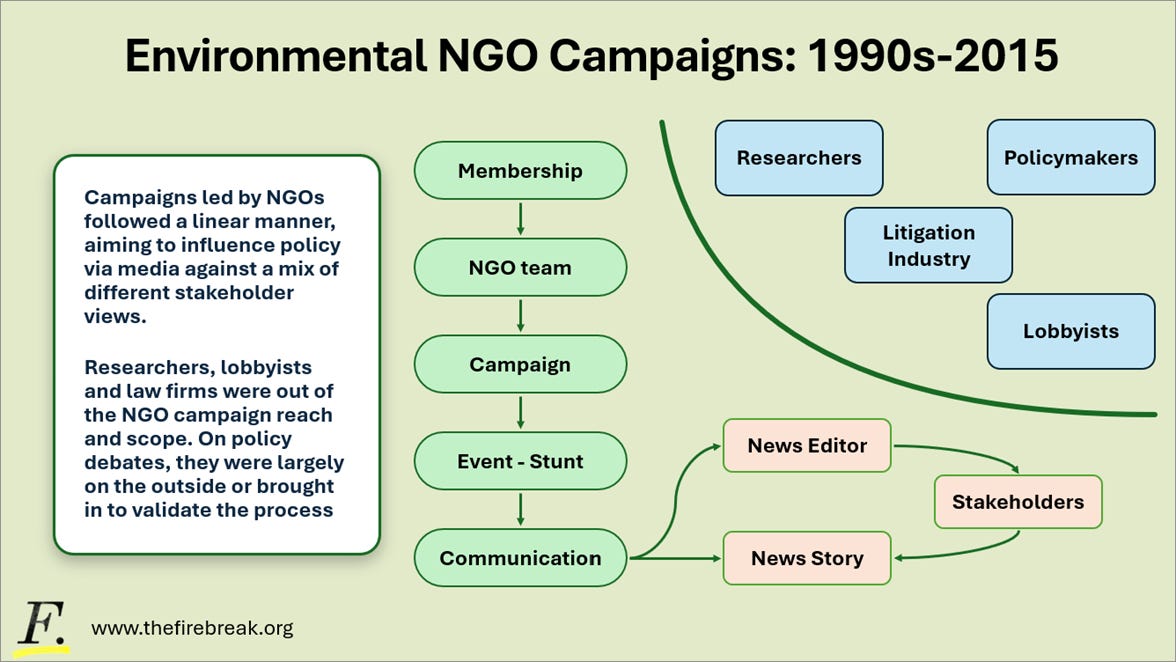
By the mid 2000s, stakeholder dialogue and corporate social responsibility (CSR) attempted to shift the decision-making process to one of engagement and consensus (with concepts like citizen science and participatory democracy thrown about), but this was largely an external validation exercise while influence remained a matter of privilege. Activists did not enter policy debates to write the regulations but, rather, the best they could play for is to apply precautionary brakes on policymakers.
As energy and agriculture issues began to dominate the environmental landscape with climate change and biodiversity loss becoming the main campaigns in the 2000s-2010s, and with many retiring activists moving into positions of influence in transnational agencies in the UN and EU, the objective of policy control started to dominate.
At the same time, with the massive wealth creation growth from the Internet and social media revolutions, foundation funding started to have an impact. Activist campaigners who used to chase individual donors started to be friendly with tech philanthropists and worm their way onto their foundations’ boards. Instead of millions of single donors (who could lose interest), they started raising millions from single donors. This allowed for more complex campaigns where the NGOs could control more of the debate.
But something else happened. These former activists who became professionalized philanthropy consultants were no longer interested in funding the traditional NGOs whose political structures and dogmatic idealists were often difficult to control. Greenpeace USA, an NGO that used to tout its funding from large foundations, only listed one donation in 2025 above $500,000 (their IRS Form 990 is not transparent, but we can assume there is only one foundation still funding the NGO). These foundation consultants left the NGOs for many good reasons.
It should be noted that this last Greenpeace USA IRS declaration shows their annual donor revenue has fallen by at least 10% over each of the last three book years (post COVID) and the NGO is making significant staff cuts (not to mention having to deal with expensive appeals to lost lawsuits). The guilded Age of the NGO has started to unwind.
The Transition from NGO Campaigns to Philoligarchy
The consultants started setting up fiscal sponsors to organize their own campaign “projects” with more flexibility and without the baggage of ideologues or the demands for transparency and accountability. It is all about better control of the issue, from campaign germination to scientific publications to media coverage to policy reforms. With hundreds of millions available from their networks, it is all about controlling all of the steps in the campaign process: researchers are funded, media is financed, influencers are paid off, lobbyists are activated, and law firms are kept on retainer.
It is important to understand that this is no longer a civil society movement or grassroots campaign representing the interests of the public or consumers. The oligarchy in philoligarchy refers to power being centralized into the hands of a small number of billionaires dedicating vast sums to controlling an issue and making an impact. There is no consultation with memberships, no answering to political interests and no accountability. If there is an investigation or a risk of getting caught, the foundation fund managers or the fiscal sponsors just erase the “project” and start all over again.
Philoligarchs play for one thing only: winning. They are campaigning, for example, against effective tobacco harm reduction tools like e-cigarettes and nicotine pouches. They do not care that more people continue to smoke cigarettes and face far worse health consequences or that black markets will propagate, destroying official distribution systems and putting more young people at risk. Michael Bloomberg pays the top ten directors in each of his “tobacco control” groups monthly salaries of at least $25,000 to ruthlessly execute; they’re not paid to have a conscience or be reasonable. Activists in traditional health NGOs don’t play the same game … but their views don’t matter anymore.
An important result of the transition is the capacity for large, relentless campaigns. Outside of the big global NGOs, most non-profit campaign groups would have budgets from between $500,000 and $1 million, enough to employ six to eight activists but having to devote up to a quarter of their budget for fundraising activities. Their campaigns are limited by lack of manpower, with no budgets for consultants, lawyers or specialist researchers.
Foundation-driven projects, especially organized by fiscal sponsors, have budgets in the tens of millions to hundreds of millions of dollars, and with very little need for fundraising manpower. This increased capacity allows campaigns to coordinate with other stakeholder groups (also often funded by the same foundations). This mapping exercise will show how the different groups (lawyers, lobbyists, researchers and media) are choreographed in order for the Philoligarchs to control and influence the issue. This is a completely different playbook than the one led by NGO campaigns.
It is to the mapping of the Philoligarch Ecosystem that this analysis now turns.