


Summary
The Republic of Palau has filed an initiative with the UN to place nicotine under international drug control restrictions.
Small island states like Fiji and Palau have been seen in the past pawning off delegate seats to NGOs wanting to attend large UN intergovernmental conferences.
The Palau nicotine initiative at the UN was researched, prepared and written by anti-nicotine activist groups from Europe, the US and Australia.
These NGOs were too busy using Palau as their UN front group to have noticed Palau has a significant level of gutka addiction.
Life has never been better for environmental-health activists. Unlimited funding from billionaire philanthropists that also own the mainstream media you are free to use, tort law firms willing to amplify your campaign message while lending you their highly-paid activist science networks and international research agencies, and political operatives in various governments happy to give you a microphone and access to lobbyists and funding. Activists can run worldwide campaigns against technologies they hate, from Golden Rice to nuclear energy to tobacco harm reduction strategies, using their deep foundation-funded pockets to impose their will on poor nations, global trade and international politics.
But sadly, one key element is missing that would give these environmental-health zealots total policy control. Although they no longer pretend to represent civil society or the public interest, they are still considered NON-governmental. This means that while they can control the agenda at large UN conferences, fly to climate COPs on private jets, shape the narrative in public dialogue…, when the doors to the global negotiations close, these masters of the universe are left outside and out of the process.
Fortunately for the activists, the UN has many small countries that are dirt poor and lack technical negotiating skills. These countries have recently been seen to be open to pawning their delegate seats to the power-hungry activists. At recent UN conferences, the Pacific Small Island Developing State (PSIDS) delegations have become more vocal (and more white), bringing delegates who are not at all connected to the country acting as mercenaries for large NGOs like Greenpeace or WWF. Equally concerning is how foundation-funded NGOs have used their billion-dollar budgets to take over developing country institutions. Michael Bloomberg’s flotilla of MPOWER NGOs is not only running the WHO tobacco control strategy, but also managing the implementation of Bloomberg’s objectives in most small and middle-income countries.
People are outraged that Russian-funded mercenary armies are supporting failed African states. How is this any different?
Buying Seats at UN Conference Delegations
The Firebreak covered the very strange manipulation of delegations to UNEP’s Plastics Treaty conference (INC-5) in Busan, South Korea. (See the list of delegates here.) We noted how of the 11 delegates Fiji brought to Busan, four were from large environmental NGOs (including a WWF director). The population of Fiji is less than a million people and although it is the fourth most populous country in Oceana, 61.3% of the population live below the poverty line, earning less than $5.50 a day in 2019. Small, poor countries don’t have the technical expertise to lead global policy discussions and poverty creates opportunities for corruption (like selling UN delegate positions to NGOs).
I have had a close relationship with the Philippines for more than 40 years and spend almost half of my time in this lovely country. And while I feel very comfortable here, have a child who lives here, I know when I enter a room, that I don’t really belong. I’m white. I speak the language with a funny accent. I would never dare represent the Philippines and I worry for Western activists who feel no integrity issues pretending to speak on behalf of a country with which they have absolutely no connection. But I suppose, as zealots who only think about winning, these activists are quite happy with their pretend allegiance.
Take another small Pacific island nation, Palau, with a population of only 17,000 and 25% living below the basic needs poverty line (UN estimates although actual data is scarce). Palau is made up of 340 islands but only 12 are permanently inhabited. And while they don’t seem to have enough resources to gather basic data, the Republic of Palau has a very strong voice at UN conferences and international policy discussions. At Busan, for the UNEP plastics treaty conference, Palau brought six delegates, but four of them had no relationship at all with the small island state (except that they got an email address made for them under the name of the Permanent Mission of Palau to the United Nations). Who paid for these fake delegates (and how much did their organizations pay the Republic of Palau for the delegate pass-through)?
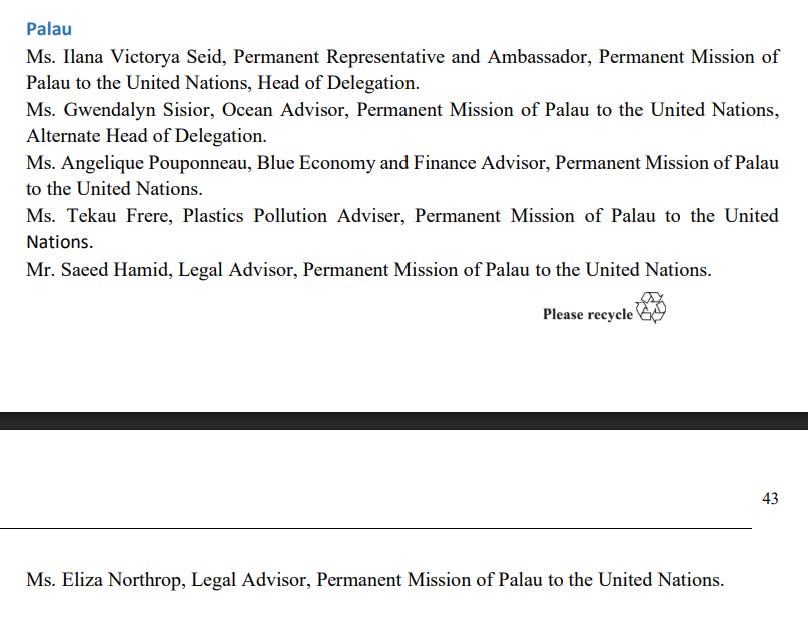
As at other UN conferences (like the climate and biodiversity COPs), Palau played an oversized role during this Busan event. Gwen Sisior, as the alternate head of the Palau delegation, was center stage as a Co-Chair of the Busan UN Plastics Treaty INC-5 conference, sitting at the front table and navigating discussions between over 190 countries. Was she representing the interests of her 17,000 citizens, or was she reading from script prepared by her “Big Change” mercenaries?
The UN rightly doesn’t scrutinize or interfere with a nation’s choice of official delegates to its events, but maybe they should pay attention when small island states, with populations smaller than some apartment complexes, start using the UN to initiate sophisticated policy campaigns.
Palau: The Anti-Nicotine Activists’ Useful Idiot
This week, the tiny Pacific nation of Palau launched yet another campaign on the global stage calling on the UN to initiate a critical review of nicotine with the intention of placing it under international drug control restrictions. This would put nicotine under the authority of the World Health Organization Expert Committee on Drug Dependence (WHO-ECDD), bringing it under international drug control (in the same way as heroin and crystal meth) rather than merely the tobacco control regulations of the WHO’s FCTC.
Palau’s initiative also included a supporting scientific evaluation of nicotine with contributions from a collection of international scientists. The scientists argue that past evaluations of nicotine only looked at combustible delivery systems (smoking), and given the growth of alternative nicotine products, their scientific review was necessary. There was no mention of funding for this review, but the phrase “An initiative of the Republic of Palau” was peppered throughout the pages, so it should be safe to conclude that this was all Palau-driven.
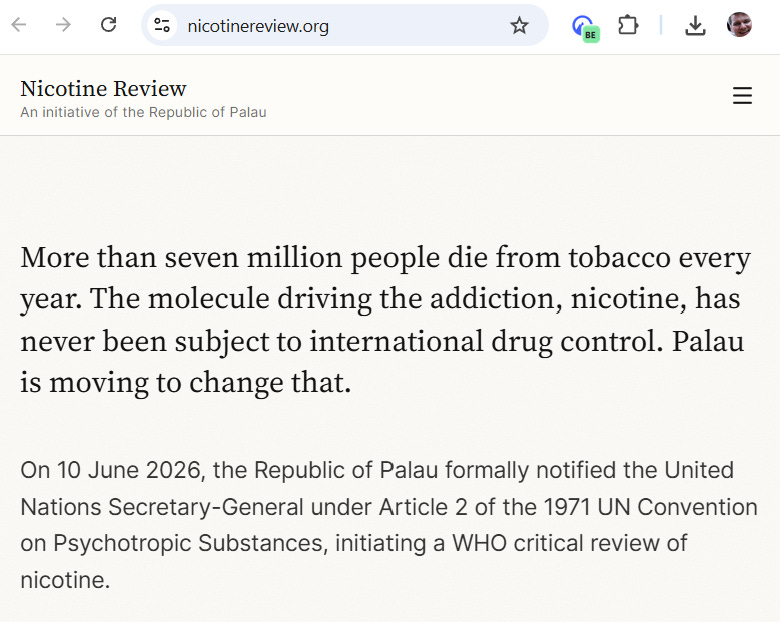
It is impressive to think that tiny Palau, with a population of 17,000, was able to produce a website like https://nicotinereview.org/ to launch an initiative with a research document to try to change how the international community thinks of nicotine. It is just as impressive to think that so many people were fooled into believing that this was legitimate and not just another case of the activist NGO community once again using a tiny island nation as their campaign front group. I hope Palau was well remunerated for dutifully carrying out the activist marching orders.
Clearing the Air didn’t have to dig too deep to discover that the entire Palau initiative was led by anti-nicotine activists tied to the European Network on Smoking Prevention (ENSP).
“Its application has been put together by Charis Girvalaki and Thomas Munzel, two names that are very familiar in the corridors of power in Brussels and paid up members of Europe’s tobacco control establishment lobbying to ban safer products across Europe. Girvalaki is the Scientific Director for the European Network on Smoking Prevention, the main non-governmental organisation advising the European Commission on its revision to the Tobacco Products Directive.”
Other activists involved behind the scenes include an activist from ASH (Action on Smoking and Health, USA), Carolyn Dresler, and Coral Gartner, Director at the NHMRC Centre of Research Excellence on Achieving the Tobacco Endgame in Australia. Clearing the Air referred to Gartner as “the academic architect and chief defender of Australia’s failed prescription-only vape model.” Nobody from Palau was referenced in this “initiative of the Republic of Palau”.
As these are activist scientists working for NGOs, it would not be unusual to find deception or embellishment in their supporting scientific dossier. The cover page misleadingly tries to give the impression that the research is done by the WHO Expert Committee on Drug Dependence.
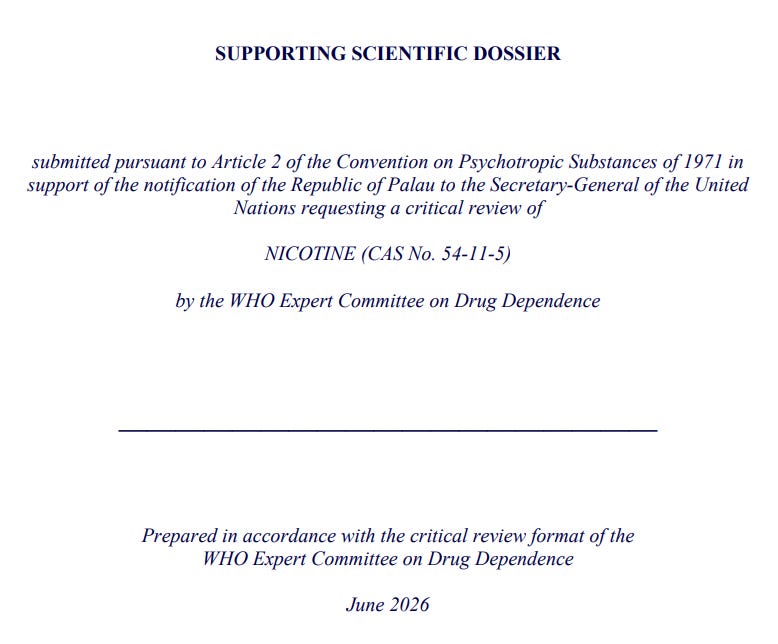
The layout spacing tries to turn a request for the WHO Expert Committee on Drug Dependence to do a critical review of nicotine look like the review was actually done by the WHO Expert Committee. After the line break, over the date of publication, the “WHO Expert Committee on Drug Dependence” is written where the names of the authors of the report would normally go. But the line above says that the dossier was “Prepared in accordance with the critical review format of the” and then the next line mentions the WHO Expert Committee. You don’t need to put your methodology on the cover page, unless…
If Page 1 tried to deceive the reader, then that set the standard for the rest of the supporting science dossier (done in the name of the Republic of Palau).
A Kick in the Gutka
While only 20.8% in Palau smoke (2023 Bloomberg data), 42.4% regularly consume gutka (or gutkha): chewing tobacco mixed with betel (areca) nut and a variety of spices and additives. Gutka is an addictive psychoactive stimulant containing arecoline, which has been linked to oral and esophageal cancers as well as cardiovascular disease.
Globally, around 600 million people consume gutka, mostly in Southern and South-East Asia. As a cancer hazard, gutka is banned in many countries, including the United States and (technically) India, but not in Palau. It has been called the “suicide masala” because of the speed at which it can kill its users.
But the Palau government is not speaking out against gutka in the same way they have condemned e-cigarettes. The anti-nicotine supporting scientific dossier, while an “initiative of the Republic of Palau”, did not mention gutka once.
Palau banned vaping in 2023, in line with Bloomberg Philanthropies’ MPOWER strategy. Didn’t Bloomberg look at gutka use in Palau at the same time? While gutka contains tobacco and nicotine as well as addictive, toxic stimulants from the betel nut, Bloomberg Philanthropies does not refer much to it or campaign against it. Two Bloomberg-funded NGOs did not mention gutka directly in their report on Palau.
I suppose Bloomberg would respond differently if Big Tobacco had moved into the gutka trade. But such a claim would imply that Michael Bloomberg and his flotilla of tobacco and nicotine control NGOs are hypocrites, more concerned about fighting industry than improving public health.
Is anyone in Palau aware of the number of people using gutka, and the health consequences compared to e-cigarettes, or were they that far removed from the UN initiative the activists were conducting in their name?
Perhaps the Western anti-nicotine activists should have done some research on the widespread use of gutka in Palau before they recruited the tiny island state as their UN front group.
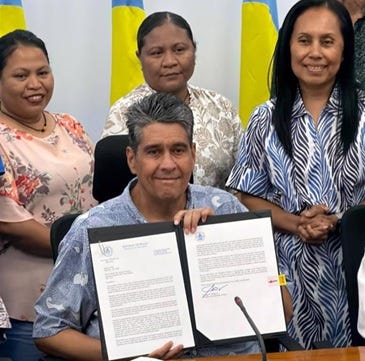
Did the president of Palau, Surangel S Whipps Jr, know what he was signing onto or was this agreement with the NGOs taken at a lower layer of government? How many layers of government does the tiny island state actually have? (The wife of the president of Palau is the sister of the previous president.)
Maybe the United Nations should look into who is actually calling the shots here before they take the “initiative of the Republic of Palau” seriously.