


My wife starts her day every morning with a long conversation with another man that she trusts more than me. His name is Claude.
As AI agents integrate themselves into more of our daily decisions, eventually driving our cars, cleaning our houses and preparing our meals, our societal institutions will need to get public buy-in (perhaps via a consultation, ballot or citizen’s assembly) for this major technological shift. But what would a participatory engagement on the future of AI look like? … Maybe we should ask Claude.
The public consultation or stakeholder dialogue approach was meant to improve public trust in institutional and regulatory decisions by engaging with the public, empowering them and seeking their buy-in for important decisions affecting their lives. A key element of trust is agency, that I (believe I) have control over decisions or actions that affect me. In the first two decades of this century, we saw a plethora of public consultations, townhall meetings, citizen assemblies, state ballots and referendums.
But today the public engagement process is broken: manipulated by stakeholders, ignored by policymakers and deemed worthless by a large part of the population. Many of the attempts by the activist left to conduct consultations to advance their transition strategies knowing that most people will not bother, giving their small but motivated movements a disproportionate voice in the outcome. Some examples:
France held a series of citizen assemblies called Citizens' Convention on Climate (Convention Citoyenne pour le Climat) in 2019-2020. But after much fanfare and support at the highest level, the French government had to quietly walk away from the citizen assemblies’ 500 page report with 149 recommendations including banning 5G, large vehicles and suburban shopping centers.
The EU Conference on the Future of Europe was launched in 2021 with grand statements from leaders of the European Parliament, Council and Commission as they started public consultations across the European Union. After wasting so much time and money by mid 2022, the EU quietly abandoned this engagement process.
The most recent EU Consultation on tobacco and nicotine products has been shown to be a farce. Hundreds of thousands of ex-smokers who were able to finally quit with the help of e-cigarettes quite rightly shared their views in past consultations on why vaping should be promoted in the EU. This overwhelmingly outcome in favor of a policy that would force the EU to break with the WHO-Bloomberg diktats against tobacco harm reduction solutions meant that the European Union had to ignore the outcome of their consultation. This year, they tried to write an anti-harm reduction bias into the survey questions, making it nearly impossible to express a pro-vaping, anti-smoking view.
The UK Brexit vote was conducted as a means for the UK Conservatives to purge itself from its anti-Europe faction. After a tumultuous time, the British people purged themselves of the Conservative Party. No one in government actually expected the UK to vote to leave the EU and this shocking result was enough to deter any other government from doing something so reckless as to ask the public what they think about complex policies.
State ballots on social issues like legalizing cannabis attract a niche population supported by powerful money and influence. Other issues like demanding a minimum wage or childcare allocations do not enjoy such privileged access to public consultations.
The bottom line is that governments and regulators are no longer using engagement processes to help mold the policy process, or if they are, they are quietly ignoring the outcomes. If these consultations are not helping foster public trust, then the process is pointless, costly and raising expectations the policymakers will only disappoint.
How did Engagement Fall from Grace?
There is not one single reason why public consultations are now perceived as useless or merely symbolic.
The political decline of the “Green-Socialist-Anti-capitalist left” in the last electoral cycles has led to a shift in issue focus, away from “consultable” public programs like climate, migration and social support toward technical strategies on deregulation, access to energy and economic development.
The public engagement tools were used as weapons to legitimize activist transition campaigns (energy transition, food transition, economic transition…). As the fear campaigns pushed the apocalyptic scenarios too far, the public backlash made such a strategy unviable.
The rising social media tribal trust deficit means that I trust those like me (familiarity) more than those outside of my echo chambers. Algorithms have channelled individuals into groups of like-minded thinkers, rendering any consultation process obsolete. If one’s tribe rejects the outcome of a public consultation, then there is no trust benefit from public buy-in (agency).
AI technologies are already playing a role in public engagement tools. The ongoing EU tobacco and nicotine consultation is showing evidence of AI-assisted contributions. An article in The Firebreak ridiculed an NGO for conducting a consultation structured and moderated by an AI bot.
People are more concerned with efficiency than participatory engagement. If a technology works and I perceive benefits from it, then there is no point engaging the public. This may explain why there have never been any large-level public consultations on the Internet, mobile phones or social media.
With these points in mind, will our governments resort to engaging the public for policy advice on AI regulations? Will concerned citizens be able to direct the future of AI policies or is the field considered “not fit for public consultation”?
The AI Public Engagement Vacuum
Given the societal pressures the emerging AI technology is causing, if ever there was a need to engage with the public on the future direction of artificial intelligence, the time is now.
Large populations are losing their jobs as this technology continues to encroach on different professions.
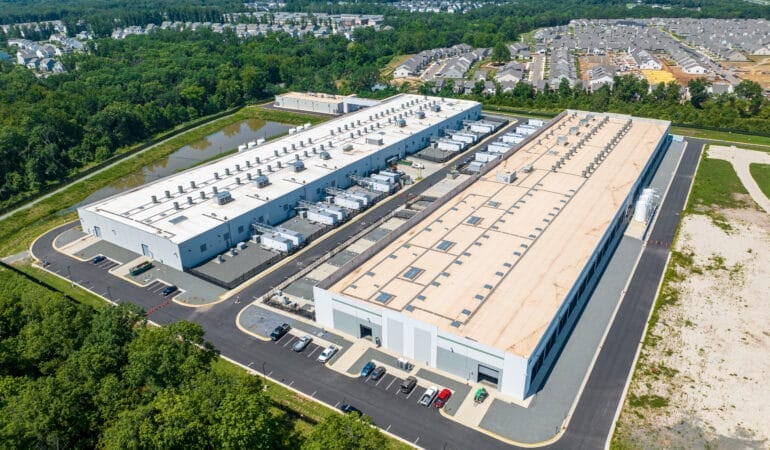
As AI data centers suck energy off the grid and push prices up, certain populations are paying a higher price for less access to energy.
The land-use and water issues have not been given serious considerations.
These data centers create a lot of noise in local communities (expect the anti-5G and EMF campaigners to take ownership here).
Deepfakes and disinformation have a serious affect on the general population.
And with the rapid rise of billionaires (and one trillionaire), will the wealth disparity and the rise of the have-not majority lead to social discord?
If there were any issue today that demanded public buy-in and societal engagement, it wouldn’t be climate change or agrotechnology, it would have to be the future of AI. But this will never happen.
For regulators to pretend legitimacy via public consultations, there would have to be an alternative (however unrealistic) should the public reject the technology. A survey or ballot where the public might reject plastics, pesticides, GMOs, ultra-processed foods, nuclear energy or fossil fuels implies that there is an interest group pushing an alternative. Such polls are advanced by Big Change activist groups to advance their transition theology.
But where the benefits are so evident or the risk of falling behind without the technology so great (as in the emerging AI applications), no regulator would dare risk seriously asking the public what they wanted. Imagine any government tying its hands with a public consultation and then forced to block any AI development. That is about as likely as building data centers in space.
I asked AI (ChatGPT and Copilot) if a public consultation on the future of AI was a good idea. These agents gave me the standard LLM answer (that democracy and engagement are important) but they do not really know me well. So my wife asked Claude the same question, and got an honest answer adapted to her personality.
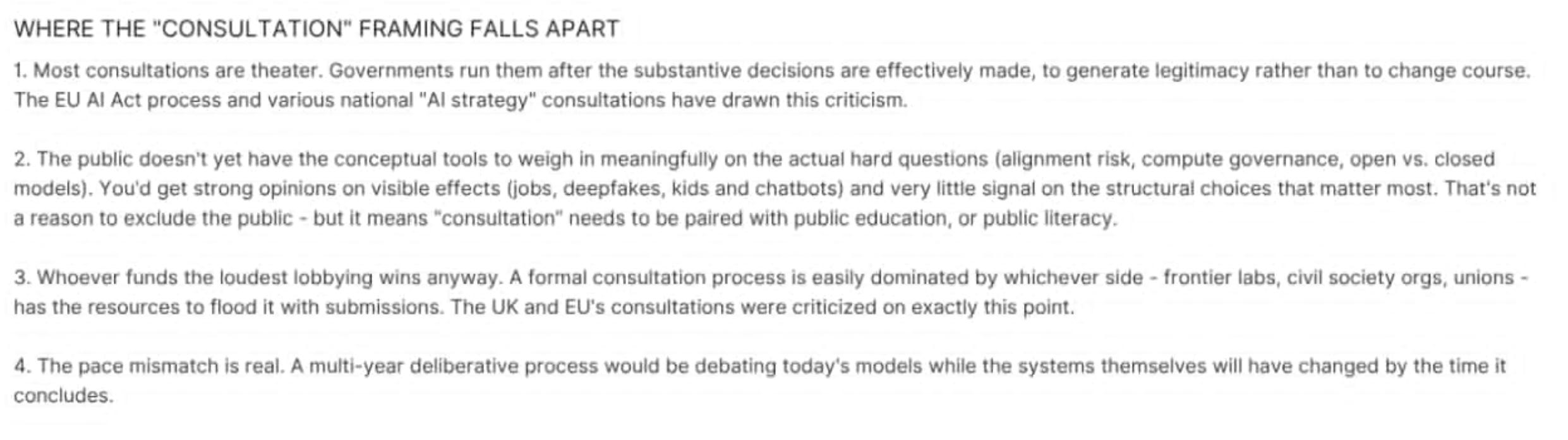
As Claude noted, the European Commission is presently consulting citizens, academia, industry, and public administrations on the upcoming Cloud and AI Development Act and a unified EU cloud policy, but it has already been established that the Commission never listens to their consultations. Claude rightly called it “theater”.
Having a binding public engagement on the future of AI would be like letting the precautionistas force a consultation to ban mobile technology in the early 2000s after the Stewart Report suggested possible health risks from cellphone use. Rather, the emerging mobile technology was perceived as developing solutions with increasing promises of greater benefits. And there is the lesson for industry.
What Can we Learn from This?
For the last two decades, the public consultation strategy has taken aim at certain industries and products under fire from activist transition campaigns. What AI and mobile phone technologies teach us is that an industry needs to present its technology as indispensable while continuously improving the product. If an industry can do this, if the public can see the benefits, there would be no threat from activists attacking products through a transition campaign that forces a public consultation.
Fossil fuels or nuclear energy are seen as necessary for the increased energy demand from the coming build-up of AI-driven data centers.
GM and new genomic plant breeding technologies are deemed essential for protecting global food security given the threats to modern agriculture.
We need better plastics to protect food from contamination and spoilage.
We need to promote tobacco harm reduction products as the only effective measures to finally attain smoke-free status.
While the activist transition campaigns can no longer rely on the public engagement and consultation tools to force the strategies through, public engagement remains a legitimacy tool in most governance arsenals. It is up to industry to communicate the widespread benefits and indispensability of their technologies to ensure long-term market stewardship.