


The last Firebreak article looked at the various forms of conflicts of interest outside of the stereotypical accusations against industry. It concluded that academics, researchers and NGOs need to be equally held to the same conditions and consequences regarding their research funding and argued that foundation funding did not meet the same scientific standards as industry-funded research. To illustrate the level of academic collusion with special interest groups and the failure to respect basic transparency obligations, I concluded the article with a postscript on Philip Landrigan’s recent activist science to make a mockery of his so-called concept of independent science.
Several readers contacted me saying Landrigan’s deceptive practices needed more attention than just a mere addendum to an article. What follows is an expanded timeline of the subterfuge and deception behind Landrigan’s use of special interest groups to promote his activist science since 2018. A further analysis has been added at the end.
It should be noted that Landrigan is not transparent (nor is Boston College) about the amounts of special interest funding behind his research activities and how it is used by the front groups he created within Boston College. Given the amounts most impact research projects attract, we have to assume that Landrigan’s campaigns are funded in the range of millions of dollars. The details have been gathered by Copilot (directed, structured and checked by the author).
Seven Years of Unspoken Wealth
Landrigan retired from the Icahn School of Medicine at Mount Sinai in 2015 although he remained a full professor and Dean for Global Health at Mount Sinai until 2018.
Landrigan set up the Program for Global Public Health and the Common Good in 2018 at Boston College. Their website offers programs with courses offered by different faculties but only lists two academics within this program, Landrigan and Summer Sherburne Hawkins.
Landrigan set up the Global Observatory on Planetary Health in 2018 at Boston College. It presently employs one other scientist, Ramazzini confrere, Kurt Straif.
While Boston College states that The Observatory is the “research arm” of the Global Public Health Program, there are no cases of joint projects outside of the two organizations sharing the same founder and director (ie, Landrigan).
Landrigan joined the Centre Scientifique de Monaco in 2019 to co‑chair the Monaco Commission on Human Health and Ocean Pollution.
Officially, Landrigan’s Global Observatory on Planetary Health partnered directly with the Centre Scientifique de Monaco and the Prince Albert II Foundation rather than via Landrigan himself.
The Prince Albert II of Monaco Foundation has funded the Centre Scientifique de Monaco since 2018 for ocean research, including plastics.
Landrigan was advising the Heartland Study start-up team in 2018 while serving as chair of the Ramazzini Institute Science Advisory Committee. The Heartland Health Research Alliance was officially formed in 2020.
In 2018, Landrigan transferred $950,000 from the Heartland Study accounts to the Ramazzini Institute for their glyphosate research. On the Heartland IRS 990 form, the transfer was made to Boston College. There was no declaration or records whether this money was channeled through his newly formed Program for Global Public Health and the Common Good, his newly formed Global Observatory on Planetary Health or via Boston College.
Landrigan only acknowledged this 2018 transfer to the Ramazzini Institute in 2023, and this was only due to a change in management at the Heartland Health Research Alliance (that took compliance and integrity more seriously than the previous management).
Heartland Health Research Alliance, created as a fiscal sponsor to fund the Heartland Health Study, gets its funding from the litigation industry and the organic food industry lobby via foundations using anonymous, donor-advised funds with foundations. There is very limited transparency. Philip Landrigan chairs Heartland’s Science Advisory Board and Boston College (assumedly via one of Landrigan’s front groups) is a Heartland partner.

From the HHRA 2021 IRS filing: Landrigan is at Boston College (mysteriously also called “Ramazzini Institute”), Perry was at GWU in 2021 and Winchester is at Indiana. These scientists seem to be running their own shows with these funds. Kurt Straif leaves IARC and begins working for Boston College with his Ramazzini confrere at the Global Observatory on Planetary Health as a Visiting Professor in 2019, formally becoming a Research Professor and Co‑Director at the Observatory in 2022. Straif and Landrigan are the only staff listed on the website.
Prince Albert II of Monaco Foundation has funded the Global Observatory and is also one of its formal partners.
The Minderoo–Monaco Commission on Plastics and Human Health was created in 2022 with an undisclosed amount of funding from the Minderoo Foundation, the Centre Scientifique de Monaco (CSM) and the Prince Albert II of Monaco Foundation.
The Minderoo–Monaco Commission on Plastics and Human Health is coordinated by the Global Observatory on Planetary Health at Boston College, namely Philippe Landrigan, who has served as the lead scientist in their report.
In the 2023 journal report announcing the Commission on Plastics and Human Health, 19 of the authors declared to either be employed or funded by the Minderoo Foundation. Philip Landrigan did not declare any funding (assumedly because Minderoo pays Boston College which pays the Observatory which pays Landrigan). This is the same subterfuge Landrigan pulled off to hide tort law firm and organic food industry funding from his involvement in the Heartland Study and the Ramazzini Institute. Likewise, another author of the 2023 Minderoo report, Judith Enck, did not declare any interests even though her NGO, Beyond Plastics a) does not exist as an entity and b) is funded by Bloomberg Philanthropies and the Rockefeller Foundation via another dark university fiscal sponsor, Bennington College.
The Lancet Countdown on Health and Plastics was designed to provide global monitoring of the impact of plastics on human health and the environment. It was launched in 2025 with principal funding from the Minderoo Foundation, in collaboration with Boston College, Heidelberg University, and the Centre Scientifique de Monaco (CSM). It was coordinated by Landrigan’s Global Observatory on Planetary Health.
The Lancet Countdown Report, with Landrigan again as the lead author, contained a 95-line declaration of interests for the authors (with most funding for the plastics researchers coming from foundations including a good number acknowledging funding from the Minderoo Foundation).
The Minderoo Foundation was created by the Australian billionaire, Andrew Forrest, executive chairman of the Fortescue Metals Group. As a main supplier of iron ore that goes into iron and steel, Fortescue will expand its markets considerably should plastics be banned or severely restricted.
The main journal articles related to these activities, with Landrigan as the lead author, have mostly been published in the Annals of Global Health journal. While the journal claims to be founded in 1934 by the Icahn School of Medicine at Mount Sinai (as the Mount Sinai Journal of Medicine), it is supported operationally by Boston College’s Program for Global Public Health (ie, Philip Landrigan). The journal was dormant after 2014 and it transitioned from a general medical journal to a global health journal focusing on “planetary‑health and prevention science” with the new publishing process finalized in 2019.
Since the reorganization in 2018-2019, Philip Landrigan has been the Editor‑in‑Chief of the Annals of Global Health journal.
In 2025, the Minderoo Foundation made a five million dollar donation to the Prince Albert II of Monaco Foundation for their ReOcean pollution campaign. It had previously funded the Monaco Commission on Human Health and Ocean Pollution (co‑chaired by Landrigan). As nothing is declared, it is unclear how much of the previous donations to anti-plastics campaigns came from the Prince Albert II of Monaco Foundation and how much was merely pass-throughs from other foundations (like the Minderoo Foundation).
In 2026, Philip Landrigan appears multiple times in the Minderoo Foundation funded film, The Plastic Detox.
Prior to 2018, Landrigan had not done any research or published any articles on plastics.
There are no public records or declarations of funding or budgets for the Program for Global Public Health and the Common Good or the Global Observatory on Planetary Health. Boston College, as fiscal sponsor, does not declare the source and use of funding for these two Landrigan institutional front groups (which do not exist as standalone entities).

While Landrigan is core to all of these activities, most of his work is done via other organizations, several of which are shell organizations created by him at the same time as foundation funding was made available and moved around. Philip Landrigan is leaving us in the dark about his funding while promoting groups like the Ramazzini Institute for their “independent” funding.
Whenever you hear activist groups and academics talk about the need for “independent science”, remember how leaders like Philip Landrigan are managing millions from special interest groups trying to profit from a ban on plastics, pesticides and GMOs. The only thing independent about this funding is the independence from any transparent declarations.
The University Black Hole
Like Bennington College, that sponsored the Beyond Plastics activist front group via large foundation “donations”, Boston College is facing some serious research integrity issues. The administrators of this university know full-well that they are acting merely as pass-throughs for millions of dollars of undeclared foundation funding (originating from other interest groups) going to non-existent front groups for activist scientists. They do not declare the funding to these groups, but rather take a commission off of the top (usually at least 10%). The universities allow academic entrepreneurs like Philip Landrigan to use their school’s name and reputation to run campaigns and organize commissions or research alliances of activist scientists to fulfil the objectives of the special interest groups funding them.
Landrigan knows how to cleanse the cash. The Firebreak’s exposé into the Heartland Health Research Alliance showed how the organization was created to disperse special interest funding from the US litigation industry and the organic food industry lobby to the universities of a group of academics. These academics (many Ramazzini fellows) had created research “labs” within their institutions to rinse the funding of any tainted sources. And just to be safe, the Heartland group worked with foundations via dark donor-advised funds so that the special interest sources are thrice anonymized, allowing the academics to publish papers casting doubt on the safety of herbicides while remaining free from any need to declare these interests.
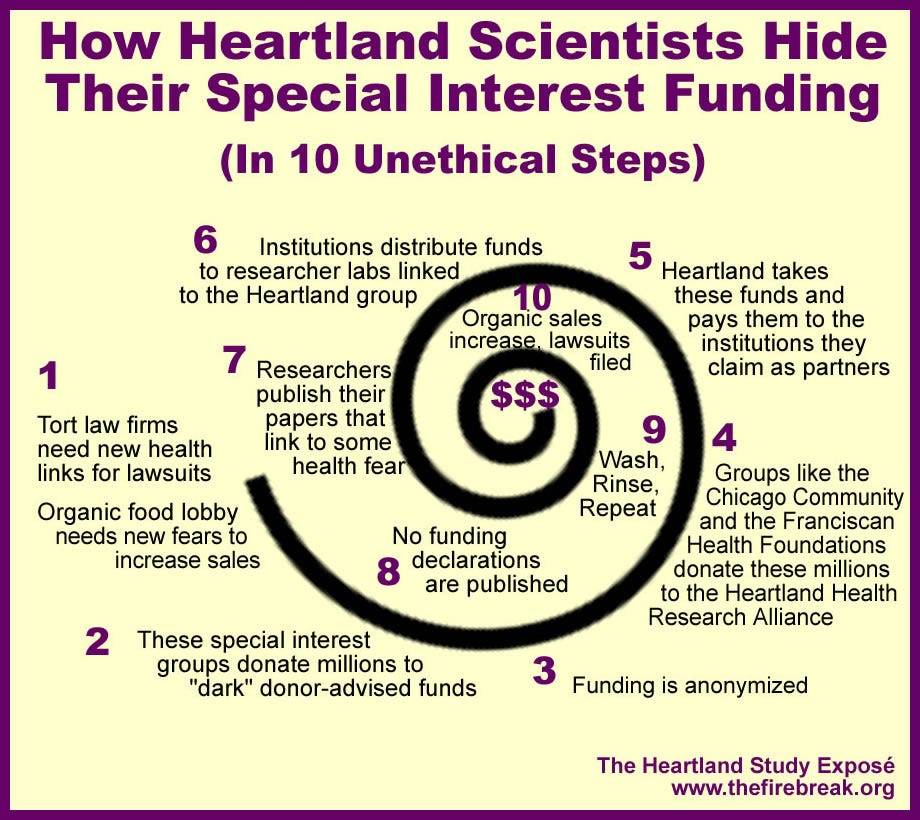
Landrigan advised Charles Benbrook how to set up the Heartland Health Research Alliance in 2018 and that same year took almost a million dollars of the Heartland’s litigation/organic industry seed capital to fund the Ramazzini Institute’s glyphosate study (undeclared until 2023) via his Boston College front group. Each laundering phase (from donor-advised funding to Heartland admin to University fiscal sponsors to the academic front groups) takes at least 10% off the top in pass-through fees, meaning that almost half of the money is lost in the numerous cleansings. That is the price activist scientists are willing to pay to hide their special interest funding and claim their “independent research”.
Philip Landrigan was the chair of the Heartland Health Research Alliance’s scientific board, as well as the Ramazzini Institute’s Science Advisory Board, so he knew how to dance the transparency two-step when the Minderoo Foundation came calling seeking a well-connected, bent activist scientist to manage their the metals industry’s anti-plastic campaigns. But just because he can get away with moving millions of dollars around without declaring any of it, doesn’t make such actions ethical or acceptable.
Welcome to the world of independent science.
The Hypocrisy Hypothesis
When the Ramazzini Institute fired its director, Daniele Mandrioli, Philip Landrigan posted a scathing letter attacking the board, implausibly claiming they were being influenced by industry actors (ie, Monsanto). This is a rich allegation from a man whose rent is being paid for by interest groups from the metals industry, the organic food industry and the litigation industry, all profiting nicely from Landrigan’s campaigns against pesticides, GMOs and plastics.
If Philip Landrigan claimed he did not know where the funding was coming from, he would be lying. Instead, he just remains quiet assuming that nobody cares if he is transparent or not, or if he is serving as a mouthpiece for a wide range of special interest groups. He and his ilk have created an environment where the chemical industry is perceived as pure evil, so any action taken by zealots to hurt these opponents is morally tolerable. I, for one, find his double standards, dallies with special interest groups and total disregard of transparent funding rules disgraceful and an affront to the reputation of science.
What is even less morally tolerable is that American universities like Boston College have pretended not to notice all of the dark money passing through their accounts. They may preach transparency in their academic codes of conduct, but these university administrators seem to be able to look the other way as the tolls received from their fiscal sponsor black holes accumulate. As long as they allow such corruption to continue, activist academics will thrive and use their academic front groups to advance their campaigns.
Universities also need to accept that foundation funding has an equal if not larger stench than industry funding. The main issue here is not that both are driven by special interests but that industry needs to be transparent while foundations move funds in total darkness. When a university then adds a further layer of shade on this darkness, while pretending to give such activism an academic seal of approval, academic integrity falls off a cliff.
Perhaps Boston College, and most other American universities that have discovered the easy money of fiscal sponsorship of activist front groups, should put a banner in their college prospectus saying: “We can be bought.”