


We are in the age of Foundation Capitalism, where billionaires use their philanthropy to advance their interests and vanity projects. In the last three decades, their foundations have changed the policy landscape, funding NGOs, media groups, researchers, activists and lawyers to control the narrative on issues from climate change to agricultural practices, from chemicals to vaping. But with billions pouring into these lobbying campaigns rather than going to humanitarian aid projects, what is the “true cost” of foundation funding?
Activist campaigns have tried to reassess the true cost of conventional agriculture by bringing in other externalized costs not accounted for in the price of products reaching the market. These clever accounting tricks attempted to show that the higher organic food prices actually have a closer true value when compared to the externalized environmental health impacts of conventional agriculture. The same true cost tactics have been applied to try to dismiss the lower prices for plastics and chemicals.
What if we took the same approach and took the billions of dollars that foundations have given to activists for their environmental lobbying campaigns and consider the true cost of such wastage compared to if they had donated those amounts to legitimate humanitarian causes? The true cost of this waste of philanthropy needs to be considered in the assessment of the necessity for foundation reform.
Philanthropic foundations have started to have a significant effect on environmental health debates with their support for activist groups, law firms, agencies within the UN, the media and fabricated phantom NGOs via fiscal sponsorships. When special interest groups led by billionaires can fund all that is needed for a campaign to win, the threat to the democratic process has become significant.
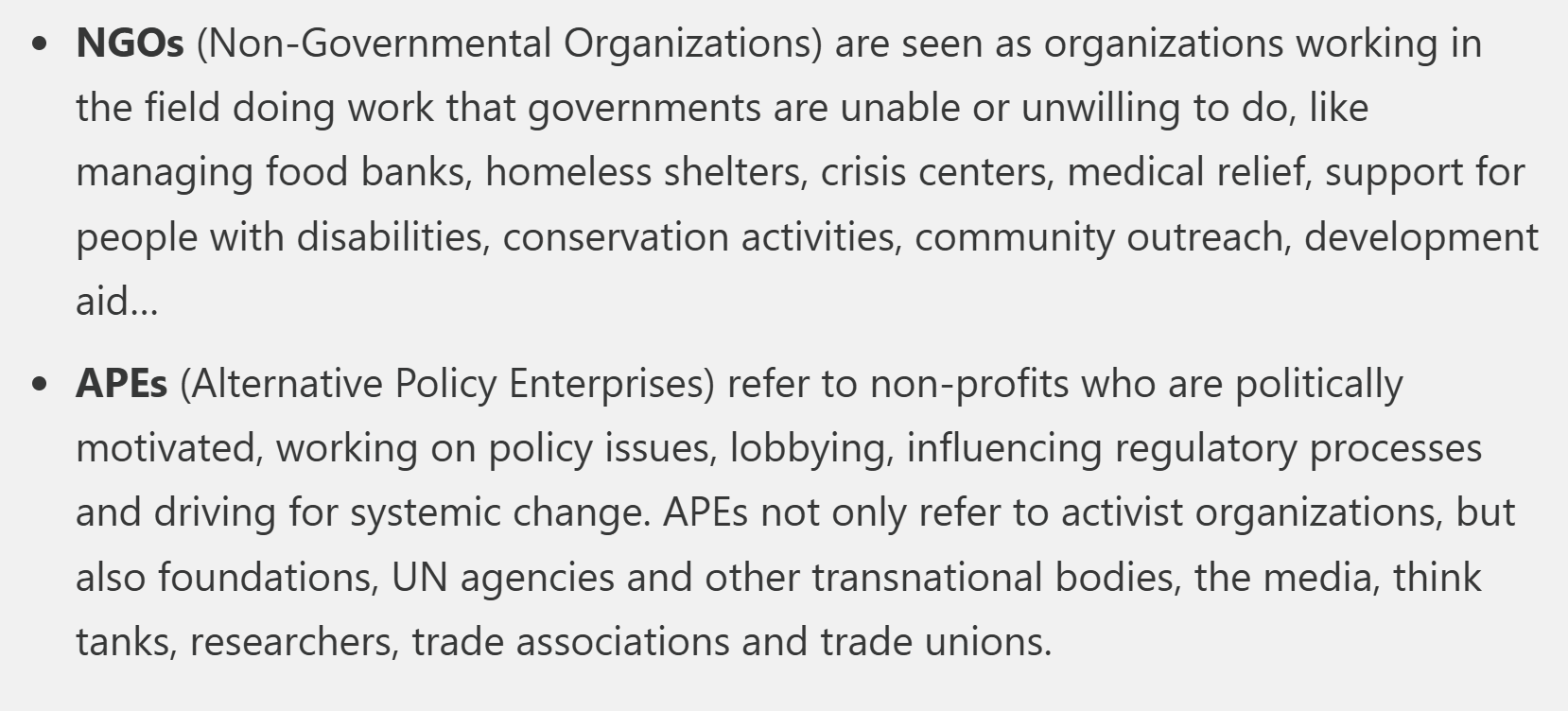
Keep in mind that there should be a distinction within the non-profit world between groups doing humanitarian work (legitimate NGOs) and activist lobby groups that try to effect policy change via fear campaigns. The latter cannot be considered NGOs, but rather, what I have termed: APEs (Alternative Policy Enterprises). See a Firebreak series on this. APEs are lobbying campaign groups, political activists trying to change public policy, and should not be considered under the same conditions as humanitarian NGOs working in the field (medical services, food banks, poverty alleviation, education support…).
What follows will assess the wasted philanthropist funding of APEs and consider the true cost of such donations (and what the funding could have achieved if the foundations had donated to legitimate humanitarian NGOs). The goal here is to start a debate on whether such donations to activist lobbying campaign groups should be considered in the same way as humanitarian aid. If, as any reasonable person would agree, APEs are quite different from NGOs, then certain regulatory measures should be taken to prevent widespread financial promotion of these lobbying groups.

European Climate Foundation
The European Climate Foundation is not actually a foundation but a fiscal sponsor working on behalf of many large foundations including Bloomberg Philanthropies, ClimateWorks Foundation, Rockefeller Brothers Fund, the Oak Foundation and the William and Flora Hewlett Foundation. This group is non-transparent in its regranting actions although the Firebreak translated and published an exposé that pieced together its donations to a wide range of climate NGOs, media groups, the World Economic Forum and UN-based associations to direct its (now faltering) net-zero campaign. Its most recent two-page financial declaration (2024) reveals an annual income of €252 million.
Instead of political lobbying, media manipulation and running the Davos show from behind a curtain, what could a real NGO have done with €252 million a year to make a difference in the world? If that funding, which only went to creating fear and disinformation, were spent on improving water and sanitation conditions in rural Sub‑Saharan Africa, it could have saved from 5,000 to 15,000 lives annually (following the Unicef/WHO WASH metric). The variance is due to countries, ages and types of intervention, but it is clear the true cost of philanthropist funding of the futile European Climate Foundation’s lobbying campaigns could have done so much more.
Michael Bloomberg’s $1.6 Billion Tobacco Control Campaign
One of the most remarkable exposés of a billionaire’s ability to control a global policy debate is how Michael Bloomberg created and funded more than a dozen NGOs (and a good part of the World Health Organization) to implement his strategy against tobacco harm reduction techniques. Focusing his flotilla of well-paid NGOs and researchers, Bloomberg has created a series of disinformation campaigns against vaping as a viable smoking cessation strategy, manipulating governments from mostly developing countries while controlling the agenda in one of the main WHO strategy initiatives. Because of confusion spread from his $1.6 billion lobbying campaigns, millions of people continue to smoke and suffer the health consequences of tobacco harm.
Outside of the number of lives put at risk by this billionaire’s smarmy self-promotion of moral sanctity, what could $1.6 billion have achieved if it had been directed toward real health issues? Since Bloomberg covets his title of WHO NCD ambassador, the amount he has squandered on spreading fear and lies about tobacco harm reduction strategies could have built between 4,000 to 8,000 primary health clinics in the world’s ten poorest countries. The variance depends on available infrastructure, construction costs and existing healthcare supply chains. These clinics Bloomberg never bothered to build could have saved 300,000 to 500,000 lives per year (more if the clinics are well-staffed). Instead, he is just killing more people who continue to smoke because of disinformation coming from his incapacity to understand basic health risk management.
Funding Agroecology or Fighting Child Malnutrition?
The Agroecology Fund, according to a Firebreak exposé, received over $100 million in 2023-24 from foundations like Waverley Street Foundation, the Ballmer Group, the Walton Family Foundation, 11th Hour Project, the David and Lucile Packard Foundation, Thousand Currents, David Rockefeller Fund, Rockefeller Foundation, Ikea Foundation, Oak Foundation... The funds were not earmarked to aiding subsistence farmers in the poorest countries or securing food supplies in vulnerable agrarian regions, but rather to funding lobbying campaigns to promote agroecology as an alternative to conventional agriculture technologies. In other words, the Agroecology Fund’s objective is to spread fear and misinformation about farming practices that do not meet their Marxist ideology.
It is difficult to get accurate figures on how much the Fund receives and regrants given that the Agroecology Fund does not exist, does not publish financial accounts and is not accountable for the consequences of its actions. It is a phantom NGO managed out of the Global Greengrants Fund, a fiscal sponsor that takes a percentage of every foundation donation. Based on the amounts the foundations declared to have donated, the Firebreak can safely conclude they receive more than $100 million a year.
But rather than funding lobbying campaign APEs to promote a failed, politically driven agricultural practice, how much malnutrition could have been prevented if this $100 million had gone toward micronutrient fortification strategies in the world’s ten poorest countries? These mal-funded donations could have corrected or prevented 20–60 million cases of micronutrient deficiency and averted one to three million DALYs (Disability-Adjusted Life Years) or roughly 30,000–100,000 deaths. Instead, the well-funded agroecology activist movement promises more malnutrition, child labor and economic impoverishment.
Stupid Is as Stupid Does
The true cost of wasted philanthropic funding opportunities is costing humanity hundreds of millions of lives per year. While statisticians like Bjørn Lomborg have heroically tried to wake people up, most leaders continue to enjoy their dogmatic slumber and feel, in any case, that there is nothing that can be done.
People are free to decide what to do with their money and donate to organizations that have done the best job marketing themselves as some sort of solution to some sort of problem. If Michael Bloomberg chooses to be stupid with his billions, and his family continues to allow him to pursue these vanity follies, it is not for some researcher in the Philippines to prevent him. But given the amount of money being wasted on misguided lobbying campaigns that deliver no social goods, we can no longer refer to these special interests as charities or civil society non-profits. APEs are not NGOs and they do not provide any service to society.
Governments cannot encourage any philanthropic APEs funding that acts against the interests of society and at a cost to legitimate NGOs struggling in the field while facing serious financial challenges. While the billionaires have allowed activists to infiltrate their foundations and spend their funds stupidly, these “donations” need to be reconsidered not as charitable funding but as special interest investments. This implies that:
Funding APEs cannot be tax deductible;
strict transparency and fiscal declaration measures need to be applied to APEs in the same way as any other corporations;
APEs have to be registered and publish their accounts.
Finally, a popular bias has to be removed - that foundations serve as forces for good and that their donations don’t have any strings attached. Given the amount of wealth created since the Internet revolution just one generation ago, billionaire interest groups have become an influential force that needs to be reckoned with. The number of foundations banding together behind dark fiscal sponsors amassing hundreds of millions of dollars for political activism is the most astonishing political shift in the last two decades. These groups are as likely to control the media, create a swarm of activist NGOs and buy-off politicians as any other interest group, just with exponentially more money.
The true cost calculations in this article, as well as the cover image, were made with the support of Copilot.