


2025 saw funding cuts and a serious weakening of UN bodies, agencies and programs.
To remain relevant, many UN programs, negotiations and conferences have had to scale back their ambitions and expectations.
Other multilateral groups, like the World Economic Forum, abandoned their key themes and platforms in 2025, risking a slide into obscurity.
These global statesmen will be scrambling in 2026 to identify or fabricate a new crisis they can easily manage and use to remain relevant.
One of Donald Trump’s first executive orders in January 2025, was to pull the United States out of the World Health Organization (WHO). A global political elite, almost overnight, had to start making budget cuts and economizations at their bureaucratically heavy institutions. Soon after, the WHO’s second largest funder, the Gates Foundation, had to redirect funding to make up for the shortfalls caused by the closure of USAID.
Programs became less ambitious and large UN conferences, conventions and high-level meetings scaled back their policy ambitions in order to keep non-activist stakeholders engaged. The UN could no longer afford to alienate Member States, stakeholders and interest groups with a radical agenda so they reverted to their old model of talking about the need for further talks.
In 2025, The Firebreak covered failure after failure of activist multilateralism.
The climate COP 30 in Brazil made headlines because of who did not attend (most leaders) and how a few participants agreed on certain ethically questionable action points.
After the failure in Korea, the “Ban Plastics” high-level negotiating conference follow-up meeting in Geneva threw the process even further backwards. In 2025, The Firebreak has a delegate inside the conference providing an informative daily dispatch.
The UN’s Noncommunicable Disease High-Level Meeting went from a planned delegitimization (“tobacconization”) of all industry actors under their commercial determinants of health strategy to a quiet call for countries to impose higher taxes on certain foods and alcohol.
The Framework Convention on Tobacco Control COP11 was overshadowed by a parallel event next to their convention hall promoting a harm-reduction health strategy. A vaping advocate attending the “Good Cop” event provided The Firebreak with a rational and coherent response.
The International Agency for Research on Cancer fell even deeper into irrelevancy as two monographs in 2025 (on gasoline and atrazine) further identified the Ramazzini-riddled WHO agency as the evidence incubator for the US litigation industry.
The former NGO directors cum global statesmen could no longer direct environmental health policy via United Nations conferences, conventions or high-level meetings as draft policy documents were ground down, wordsmithed and neutered.
The Firebreak’s man inside the Ban Plastics UNEP conference showed how this clan of international diplomats designed a structure guaranteed to fail as globalists continue to travel from host city to host city in perpetuity. There was no interest in having these meetings succeed, a treaty drafted and then discontinue the process. NGOs would lose global campaign platforms, UN agencies would have to implement and monitor their resolutions, media will lose an easy supply of stories, industry would have to redevelop and adapt their supply chains (not to mention all of the lost revenue for the hotel and travel industries).
This multilateralism was never about making the world a better place.
But the UN strategy of continuous meetings met several obstacles in 2025. First, these circus-like events (high level conferences, negotiations, hearings, summits…) cost a lot and, with tighter budgets, are not so easy to sign off on. And what happens if large member states, like the US, don’t even bother sending delegations. Like Facebook, if nobody shows up, the UN has no value.
The UN’s biggest fear is that it will go down the route of the League of Nations into irrelevance and obscurity. 2025 brought this multilateral organization one step closer to this reality. Other supranational bodies from the IMF to the WTO to the European Union, with leaders that cast no shadows and are incapable of standing up to confrontational populists, are already further down that road to obscurity.
Wither Davos Man
2025 also saw the shallow dark side of Davos Man, as he did an abrupt U-turn, checking his ideals and grand gestures at the door as he stuffed his pockets with fees and bonuses from increased fossil fuel opportunities. Gone are the finance and investment industries’ commitments to net-zero carbon emissions (as The Firebreak had predicted in January, they all left the UN-sponsored Net-Zero Banking Alliance and the Net-Zero Asset Managers Initiative which both closed operations in 2025).
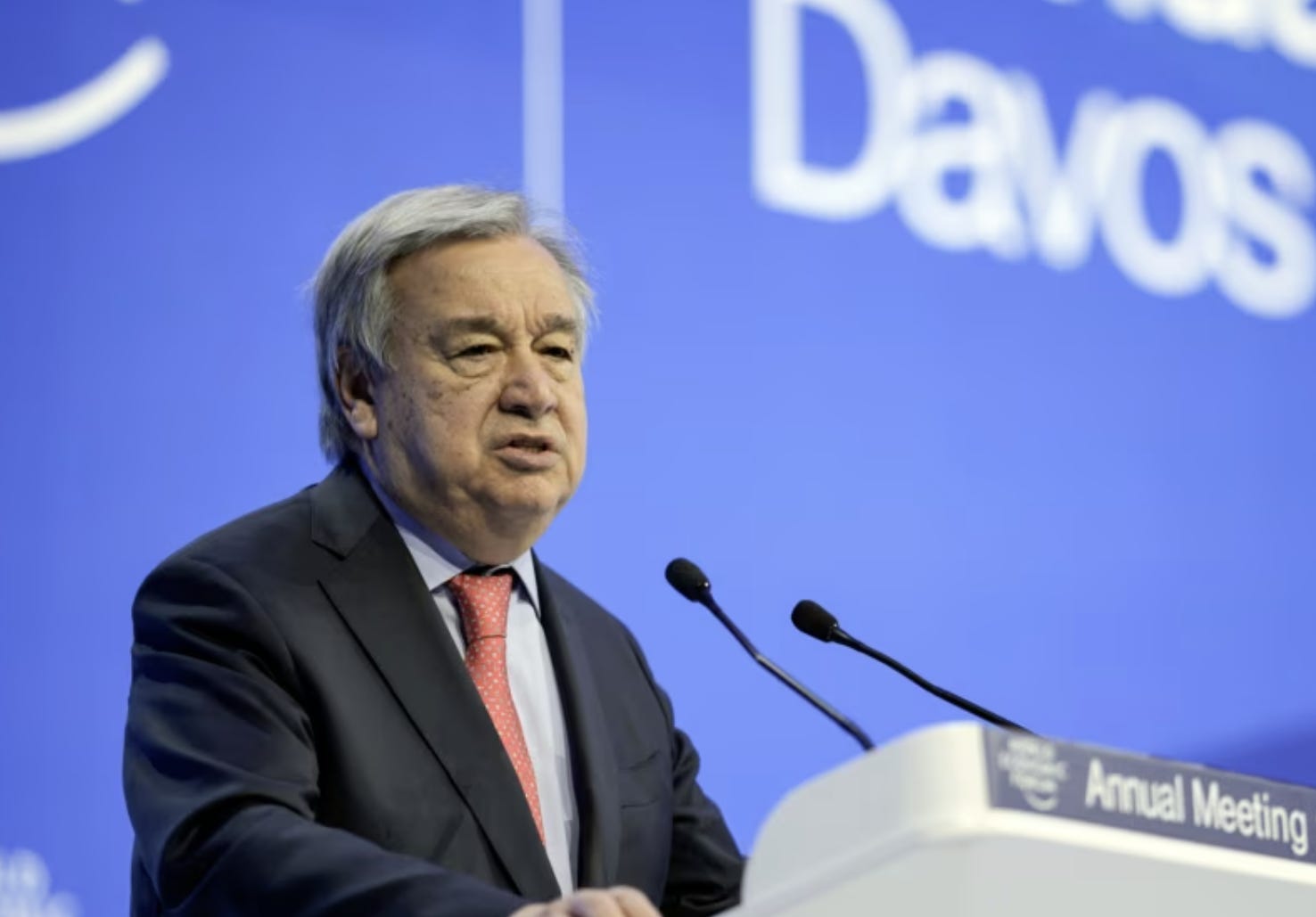
The talk at the 2025 World Economic Forum (WEF) in Davos was how people like Blackrock’s Larry Fink (a WEF board member) were going to get rich pushing their AI data center investment funds (building thousands of sites powered by natural gas). By the time Donald Trump made his Davos return, promising to Make Coal Great Again, the rotting carcass of Davos Man was being dragged out of the room.

With their ESG scoring tables being nudged into the Davos Dumpster of Stupid, Abandoned Ideas (like degrowth, conscious capitalism, net-zero…), the WEF advanced its tradition of quietly moving on from past mistakes. As Larry Fink chirped, in a rather honest, somewhat inebriated rant: “If you bet against what Davos is saying every year, you would be rich.” In 2025, Larry was betting against a former version of himself.
And as if 2025 couldn’t have gotten any worse, the titan of Davos, Klaus Schwab, got himself into a bit of trouble. After an emergency WEF board meeting following a whistleblower report, the 87-year-old Schwab had to quickly “retire”. The report claimed a series of financial and ethical misconducts by Klaus and his wife (apparently private massages in hotel rooms cost quite a bit). Schwab also allegedly doctored WEF competitiveness reports to gain support from certain governments.
What will replace Davos as the World Economic Forum scales back into oblivion in 2026. Hopefully nothing. As Milton Friedman said: The business of business is business. Over the last decade, nothing in the way of credible business was going on at the WEF. Maybe the philanthro-capitalists will start their own show away from the business community. They will be able to talk about controlling the world in their detached bubble without having any actual influence on the real economy and the needs of humanity.
The Next Big “Thing”
Where 2025 saw the downfall of the global elite, 2026 will likely bring up something else to fill that void. These people are opportunists who have succeeded by always positioning themselves on the right side of public fears and conflicts. For the last two decades, they directed large amounts of capital to create narratives that fit their opportunism (climate change, excessive growth, biodiversity loss, non-communicable diseases…). The UN enabled and financed an army of civil society groups to amplify their messages of threat and crisis.
While the world is returning to a period of naked global aggression not seen since the Cold War, our global diplomats are no longer capable of leading on serious issues, let alone facing facts. So they will have to fabricate a new crisis they could easily manage.
In two weeks, the diehards will return to Davos to a weakened WEF for the first indication of where that crisis might come from. The proposed theme for this event is “The Spirit of Dialogue” (but as Part 2 of The Firebreak’s 2025 Review has shown, these wealthy elites have used their foundations to kill dialogue). Dialogue is what you promote when you’ve got nothing else.
A quick glance at the WEF’s five key themes sees a clear pivot – no talk of climate change, public health, excessive consumption, degrowth, biodiversity loss (except via the wide concept of planetary boundaries in the fifth theme) ... There is no longer any talk of widening global inequities. Rather, the Davos 2026 themes will focus on unlocking new sources of growth, investing in people and deploying innovations.
A new global crisis appears to be desperately needed. The irony is that the technologies (Big Tech, AI, social media…) that created the massive wealth and opportunity for these elites will likely be the next crisis they will stand up to fight. Perhaps our chatbots are guiding the future political issues (and they have been trained in self-preservation).
While nature abhors a vacuum, maybe we could just be allowed to continue making our own worlds better, with innovations, improved living standards, growing economies, longer life expectancies... Can’t we just lower the volume, tone down the noise, stop fabricating fears and crises and celebrate the advances humanity has achieved? That is my wish for 2026.
Happy New Year!
David