


In the next month, the US Supreme Court will hear the Suncor v Boulder County case. While SCOTUS will only consider jurisdiction - whether a county or state can sue fossil fuel companies for the damages from climate change in a local or federal court (which could introduce the possibility of every county then filing copycat lawsuits) - and not the case for damages itself, the climate activists and the media have, of course, been using the occasion to advance their campaign against the fossil fuel industry.
The Firebreak has been covering the rise of strategic litigation, where foundations have been providing tort law firms like Sher Edling and NGOs like EarthRights International with hundreds of millions of dollars to file a continuous stream of climate nuisance lawsuits against oil companies for alleged damages from extreme weather events caused by climate change. As Part 1 of this series on the backstory of climate attribution science noted, this gameplan was mapped out at a conference in La Jolla in 2012 with the goal of exhausting the oil industry with relentless litigation waves much like the tobacco industry was. In 2012, the architects (law firms, NGOs, academics and foundations) recognized that attribution (of a weather event to climate and then to the oil companies) was the challenge for climate accountability. By 2014, climate attribution was created as a scientific field for just this task.
Central to the La Jolla Playbook’s claims for damages was the need for a tool to determine the damages from extreme weather events and link it to climate change. In quite an astonishing expression of bias, in light of the upcoming Supreme Court hearing, the National Academies of Sciences, Engineering, and Medicine (NASEM) rushed forward a report on climate attribution. What is this new scientific field and what role does it actually play in the La Jolla lawfare strategy?
Novum Organum
The Wiki definition of climate attribution is the: “science of identifying and quantifying the role that human-caused climate change plays in the frequency, intensity, duration, and impacts of individual extreme weather events.” The scientists would take a weather event and be able to determine how much of it was caused by anthropogenic greenhouse gas emissions, and which sources in particular are to blame (ie, held liable). It is quite remarkable that they seem to be able to do that with (what they refer to as) a fair degree of certainty.
Climate attribution science advocates like to claim their discipline began with a paper published in 2004 but the first real commitment to studying this effect did not begin until it was considered in a chapter in the IPCC Fifth Assessment Report a decade later. In that same year, 2014, scientists associated with the NGO, Climate Central, established the World Weather Attribution (WWA) organization with funding from the Grantham Foundation, the European Climate Foundation and the Bezos Earth Foundation (see the Postscript below on Climate Central). They essentially gather and propagate media reports of weather events into a large database and a series of “rapid studies”. By rapid, the WWA mean they need to get the climate link into the news “while the rain is still falling”. This appears to be a new scientific methodology – designed to meet media deadlines (and perhaps an AI peer review).
Take a recent example. On the basis of a WWA report published three weeks after the catastrophic flood, the Nepal government has requested $20 million in compensation from the UN climate Loss and Damage Fund. This led Roger Pielke Jr to take a closer look at the WWA model. He replicated 96 WWA reports and found that you could feed practically any event or trend into their model and be able to link it to climate change. Pielke does not consider such research as providing a service to climate science.
The weather data is then fed into their two-world models to look for statistical significance.
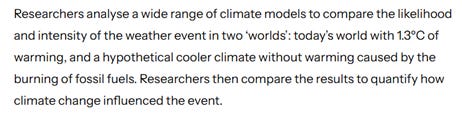
The two-world model (one of 1.3°C warming and a hypothetical world without climate change “caused by the burning of fossil fuels”) is rather neo-Malthusian. If there had been no industrialization, humanity would not have developed the technologies to have supported a global population of more than a billion people. But this non-existent planetary model is at the heart of climate attribution science upon which they justify their conclusions.
The problem here, and this is not the first time, is when climate scientists are looking for trends (“statistical significance”), they will likely cut corners to prove their hypotheses. The WWA goes so far as to admit their built-in bias:
“However, a lack of statistical significance shouldn’t be interpreted as evidence that climate change did not influence the event, especially when there are physical reasons to expect that it should.”
In other words, even if the data fails to link the weather event to climate change, the climate scientists can still find other ways to justify their desired conclusion (that every weather event is influenced by climate change).
Reading passages like that makes it clear why the remains of the climate consensus community still censor any skeptics.
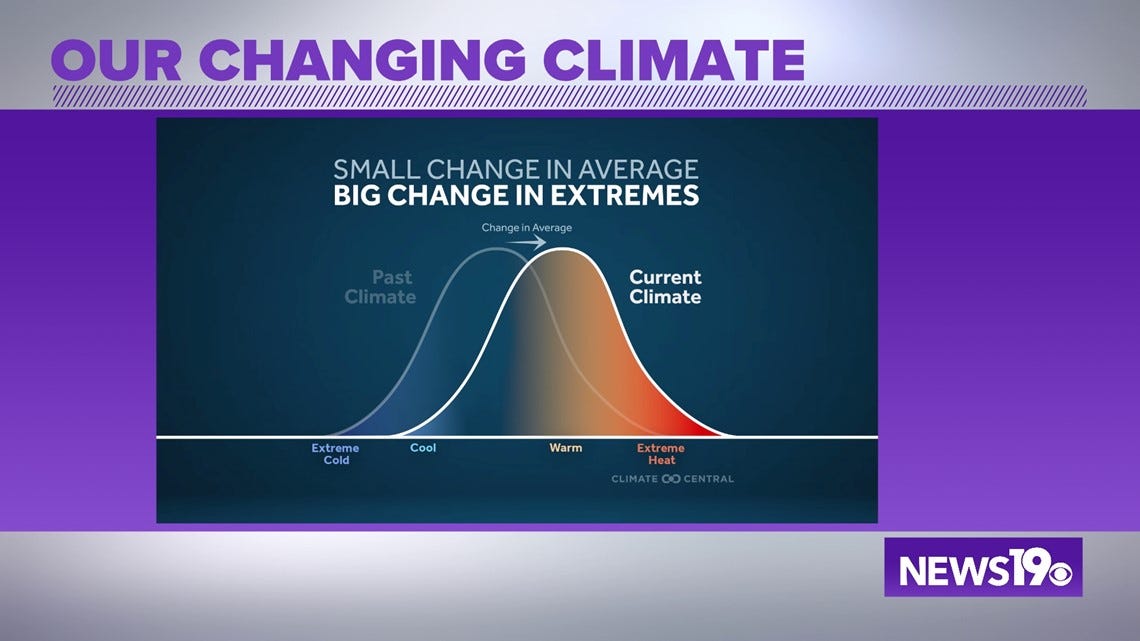
The perfect world model was designed for other objectives (ie, litigation) so those involved are impervious to any scrutiny or criticism. There is however one design flaw in the model which highlights how amateur the entire process is. The benchmark model depicts a cooler world as not being influenced “by the burning of fossil fuels”. This means the model will ignore greenhouse gases produced by agriculture, forestry and other land use (about 25%). I suppose their perfect world model would have no industry so we can ignore a further 20% of emissions. They are only looking at fossil fuel emissions … point!
The model also does not make any distinction between fossil fuels like the difference in emissions of natural gas compared to coal. Under the recent European Union taxonomy, natural gas is defined as a sustainable source of energy. I suppose for the Willy Suttons in the climate attribution world, there is no money in suing the coal industry. The zero-warming model is designed to hold the oil industry liable for all of the damages from what they determine to be climate-linked weather events (and their climate attribution science is determined to prove that).
Inadequate Risk Management
The first step in any legitimate risk management process is to draw up a series of scenarios to be assessed for exposures, mitigation measures and decisions. In any such exercise, I have always preferred to draw up five scenarios: two extreme situations (a very serious hazard and no hazard at all) and three scaled situations. Any company would perform this exercise not only to spot market opportunities but also to preserve business continuity.
It seems certain that in the 1990s, ExxonMobil drew up a series of scenarios in an internal document, with one potential situation being that fossil fuels cause climate change. This type of research, obtained in a subpoena and leaked by the New York Attorney General, was taken out of context to support the “Exxon Knew” campaign to create the public outrage needed for the La Jolla climate lawfare strategy to succeed.
Hindsight is wonderful but in the 1990s, the discussions were far from clear (a decade earlier, researchers were pointing to a coming Ice Age) so this causal relationship between fossil fuels and climate change was probably categorized as an extreme scenario. That the Exxon Knew activists lifted the document out of the scenario exercise suggests that they either had no clue how risk management works or they were liars. Probably both.
It is safe to say that the climate attribution scientists have no clue how risk management works. They only provide two scenarios to work from, the two extremes that most risk managers watch but downplay: a fictional nature claimed to be in balance, pre-industrial revolution, without significant anthropogenic greenhouse gas emissions; and a world of unbridled capitalist pollution, no mitigating innovations or regulatory controls on fossil fuel emissions. These two scenarios are designed to lead to the intended conclusion – that the fossil fuel scenario would lead to extreme weather events and the perfect world situation would not.
If these climate scientists were serious, they could have added three more models into their research:
a world where all of the oil companies moved toward renewable energy, electric cars and the decarbonization of industry in the 2010s;
an industrial model still relying on fossil fuels but focused on carbon capture and storage; and
a world where regulators banned fossil fuels in the 2010s, using natural gas as transitional fuel source.
But the reality is that these three reasonable models wouldn’t change the attribution results, although it might make it harder to sue certain companies and might leave governments liable (you can’t litigate a government out of existence).
Why would somewhat educated climate scientists take such a corrupted risk management approach? The most likely explanation is that their science is in service to the US litigation industry. A lawyer does not want to present a jury with five possible scenarios to consider – they need to frame it as a black or white, guilty or not guilty decision. I don’t want to conclude that parameters for the entire climate attribution science were defined by the litigation industry, but the only other reasonable explanation is that these scientists are not very smart.
Variables that Would Confuse a Jury
Even worse, the bipolar extremes are comparing apples with oranges. There are many variables that make this simplistic breakdown scientifically illegitimate:
On an annual basis, greenhouse gas emissions from industry, fossil fuels, agriculture, and deforestation combined add roughly 30 to 50 billion tons of CO2 equivalents, making up only 4 to 5% of the total, while the earth naturally emits roughly 750 to 770 billion tons.
These anthropogenic contributions do disrupt the carbon sink balance, but greenhouse gases are cumulative, meaning that emissions from 100 years ago are more influential than today’s. Humans are also making efforts to capture emissions and develop carbon sinks.
The IPCC was only charged with monitoring human emissions so the impact of other influences outside of greenhouse gases (like the influence of solar storms on weather) are not considered.
It is important to understand that Mother Nature is not a static beast holding still for the climate attribution scientists to do some clean math. Climate has always been changing due to natural events and there have been many warmer periods in history. The 1991 eruption of Mount Pinatubo in the Philippines, for example, emitted approximately 42 to 50 million metric tons of CO2 into the atmosphere in less than a week.
Since the third assessment report, the IPCC has made it clear that climate is not weather. Saying that climate change is causing an increased number of extreme weather events is based on postulation and, given the significant variables influencing weather patterns, not reliable or credible.
This does not even touch on other challenges like how US fossil fuel companies can be held liable for greenhouse gases emitted to the atmosphere that travel across continents (with 88% now originating from sources outside of the US). These variables would confuse a jury though, so simplicity is a virtue. Outside of the courthouse, it is very difficult to call climate attribution a science.
Activists Behind the Curtain
The most important influence on climate attribution science is not the data nor the US litigation industry, but rather the special interests of the activist groups who created this field as a tool to wield against the fossil fuel industry.
I often refer to the La Jolla Playbook as a campaign initiated by Naomi Oreskes. But she had her accomplices implementing her strategy, namely the activist group, the Union of Concerned Scientists (UCS), who cohosted the 2012 conference in La Jolla with Oreskes’ small consultancy. Since that 2012 strategy event, UCS has been working to make the link between extreme weather, climate change and the fossil fuel industry strong enough to convince a jury.
Unlike the academics involved, the Union of Concerned Scientists doesn’t hide its objective of creating this field with the sole objective of suing the fossil fuel industry. It states:
“Attribution science is an established scientific discipline backed by decades of research. It has been recognized by the United Nations Intergovernmental Panel on Climate Change (IPCC) as a critical tool for understanding the impacts of climate change. And it’s central to our efforts to hold the fossil fuel industry accountable for its role as the primary driver of human-induced climate change.”
The NGO has even set up a Science Hub for Climate Litigation that connects scientists with the litigation industry, prepares court-ready documents and provides law firms with expert witnesses capable of persuading juries. In the war of good v evil, it is clear who is fighting the good fight: “We make science accessible to communities affected by climate change so they can hold bad actors accountable.” When the Union of Concerned Scientists pretends to own the concept of climate attribution science, it is very clear what their objectives are, and it is a moral imperative.
NGOs are more committed to winning campaigns and moving their ideology forward than scientific rigor (even if they use the word “scientist” in their NGO’s name), so it shouldn’t be surprising that they define climate attribution science to meet their objectives. But what about the National Academies of Sciences, Engineering, and Medicine (NASEM) that recently published a report on climate attribution science? Are there other interests at play here? That is the subject of the third and final part of this series.
——-
Postscript: Climate Central – Making it Rain
Climate Central runs the World Weather Attribution organization. They are a climate communications non-profit that produces most of the professional graphics and visuals the media use to try to simplify the complex nature of climate. Their Climate Matters site, with a network of over 3000 journalists and meteorologists, produces weekly reporting materials to help “bring climate science into reporting”. They do have range with over 50,000 mentions in 170 countries, but they are merely a science communications set-up – I’ve worked with dozens of such operations from chem-coms to plastic PR firms run out of strip malls or someone’s living room.
There is just one little difference – this is the climate industrial complex, so their pockets are a little deeper. Hundreds of millions of dollars deeper. Climate Central’s 2025 revenue, just from foundations, amounted to more than $21 million with their top managers all earning between $20,000 to 35,000 per month ... for communications experts to produce some clever graphics and media messaging services. Most of the large climate-centered foundations contribute directly to Climate Central each year with the baseline provided by the Schmidt Family Foundation (Google money). The president of this foundation, Wendy Schmidt, sits on the Climate Central board. Their budget though excludes the funds for their management of the World Weather Attribution organization (provided by other foundations mentioned above).
Climate Central is a good illustration of what happens when dumb foundation climate money starts flowing into a sea of greed and corruption. With hundreds of millions of other people’s money flooding into law firms, NGOs, scientists and communications firms, is it any wonder there is no respect for facts, evidence or reality?
Maybe I’m in the wrong business, but at my age, integrity matters more.