


The recent criticism of the National Academies of Science, Engineering, and Medicine (NASEM) is not an issue of climate skepticism or denial. There is no denial of facts that the planet is warming and what may be the consequences. As much as activists want to paint the crisis along the lines of a right-wing v left-wing political conflict, this emerging scandal is a result of unethical academic behavior by a small group of highly-paid climate attribution interest groups.
The recent activist campaigns on climate attribution implicating NASEM demonstrate levels of greed, corruption and abuse of research never seen before in any scientific community (and far worse than the University of East Anglia Climategate scandal from almost two decades ago). The NASEM scandal not only involves academic deception, but it is also poisoned by big money from foundations and litigation industry opportunism. The misuse of academic positions to appeal to these interest groups has led to a breakdown in public trust that will have a profoundly negative effect on the reputation of science.
In Parts 1 and 2 of the Firebreak exposé into the field of climate attribution science, it was seen how the “science” was created to provide evidence to the US litigation industry to prove that certain extreme weather events could be attributed not just to climate change, but to the fossil fuel industry’s greenhouse gas emissions in particular. The reason for these caveats on climate science was so their research could then be used for lawsuits against the fossil fuel industry ( known as “source attribution science”). Needless to say, this was “Hillbilly Science”, funded by foundations to support a number of ongoing lawsuits against Big Oil (also funded by the same foundations) as part of a larger La Jolla Playbook established in 2012 by a small group of political activists and lawyers.
The NASEM scandal started when the National Academies published the climate science chapter in their 2025 update of the NASEM / Federal Judicial Center’s Reference Manual on Scientific Evidence, and a report last July on climate attribution science entitled: Attribution of Extreme Weather and Climate Events and their Impacts. Was this an attempt to legitimize a bastard child of the climate science community or was this the future direction of climate science (the anti-capitalist goal that many social academics like Naomi Oreskes have made a life-long ambition to see fulfilled)?
In any case, what is needed is science-led litigation. What the National Academies have delivered is litigation-led science. The scandal has caused a crisis in public trust.
To put this in context, the litigation industry, supported by hundreds of millions of dollars in foundation funding for strategic litigation NGOs and specially created climate lawfare firms, has been pushing to firm up court-friendly evidence ahead of the deluge of climate justice lawsuits they expect after the US Supreme Court decision on Suncor v Boulder County (heard yesterday). NASEM is being used to play a key role in the production of this litigation-friendly evidence.
What is increasingly becoming clear is that there is a small group of academics (mostly law professors and social scientists) moving freely between foundation fund managers, state attorneys general offices, judges, law firms and science policy institutions. Their strategy is to legitimize a climate attribution science that they can then use to generate evidence in suing oil companies for damages from extreme weather events they have been trying to link to climate change.
This is a story of how money, politics, corruption and deception can destroy trust in science and perhaps bring down a major American scientific institution founded in the 1860s.
Part 3 will look at how this small group of foundation-funded academics has been working to corrupt climate science for the benefit of the forces launching a climate lawfare onslaught upon the energy industry. This section will focus on the groups behind the NASEM reports (setting up the next chapter on the Institute trying to train federal judges). The Firebreak also looked into the recent infiltration of activists into the state attorneys general offices to act as special prosecutors.
This relatively small group of activist academics that have led this charge could be called the “Climate Attribution Cabal”.
The Climate Attribution Cabal
There seems to be the same five organizations working together to advance their political litigation agenda under the pretense of climate attribution science. All of them are generously funded by large, climate-oriented foundations, closely tied to law firms, strategic litigation NGOs, attorneys general or judges (that they are trying to bias). (Note: the term “climate cabal” has been used elsewhere to refer to factions working to speed up or delay climate regulations, but never to a private clique of academics.)
Some of the leaders of this climate litigation campaign faction include:
The Sabin Center for Climate Change Law (with funding from the Rockefeller Family Fund among others with Columbia University serving as its fiscal sponsor) is tied to Sher Edling and their unlimited funding from seven large foundations to conduct climate lawfare.
Climate Central ($21 million last year from foundations like the Schmidt Family Foundation and others) runs the World Weather Attribution organization (funded by the Bezos Earth Fund and others).
NYU Law School took $5.6 from Michael Bloomberg to set up a phantom organization, the State Energy & Environmental Impact Center, that appointed and paid the salaries of Special Assistant Attorneys General in eleven (Democrat-led) states to prosecute oil companies.
The Union of Concerned Scientists’ Science Hub for Climate Litigation has the objective of advancing climate accountability. This cofounder of the La Jolla Playbook is funded by the Bezos Earth Fund, Rockefeller Family Fund, Grantham Foundation, ClimateWorks…
The Environmental Law Institute, funded by Hewlett, MacArthur and Walton Family Foundations, set up the Climate Judiciary Project to “educate” judges likely to hear climate lawfare cases about the links between extreme weather events and fossil fuel emissions that contributed to climate change. More on this in the next Firebreak chapter.
These are the principal groups forming a cabal that has controlled the climate lawfare process: influencing the state attorneys general from the inside, running the law firms, brainwashing the judges and convincing the frightened public that any climate justice served on Big Oil will save the planet (while they can continue driving their cars and heating their homes at no extra cost).
And together, this Climate Attribution Cabal directed NASEM to deliver a litigation-friendly science on climate change, climate attribution and climate justice lawfare.
There are actually two NASEM scandals (involving the same cabal special interest groups).
NASEM Climate Attribution Scandal 1.0
NASEM, together with the Federal Judicial Center (FJC), rushed through an update of the Reference Manual on Scientific Evidence in 2025. This manual is meant to provide the best scientific research to guide the courts on technical evidence required in many lawsuits. The latest update, for the first time, included a chapter on climate science for the judiciary (ie, climate attribution). The climate chapter was quickly retracted following complaints from 27 state attorneys general who charged it with poor methodology and a bias to influence climate-related litigation.
In an article from last March, Roger Pielke Jr got into the details of the how the climate chapter in the NASEM-FJC Reference Manual was removed from the latest update. The two authors of the chapter, Jessica Wentz and Radley Horton, are both affiliated with the Sabin Center for Climate Change Law. Pielke showed how the section on climate attribution had a 41–48% of overlap with a 2020 article published by the head of the Sabin Center, Michael Burger. Pielke concluded that Burger had ghost-written the chapter on climate attribution science.
This should come as no surprise. In a recently released email, the principal editor of the NASEM / Federal Judicial Center’s Reference Manual on Scientific Evidence, Joe Cecil, invited Michael Burger to write the chapter on climate science, asking him to base it on his 2020 article on climate attribution (and offered to pay him $8000 for his quick turnaround that would be rushed through peer review, all within three months). See the email below.
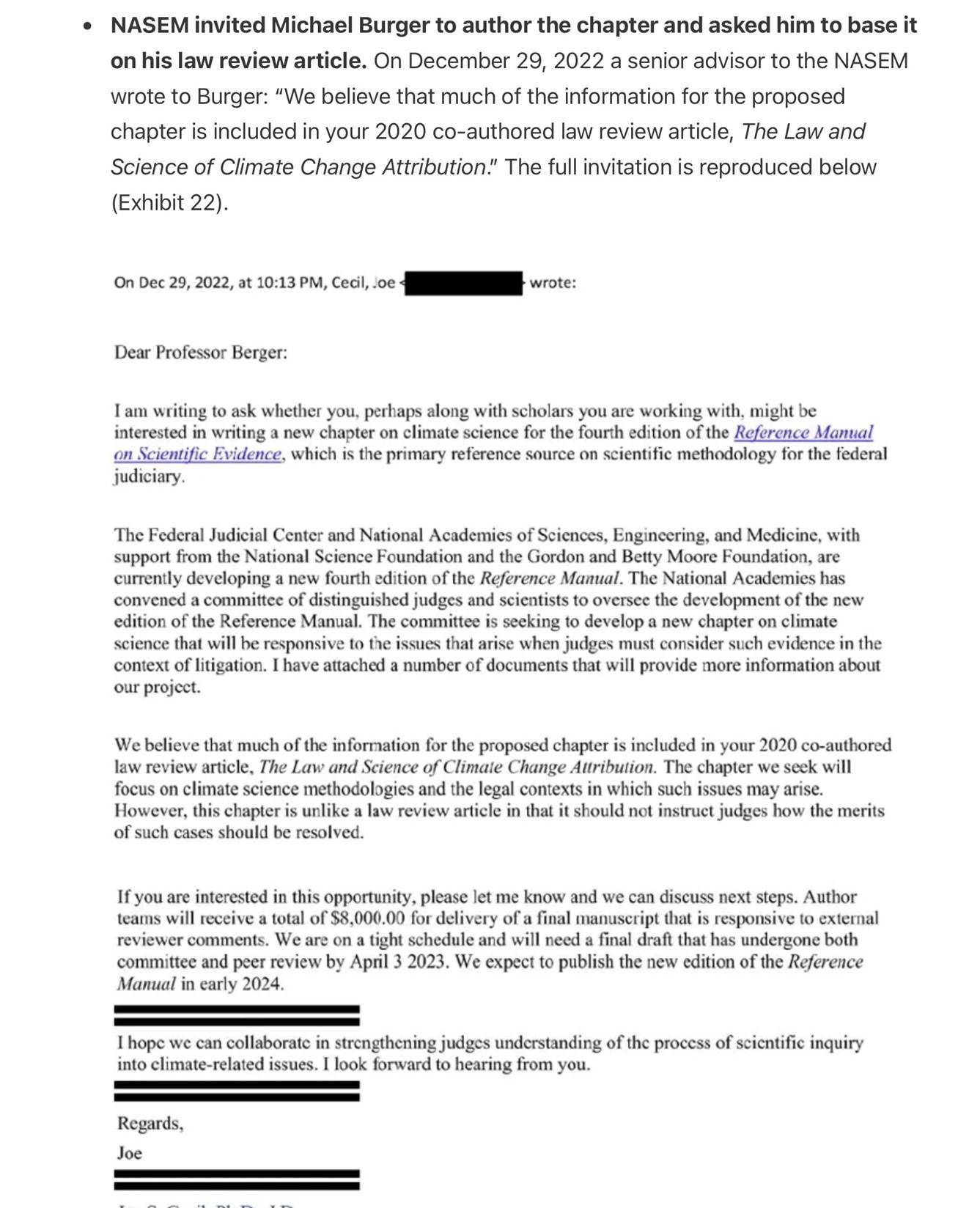
As a recent Firebreak article showed, Burger is also employed by Sher Edling (as well as the Sabin Center) but these conflicts of interest were not acknowledged when he contributed to the NASEM climate attribution report (claiming only an affiliation with Columbia University). Sher Edling, the foundation-funded law firm filing climate nuisance lawsuits against the fossil fuel industry, would clearly benefit from having their man on the inside, writing national science policy documents for the courts to base their decisions.
It is curious to note, from a recent disclosure of controversial emails between the cabal members, that NASEM knew of Burger’s conflict of interest, and rather than acknowledge it, they decided (less than a month before the April 3 peer review deadline when we can only assume the chapter had been completed) to remove Burger’s name from the climate chapter in the Reference Manual.
See a truly despicable affront to research integrity in the email below.
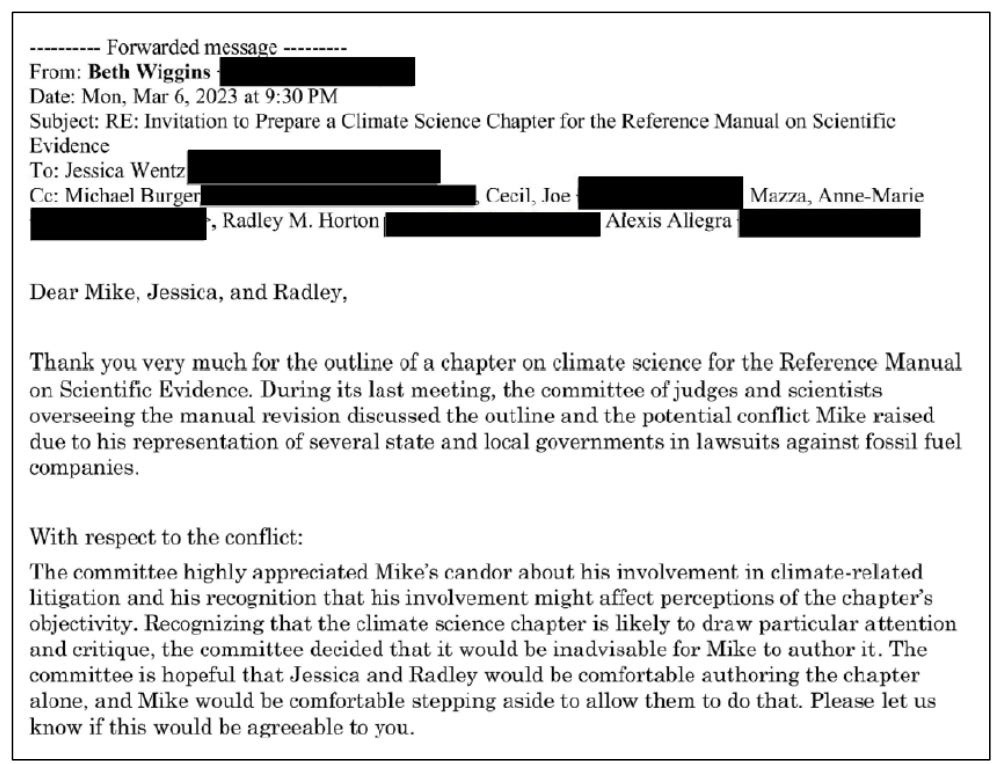
Pielke was right then on his original suspicion back in March that Burger had written the climate chapter in the Reference Manual, but for the wrong reason. He suspected fraud within Sabin (plagiarism and ghostwriting) while the real reason was an intended cover-up of conflicts of interest at NASEM - at the research institution level.
I fear we will need to conduct an ethics review to determine which of these scientific misconducts is more detrimental to research integrity. In any case, NASEM needs to fire several of their more gung-ho activist scientists. Maybe the foundations should close down the Sabin Center they are funding as well (in the same way Bloomberg made the State Impact Center vanish into the night when things got “inconvenient”).
Even more curious, Burger submitted an amicus brief on behalf of Sher Edling for the US Supreme Court case on Suncor v Boulder County. This amicus brief relies heavily on Burger’s contributions to the NASEM report. The case before SCOTUS is not about the reliability of climate attribution science, but whether such cases fall under the remit of county or state courts or only federal courts.
Suncor v Boulder County is a crucial case for the La Jolla Tobacconization Playbook. If a county like Boulder can be allowed to sue oil companies for damages from climate change, then the foundation-funded litigation machine will file cases in every county court in the US. There are over 20,000 counties and cities in the US. The strategy here is not to win on the science, but to overwhelm the fossil fuel industry with relentless lawfare, suing them out of existence. Like other La Jolla inspired mass tort lawsuits (glyphosate, talc …), it is expected that oil company shareholders (fund managers) and board members will pressure the management to settle as the share prices tank.
In 2012, the report published after the Climate Accountability conference in La Jolla, CA recognized that the law firms would need to develop a strong climate attribution science (linking extreme weather events to climate change and then to the fossil fuel industry), and from that, academics set out to establish a robust new field in climate science (designed for the litigation industry). The second NASEM report on Climate Attribution Science marks the high point of this political strategy.
NASEM Climate Attribution Scandal 2.0
The second scandal involves the NASEM report: “Attribution of Extreme Weather and Climate Events and their Impacts” published on July 16, curiously just 11 days before the cut-off date for the Boulder merits brief for the Supreme Court case, Suncor v Boulder County. While it is clear that this field of climate attribution science is promoted by climate lawfare special interests who would promote selections of the document, what did NASEM pretend that the report would cover?
The Terms of Reference
The NASEM report on climate attribution was called within the context of updating the state of the science following from a previous study in 2016 (Attribution of Extreme Weather Events in the Context of Climate Change). A decade ago, there were many weaknesses in attribution science (data gaps, methodology, reliability of certain types of weather events…). The terms or reference (TOR) of the 2026 NASEM was quite simple: In the last decade of research, has the attribution science field (methodology, capacity, data, scope…) since improved to enable linking extreme weather events to climate change (and what are future research needs)?
The TOR was minimal because the field is limited. The first sentence defines the climate attribution science accordingly: “Event attribution seeks to tease out the influence of human-caused climate change on specific weather and climate events.” To “tease out” an influence is a rather interesting choice of words. If you tease something out, it implies that you are aware of the limitations and try to avoid ambitious declarations or conclusion given the wide degree of variables.
The NASEM TOR was therefore not ambitious and much of the report reflects that caution. It was not charged with providing evidence for the US Supreme Court, or any other courts, to consider. Nor was it asked to determine whether climate change exists or whether humans influence climate. The TOR did not require a focus only on fossil-fuel based greenhouse gases or appropriating blame for the cause of climate change.
While their mandate was quite clear, the NASEM was once again taken over by activist scientists who saw political opportunity in pushing the TOR towards political and litigation opportunism. For coverage on some of the special interests that have pushed their way into this NASEM process, see an earlier Firebreak article that showed the influence of the litigation industry, climate comms organizations, lobbying groups and media outlets committed to amplifying climate fear campaigns. But the most curious special interest involved in this NASEM report is the lead foundations funding its production.
Special Interest Funding
The NASEM report on Climate Attribution Science is not a government funded research endeavor. The lead funder listed on the NASEM front page is the Bezos Earth Fund. At the same time, the Bezos Earth Fund is a key funder of the World Weather Attribution (WWA) organization leading the campaign to link all extreme weather events to climate change.
In December 2022, the Bezos Earth Fund awarded $10 million to their “Advancing and Communicating the Science of Extreme Weather Attribution” initiative. This included organizations such as Climate Central, Imperial College, and Yale University. The Bezos site added “and others” who received funding, although there is no mention of how much money was given to NASEM to produce a report that would reflect their $10 million investment in climate attribution science. NASEM did not declare the amount this foundation provided for the research and production of this report.
This is an evident conflict of interest. The Bezos Earth Fund has invested $10 million dollars in promoting research proving the link between extreme weather events and climate change (and linking them to the fossil fuel industry for litigation opportunities).
The National Academies of Sciences, Engineering, and Medicine took money from the Bezos Earth Fund to produce a report on climate attribution science, and it is hard to imagine that they were unaware of the foundation’s $10 million in special interest funding. In any scientific institution with integrity, this financial transaction should have been refused or it would have disqualified the entire report.
The second foundation funding this NASEM report was the Heising-Simons Foundation. Mark Heising is the chairman of the Environmental Defense Fund, a strategic litigation NGO and cofounder Liz Simons contributed to California Attorney General Rob Bonta shortly after he sued oil companies.
Beholden to the Cabal
As if the direct funding weren’t enough, the NASEM climate attribution report acknowledgements page reads like a Who’s Who from the Climate Attribution Cabal, with at least six members contributing to the report’s content.
The National Academies seem to have become beholden to a group of activist climate academics (mostly law professors) who will stop at nothing to advance their strategy of exacting climate justice through the litigation industry’s relentless climate lawfare campaign. Meanwhile these Cabal members can be seen at conferences and events like UN Climate COPs posing as climate scientists. They are anything but.
The next part of this investigation will look at another member of the Climate Attribution Cabal, the Environmental Law Institute, that has been targeting judges for training courses via its Climate Judiciary Project where they teach judges how to identify the right evidence on climate attribution to use in court decisions. Last week, the House of Representatives Committee on the Judiciary released a report entitled: “How Radical Environmental Special Interests Manipulate the Federal Judiciary”. While it focused on ELI’s Climate Judiciary Project, its release of emails provides an enlightening investigation into the close ties and coordination within the Climate Attribution Cabal.