


Date: March 1, 2026, 10:00 am
Location: UCSF, San Francisco
Attendees: Don, Joanna, Robbie, Sam, Susan, John
Subject: Finding new targets for MDLs
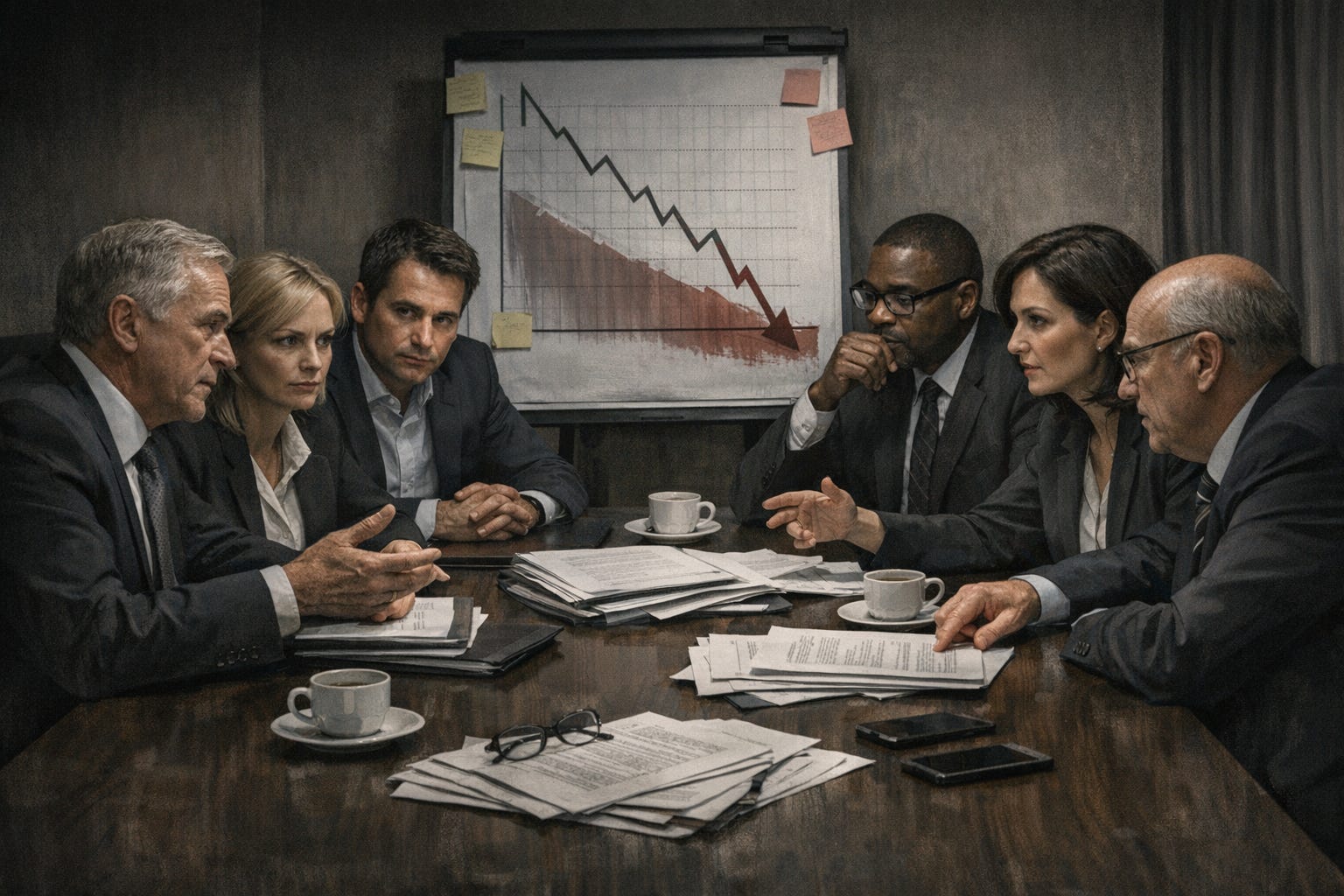
Don: Thank you for joining us today. The purpose of this meeting is to find new chemicals and companies to focus our next wave of litigation efforts on. It has been an amazing time for our industry. We moved from being the joke of the legal profession, the greedy strip mall ambulance chasers, to becoming the wielders of social justice by: shaping societal narratives with our influence on regulators, the media and filmmakers; having the ability to fund studies to create courtroom-ready evidence; and being the true public defenders protecting humanity from the excesses of industry and capitalism. With billions in fees from recent headline lawsuits, we have built an empire of power and control.
… But we are also vulnerable, as the expenses and debt of our industry has grown faster than our opportunities. For some time now, we have needed much more revenue and, quite frankly, we are running out of credible cases on talc, glyphosate, fossil fuels and benzene. I think we have exploited these issues as far as we could but our budgets and debts keep multiplying. Bottom line: Given our cost structure, we urgently need big health issues to harvest new revenues from.
Robbie: I thought we were moving on paraquat? We invested a lot in that EWG journalist to promote the “Paraquat Papers”.
Susan: No, the science was really weak there and the bellwethers were an embarrassment. I thought we had bought that judge, but she really ripped into our strategy. And in any case, Syngenta, our primary target, announced they were going to stop producing the herbicide. That means the punitive damages part of the court decisions would be lower. That is always our best fee source.
Joanna: But herbicides are a real money spinner. We have built a strong network with the Moms, the NGOs and Big Organic behind us, most of the public will believe anything we say about the risks of herbicides and almost everyone except farmers think they’re unnecessary.
John: Didn’t we fund a group of scientists around that Benbrook fellow to test urine samples of pregnant women to track the correlation between herbicides and neonatal issues? That was sure to be a blockbuster, plus the researchers were eager to refer plaintiffs to us and act as litigation consultants. What did they call themselves?
Sam: They were called “Heartland Something Something”. I heard they folded operations after failing to get government recognition and funding. Then their new director had a rather public meltdown after he discovered the rules the scientists were breaking and what they were actually doing for us. He kept going on about them needing more integrity and some ethical procedures.
John: That’s too bad – Our law firm invested a lot of money into them via their donor-advised fund.
Don: Look, I am not going to have to remind you how urgent this is. Speaking for our firm, the litigation finance interest rates are really starting to bite. One more appeal on talc and we will have to ground one of our jets.
Robbie: Yeah, I hear ya. We’re selling off caseloads and had to cut our plaintiff settlement contributions to under 10% … some clients have even complained to the press … in breach of our NDAs. Thank goodness our media groups kept that off the news. … What are your loan rates, if I may ask?
Don: 25% annual interest and 25% of the payout or settlement. But they keep rolling the debts over, never question new loan applications or follow up on how we actually expense the cash.
Joanna: That’s pretty good. Can you give me their number? … What about climate change issues. Couldn’t we sue Big Oil for hiding the facts and causing climate change? Foundations will give us millions to file these climate nuisance cases so we don’t have to invest much into trying to win.
John: No, been there, done that. New Ventures Fund tried to group foundations together to support Sher Edling. They haven’t won a bloody thing and wasted too much cash on celebrities. The idiots were even plagiarizing their arguments.
Joanna: But Sher Edling were trying cases on behalf of State governments who were only interested in political posturing. What if we try to get plaintiffs who lost their homes to storms and wildfires to cry in front of juries?
Don: Those would give us peanuts. How much is a house worth? 10 mill, plus 100 more in punitives? That won’t even cover our ad spend and expert witness fees. The foundations were funding Sher Edling’s lawsuits just to harass the fossil fuel industry – they never planned to win.
No, we need something big, where we can file hundreds of thousands of cases to extort a large corporation to settle for tens of billions of dollars. It is the only way we can pay off of our debts and open up a new cash line with the finance firms.
Joanna: Whatever happened to those scientists and NGOs we had been funding to create doubt on artificial sweeteners? Didn’t we have Coke against the ropes to be the next Monsanto, with aspartame as the next glyphosate?
Susan: I thought so too but the industry groups finally got up and did something. They got the governments of Japan and the US to push IARC into a corner. We only got a “possibly carcinogenic” classification from their aspartame monograph, and that wasn’t enough to sway even the most outraged jury. I fear industry is finally catching on to our IARC playbook.
Don: That’s bad news. Can someone please tell me why we are paying those Collegium Ramazzini scientists so much if they can’t deliver a simple 2A classification? I mean, it’s only a hazard assessment for Christ’s sake.
John: Yeah, Fiorella doesn’t have the same influence as she used to. I blame the Russians.
Don: And Chris, Martyn, Philip and Bernard are getting on in age. We need some young blood to take over there. Daniele was good but he got himself into a little bit of a scandal and lost his job – does anyone know if we were found out in that scandal?
Joanna: I’ll check with Jennifer at Mercury Films. She’s always been very discreet. In any case, it wouldn’t help Ramazzini to expose us, so they are doing a good job keeping the media at bay.
Sam: I was reading somewhere that vaping might have health issues. Should we take another swing at Big Tobacco. Juries love to hate them.
Susan: Not gonna work. The science isn’t there, nicotine does not cause cancer and the harm reduction advocates have a compelling argument.
Sam: But we don’t need science, never did. Look at how Michael Bloomberg has made it rain. He is coming up to two billion in funding his campaign against tobacco harm reduction alternatives, has the WHO in his pocket and has an entire flotilla of highly-paid activist NGOs following his directions. Surely we can tap into some of that loose cash pile.
Don: At most we could only get a billion from them, nowhere near enough to move the needle. In any case, Big Tobacco is so last century. We need the next new Big Tobacco. Has anyone lunched with Naomi lately? I should give her a call.
Joanna: Well, didn’t we pay a group of researchers to make the case that the food industry is intentionally making people addicted to ultra-processed food? They even found some former tobacco scientists in their labs. That story writes itself – especially all of those big fast-food corporations who would settle out of court in a heartbeat. Ten billion is absolute peanuts for them.
Robbie: Two problems there. One, they print all of the food information on the back on the tray linings so the customers only have themselves to blame for their poor food choices. Two, we haven’t even got a definition of ultra-processed food and most research is based on really weak correlation studies. We’ll lose all cases in appeal when we aren’t able to choose the Judicial Hellhole jurisdictions and judges.
Don: What’s the point of paying campaign contributions to all of those judges and attorney generals if they can’t deliver anything for us?
John: I was thinking that the plastics industry is ripe for some settlement harvesting. There are a few cases in California against industry’s claims of being able to recycle plastics. These were funded by that Australian metals industry billionaire, so maybe we could amplify them with claims for environmental clean-up costs and force a settlement.
Susan: Sorry, but nobody in any courtroom cares about the environment. We need to march in the walking wounded, preferably hooked up to IVs, to show how plastics poisoned them and made them sick.
John: Our firm has been funding studies into microplastics causing all sorts of diseases and endocrine disruption. Can’t we start advertising for victims? I’m sure Andrew at Minderoo will underwrite our bellwether cases.
Robbie: Negative. The studies have all been making claims that are embarrassingly unsubstantiated … sorry. It doesn’t matter how many times our NGOs push that fear campaign, it is not sticking. PFAS??? Only regulators gave a damn and many are walking those decisions back. And besides, most of the companies processing the plastics that we are detecting in humans are small, downstream operators. They will just go bankrupt and that is a rabbit hole I am not going down again.
Susan: We can always hit Tylenol for autism. Bobby Jr practically handed that to us on a platter.
Don: Yeah, but Kenvue is on its knees already. Do you really want to spend the next decade in bankruptcy arbitration?
… Guys, this is going nowhere. We need new blood and we need it soon, otherwise it is back to the strip malls for a good number of us.
Joanna: You make us sound like vampires. (Heavy, nervous laughter from Don and Robbie)
Sam: We investigated the books of most Big Tech companies, and their cashflow will easily cover the billions to settle out of court. Given our financial distress, we need to go after the motherload.
Robbie: Yeah, but what cases can we use to extort them?
Sam: I’m sure we can find something. We might be able to go after Apple and Samsung on cell phone radiation. We can find some scientists to link 5G to cancers. Or maybe file more cases against social media companies for getting our kids addicted and depressed. The GenZs are ready and willing to take a microphone to claim their victimization. I mean, … they’re already doing it on TikTok. Then there is data protection, AI and misinformation. The public hates these tech billionaires so the juries are well-primed to deliver a few landmark decisions. We can easily pay some experts to come up with some evidence and publish some papers in the usual journals.
Joanna: But we are risking getting more and more exposed as the power controlling these issues from the shadows. Isn’t there a threat of reputational damage to our industry if a couple Elon posts stick to us?
John: No issue. Big Tech is falling more and more into the Evil Industry category. Did you see what the media did to that nice Sam Altman guy? Now the public are attacking his house. No, the public will be too outraged by industry malfeasance to notice the billions we are harvesting from them. They lie and we lie low. Our networks and industry groups will do all of the work for us. Those New York and DC-based NGOs we have been using work for peanuts.
Susan: It’s time to tobacconize them! Maybe our friends in IARC can do another monograph on cell phone radiation and cancers. I’ll reach out to Chris and Bernard to make some calls. Our journalists and foundations won’t need much convincing to use our reports to go after them.
Don: OK, it looks like a plan. Their pockets are deep and the billionaires don’t want to be vilified more than they already are. Let’s get a group together to see what Big Tech companies are doing that we can sue them for, then we can target one company and start planning our campaign. We’ll need to decide whose litigation finance company is going to underwrite and package this one.
Sam: We should set up a separate shell foundation to coordinate the attacks. Which NGOs and universities can we sign on? Let’s start with a short list of academics for our fiscal sponsor group.
John: And Davos has been picking up the AI and security points at the last two meetings. With all the scandals going on, I guess Larry is the one we should tap into at the World Economic Forum? I know Blackrock is rolling big time in data center investment funds, but this wouldn’t be the first time we got him to speak out of both sides of his mouth.
Don: Good points. But we’ll need to generate some credible-sounding evidence first. Remember the chemtrail fiasco? Shall we meet up at the Rockefeller Foundation’s New York offices in a month to start developing a strategy and dividing up who gets to sit on the Plaintiff’s Bar?
Meeting closed at 11:45, followed by a nice lunch.
These minutes are not 100% accurate. Given the nature of the business, it is likely the vocabulary and attitudes were less humane.