


Watching a recent webinar on strategic litigation (ie, how NGOs can sue governments and industry) it became clear whenever the activists referred to industry, they seemed to be working from a simplistic, single-minded perception of what industry is. Was this intentional or are these activists actually that naïve?
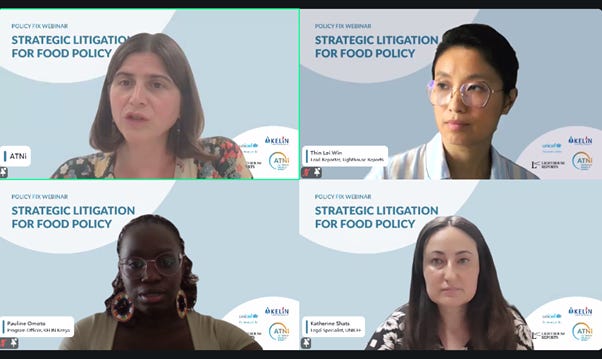
When activists refer to Big Food or Big Chemicals or Big Oil (all of whom are operating from the same playbook established by Big Tobacco), these present business groups as unified behemoths seeking the same goals and opportunities. When industry lobbies or files lawsuits, it is assumed that all industries are pushing for the same outcome. All that post-capitalist NGOs have to do is count the number of industries filing lawsuits or lobbying government officials, brand it as industry interference, and use it in their anti-industry campaigns. We saw this in activist complaints against industry involvement in UN conferences.
Anyone who has worked in industry will know that nothing could be further from the truth. There is no such thing as the Chemical Industry or the Food Industry but rather a series of companies, traders, manufacturers, importers across a wide value chain, many with competing interests and varying target audiences. To save on costs, for regulatory research issues as an example, a company may join a trade association, but this grouping is usually neutered and tending to represent the lowest common denominator.
When a company lobbies a government, it is not trying to influence decisions to harm the public, consumers or the environment, but rather to protect their interests against other companies lobbying for their advantages. So a company in France with access to a stable supply of nuclear energy, may lobby for stricter CO2 emissions on manufacturing while another company in the US will want to protect its fossil-fuel based energy advantage.
Sometimes companies will run full-out assaults on their competition. I have referred to this as the tyranny of the alternatives where, rather than innovating to gain market share, it is more profitable to invest in fear and outrage campaigns against your chief competitors. When I was working on brominated flame retardants, it was clear that the main lobbying assaults originated in Norway and Washington State, the two main regions for the aluminum industry. After the Greenpeace “Green my Apple” campaign, Apple shifted from plastic computer casings (that would burn without protection) to aluminum. As the US is regulating the replacement of lead water pipes, we see intensive pressure on PVC plastic pipes from the steel and copper industries. Who is behind the PFAS campaigns? Just look at which industries are profiting. In these cases, NGOs campaigning against plastics are not innocent actors in these internecine industry conflicts.
What is an Industry?
I once visited a family farm in the UK and spent time with a father and son as they were negotiating the purchase of a new tractor. To save on taxes, retail processes, subsidies and succession issues, the farm was registered as a public company with a VAT number. To a food activist, they would paint this as a company and part of the massive conventional agriculture industry. If only the tractor company would come under the same heat as this small family farm has.
Is an industry defined by the same market and products? An upstream plastics manufacturer has different markets and issues than the downstream plastics converters, bottlers or packaging companies. And plastics is a general term encompassing a wide range of feedstocks, processes and applications. When researchers at a company I worked for were trying to develop a soft polypropylene alternative to PVC blood bags, I began to realize that that the company was not itself a unified whole. Business sector groups are designed not only to compete internally, but also to eventually become stand-alone businesses or traded like chess pieces with the competition.
To say that all industry is concerned with maximizing corporate profits and exploiting consumers, public health and the environment assumes that these companies all have the same structure and are involved in some identical capitalist system. Private family companies like Cargill take a different approach to business opportunities than publicly traded companies like Archer Daniels Midland who need to report regularly; meet forecasts and pay dividends. When a hedge fund buys a business (in the hopes of converting it into a quick turnaround), its interests are definitely different from market leaders concerned with consumer trust and public reputation.
As markets, consumer preferences or regulations shift, companies obviously want to survive and may need to adapt. Some distilleries may venture into the alcohol-free market, food manufacturers might shift into lower calorie or all-natural products. Or they may try to change the laws to protect their market advantage. By painting them all as one industry, activist campaigners lose the ability to separate the leaders from the laggards.
When several tobacco companies, recognizing the long-term risk to their business model, diversified into alternative nicotine products and carved a space in the growing tobacco harm reduction field, this was a normal business response. When activist health campaigners saw “Big Tobacco” entering into the e-cigarette and nicotine pouch markets, they immediately condemned these products and the good they were doing in helping people to finally quit smoking.
Associating and campaigning against effective harm reduction products only because the market now involved industry actors was stupid. When the WHO, dependent on Michael Bloomberg’s MPOWER activist network for its tobacco control program, sheepishly followed the activist campaign strategy of banning all nicotine products, it was tragic.
Consequences of this naïve perception
It is safe to assume that the activists who have painted this singular perception of industry have never worked in the private sector, have never had to sign a code of ethical conduct on their first day at work and have never worked to innovate and enhance their company’s product line. The naivety and simplistic ideology has allowed their campaigns and influence to be exploited.
In painting all industry as some singular monolithic source of evil, these activists then put pressure on governments to exclude this important stakeholder group from the policy process. So activists and regulators with no idea of what industry is or does, are left on their own to determine regulatory policy that will have a direct impact on industry, production, trade and the economy. The European Green Deal was a good example of a series of misguided policies against some mythical concept of industry that will likely take more than a decade to unwind.
By grouping the leaders and the laggards under a single exclusionary class, deeming all companies as corrupt and untrustworthy, there is no mechanism to reward corporate social responsibility. The advocates of this post-capitalist ideology won’t stop until all industries are eliminated. Is this neo-Marxist dogma the best alternative we have?
Consumers become confused because while they hear the campaigns against industry, they need to use their products. Activist campaigns against anything industrial means that innovative solutions to promote more sustainable production are lost or heavily restricted. GMOs were designed to solve problems, reduce pesticide and fertilizer use, increase yields while reducing impact on the soil and water tables. As activists portrayed the seed companies as wanting to control nature, they got their solutions largely banned and three decades later, farmers, consumers and the environment are still suffering.
But perhaps the biggest failure of this monolithic approach is how other interest groups exploit these naïve policy activists. The litigation industry (yes, a very big industry) profits from public outrage against large corporations. In exploiting companies with hundreds of thousands of lawsuits, these Predatort lawyers can extort billions from companies facing shareholder pressure to settle. While they share the objective of putting industry out of business, these activists play the role of litigation useful idiots for a corrupt legal class built on greed and deception.
The law firms are ruthlessly efficient in capitalizing on everything these activists had been campaigning against. Now these innocent lambs are getting into bed with these relentless wolves to train their confreres on the benefits of strategic litigation to sue companies out of existence. At what point does “naïve” become" “stupid”?
Editor’s Postscript
My apologies for the negative depiction of wolves in the closing paragraph. It is well-known that wolves are highly intelligent, work well in packs and have a strong sense of justice. The author has advised generations of students to be like wolves in their daily strategies. But the image of their bad public reputation (due in part to their taste for lamb) was too juicy to pass up as a closing metaphor.