


The Agroecology Fund, a non-existent entity that regrants tens of millions a year to agroecology advocacy campaigns, including the UN’s Food and Agriculture Organization, is fiscally sponsored by the Global Greengrants Fund – the “project” lists 43 foundations as donors.
Beyond Plastics, an anti-plastic campaign project based in Bennington College, Vermont (2026 student enrollment: 708 undergraduates), does not declare its accounts, but little Bennington, as its fiscal sponsor, takes in donations from 115 foundations and organizations.
Earthrights International, a strategic litigation NGO that pays law firms to execute climate lawfare cases against fossil fuel companies, does exist as an entity, declaring funding from at least 32 foundations.
What these cases all have in common is that many of the same foundations are ponying up tens of millions of dollars to these often unaccountable groups. These foundations are coordinating funding through fiscal sponsors who run the “projects” for decades without declaring their accounts (while claiming tax-free status).
Part 1 of this section looked at the transition from NGO campaigns to the foundation-led process. To understand the fundamental shift in the nature of environmental-health campaigns, a mapping of the philoligarch ecosystem is necessary.
The Usual Suspects
There are 21 philanthropic foundations that have made a significant impact on activist environmental-health policy campaigns. While some may argue that I left out at least 20 more large foundations, these same names keep appearing in a wide variety of environmental campaign projects. Many philanthropists got involved in green advocacy by funding climate change campaigns, and with the billionaires’ deep pockets and their desire to expand their cults of personality, saving the planet with a token benevolence was an attractive proposition.
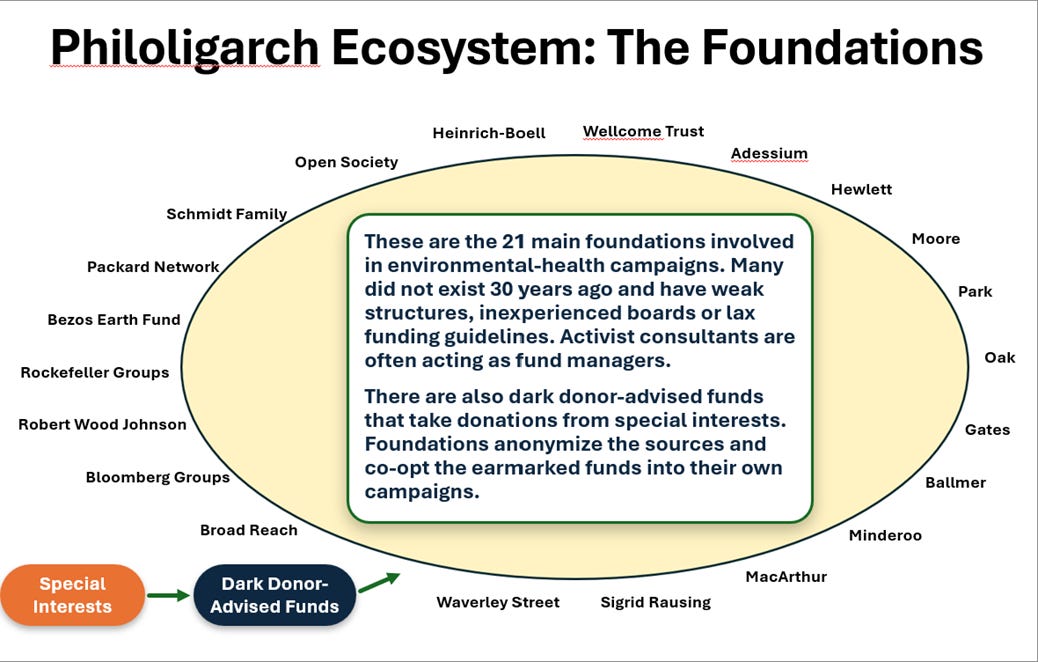
The development of the philoligarchy was not only due to the significant number of new billionaires creating foundations (prodded by the Giving Pledge) but also the transition in the donor management systems, now called the professionalization of philanthropy. The classic model was of a foundation founded by a retiring industrialist aiming to give back to society. They would set up small offices to manage and distribute requests for funds. Today’s tech billionaires are still young, busy and uninterested in running a foundation, so they outsource the management to a class of philanthropic consultants offering full services and guaranteeing the highest return (impact) on investment. I have referred to this consultant class as the billionaire bottom feeders.
These consultants, often coming from the environmental activist community, work with networks of other foundation consultants to create campaign-oriented projects. They fund third-party organizations known as fiscal sponsors that manage donations from multiple foundations to create an NGO-like body that would run specific campaigns.
I started to notice these 21 foundations frequently coming up as the usual suspects working together to fund fiscal sponsors financing climate lawfare groups, agroecology regrantors, anti-plastics campaigns, media front-groups, oceans programs… This is not a coincidence – this is a managed strategy. Chapter 3 of the Philoligarch investigation will draw attention to these choreographed “patterns”.
The Deceptive Veil of Fiscal Sponsors
In most cases, the NGO-like bodies, institutes or associations do not exist outside of the fiscal sponsor (that manages their administration), so there is no transparency or accountability. They try to make these “projects” (that do not exist as legitimate entities) look like NGOs. But who are these fiscal sponsors (see image below) pulling the campaign project strings while enriched by the foundation purse strings?
A group like Beyond Plastics walks like an NGO, talks like an NGO, but it does not exist like an NGO. It is merely a project line managed by tiny Bennington College in Vermont with unlimited funding from an undisclosed number of foundations (including Bloomberg and Rockefeller) hiding behind the school posing as its fiscal sponsor. This is not a temporary situation until Beyond Plastics gets on its feet and is able to register as an entity – they have been funneling tens of millions of dollars a year to this anti-plastics campaign for much of the last decade. Later in this chapter, there will be a section examining the value of foundations acting through fiscal sponsors rather than directly funding legitimate organizations.
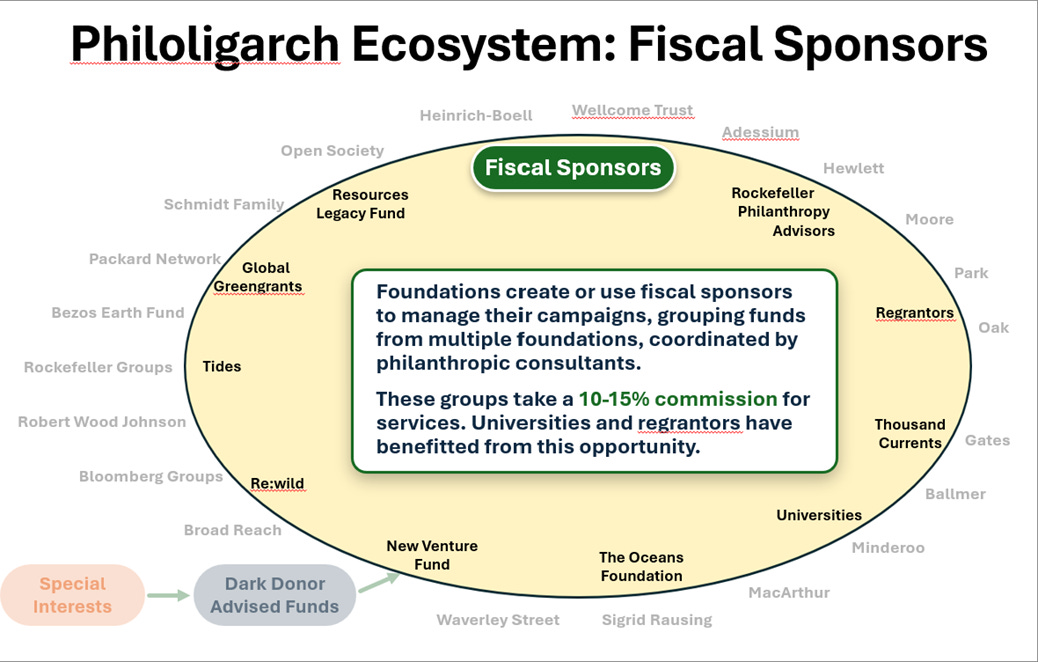
Fiscal sponsors take around 10-15% in commissions so $100 million in annual foundation funding can provide a lucrative service fee. Their clients are the consultants managing the foundation fund desks and do not get involved with the projects they are administering (unless the projects need to be quickly shut down). They are professional administrators and strategic project managers (and not passionate activists).
What do the fiscal sponsors do with these funds? They not only coordinate multiple foundations to provide them with more than sufficient grants, they then spend it on a campaign project. To win this campaign, they heavily invest in a wide range of policy actors to ensure that they control the narrative and dominate the issue. Not surprisingly, there are individuals in the media, research community, lobbying and litigation industries that can easily be bought. It is to the philoligarch funding of the policy actors that this mapping now turns.