


Environmental-Health Non-Governmental Organizations (NGOs) are going through a difficult period with the decline in public funding, the increase in scrutiny and the rise of political extremism in Western democracies. With wars, economic uncertainty, and a more aggressive social dialogue landscape, NGOs are starting to struggle to keep the public trust, financial support and campaign engagement.
To deal with these challenges, many NGOs are turning to large philanthropic foundations for financial support. My message to the NGOs is: “Don’t !!! It will not end well for your organizations.”
The best example of this challenge to NGO autonomy is from the Firebreak’s translation of Florence Autret’s investigation that showed how almost every Brussels-based NGO campaigning on climate issues received large donations from the European Climate Foundation (ECF), with a 2023 budget of €275 million (funded largely by US tech billionaires). They were expected to fall in line within the ECF flotilla of NGOs and support their net-zero campaign. I do not believe the NGO community has given much thought to the implications of this strategy, the loss of autonomy and the compromises they had to make.
Editor’s note: The acronym “NGO” is being used in this article as it is still widely understood by the public in reference to advocacy / lobbying non-profits. In reality, most of these campaign groups are Alternative Policy Enterprises (APEs), quite distinct from genuine NGOs like humanitarian groups, food kitchens, homeless shelters and other charities and service organizations.
Here are 12 reasons why NGOs need to rethink working so closely with their billionaire bedfellows.
Foundations are not transparent: Many foundations have donor-advised funds where individuals can donate anonymously to the fund earmarking a particular project or NGO. The intention is to make it impossible to track the special interest sources behind these funds. Some organizations that use the word ‘foundation’ are nothing more than donor-advised program managers acting as pass-throughs (minus their commission fees). It has to be assumed that any NGO taking funding from a foundation using dark donor-advised funds has a special interest group involved in the campaign. The NGO cannot pretend to be transparent by simply declaring the foundation as “funder”.
Fiscal sponsors are direct competition: Foundations often set up fiscally sponsored “projects” as an alternative to supporting existing NGO campaigns. It gives the fund managers (ie, activist consultants) more control over the organization and strategy. Take the example of Beyond Plastics. There were many NGOs campaigning against plastics, but Michael Bloomberg decided to donate large sums to Bennington College to start up Beyond Plastics (in line with his Beyond Coal and Beyond Petrochemicals “project” strategy). Hundreds of millions go into these fiscal sponsors rather than supporting existing NGO campaigns. It is assumed that the Rockefeller Foundation’s donations to this little liberal arts college in Vermont with 797 students is also earmarked for Beyond Plastics.
Fiscally sponsored “projects” distort public perception: The public sees an organization like Beyond Plastics, their campaigns, websites, networks and publications, and think that it is a legitimate NGO. After more than a decade of campaigning, Beyond Plastics still does not exist as a legal entity, does not produce any transparent financial records and remains a “project” of little Bennington College. Even the US Congress was fooled by this trojan horse when allowing the Beyond Plastics founder, Judith Enck, to testify at a Congressional hearing on behalf of this phantom NGO.
Fiscal sponsors are not accountable or transparent: Another phantom NGO is the Agroecology Fund. It does not exist as a non-profit 501(c)(3) or any other legal constitution, but merely as a project managed by the Global Greengrants Fund. Like other fiscal sponsor projects, they do not file IRS Form 990 declarations, so no one can know how much they receive, how much they regrant and to whom (although it can be assumed a large chunk of it went to the UN’s FAO agroecology program). They definitely fund NGOs. The Firebreak did a study on foundation donations to the Agroecology Fund, and estimated over $100 million in the first year under the Global Greengrants management. Worse, as the Agroecology Fund does not legally exist, if one of their reports makes a false or libelous statement about conventional agriculture practices, there is no one to be held accountable. Do NGOs want to take money from groups that don’t exist in any legal or accountable form?
Billionaire philanthropists peddle political influence: In the 2026 US midterm elections, George Soros is the largest political donor among a long list of philanthropists. It is not unusual for billionaires like Michael Bloomberg to use their wealth to seek the highest office. They then use their foundations as extensions of their political dogma, donating to groups that will help carry out their ideological objectives (and often to extend the philanthropist’s persona). While it is their money to be spent as they wish, NGOs receiving politically-motivated donations risk having their issue or campaign clouded in the dogma and politics of an ambitious public personality. Even the WHO, dependent on Bloomberg’s $1.6 billion in tobacco control funding, has lost their political independence.
Global foundations carry baggage: NGOs like to think that philanthropic donations are more fragrant than the stench of industry funding, but the public is becoming less naïve and some relationships could cause irreversible reputational harm. The strategic litigation NGO, Earthjustice, lost all credibility when they took money to litigate fossil fuel installations from a Chinese foundation promoting renewables. When people think of the Ramazzini Institute, they can’t help but remember Factor GMO when they took Russian money to attack GMOs. But the most hypocritical case has to be Corporate Europe Observatory. This anti-industry, anti-trade, anti-capitalism NGO campaigning on EU issues has almost half of its funding coming from dark donor-advised foundations based in the US. Such undeclared conflicts of interest from foreign entities to influence EU policy should ban the NGO from engaging with EU institutions. NGOs should not leave their reputations open to such vulnerabilities.
Media exploitation: Professionalized philanthropies choreograph their funding across a wide mix of NGOs, media groups, lobbyists, law firms and influencers. When you are pumping 100s of millions into a campaign, you can make it rain. Meanwhile large media groups were struggling with a financial drought until the philanthropists came to the rescue. Some media groups like The Guardian receive millions from foundations (and try as they might, this money doesn’t come without strings attached). The Firebreak revealed how foundations were funding media organizations to report on actions taken by NGOs they were controlling.
- Are NGO campaign managers happy to be a cog in a complex process, restricted to a bit role with certain parameters?
- Are they happy that the journalists are only reporting on their campaign because they are paid to do so by central command?
- Are they willing to do the coms work for tort law firms getting rich with foundation support?Impact over Process: As the Effective Altruism cult (remember them?) argued, philanthropy should achieve the highest impact and return on investment. NGOs, by contrast, often invest decades in a policy process, hoping to make incremental progress while slowly influencing changes in human behavior. A foundation fund manager with $100 million to spend on a campaign and an algorithmic chart, has no patience for such gardening techniques, preferring to unleash a coordinated onslaught on an industry or company. They might throw a million at an NGO to maintain their policy game as a flanking exercise (and to keep influence over them), but the NGO will not be taken seriously.
Michael Bloomberg’s poodles: I feel sorry for the directors of the dozens of NGOs created by activists within Bloomberg Philanthropies like: Vital Strategies, Campaign for Tobacco-Free Kids, the Framework Convention Alliance... Every morning they get up and wait for the day’s marching orders from central command, which sister groups will be involved in the next project, the funds they need to redistribute and the position they will have to propagate. They are paid far too much to quit ($25,000 per month for the top ten directors in each of Bloomberg’s NGOs), but it must be horrible to have to implement strategies without any input. And what if Michael wakes up tomorrow with a new idea, say, on raising doubt on vaccines? NGOs have to be careful about getting pulled into a foundation’s ecosystem – easy money can lead to hard choices and lost autonomy.
Superiority complex: When foundation-funded campaign budgets expand into eight or nine figures, and offices and salaries augment accordingly, it is easy to forget of the vulgar but passionate activists campaigning from the strip malls. The Firebreak was contacted, for example, by Oceana, funded by the Packard foundation, to remove any reference from our article about the group’s involvement with Greenpeace on a salmon aquaculture protest. Oceana and Packard were OK with all of the other criticisms we made about their campaign, but that association, however factual, really got to the handlers upstairs. The reality is that these foundation consultants and fund managers don’t really like working with NGOs or being associated with them. Any cooperation with NGOs will be short-term and one-sided.
Charitable front groups: Many foundations are merely fronts for larger investment funds, taking advantage of tax-free status while growing wealth for the family’s interest. The Firebreak has shown how some foundations, like Chan-Zuckerberg Initiative have enormous investment divisions or how the founder of Yahoo!, David Filo’s Skylight Foundation, turn a healthy annual rate of return on their hundreds of millions in stock holdings. This foundation capitalism and illegitimate exploitation of tax loopholes represent the type of opportunism most NGOs have been speaking out against.
Unstable long-term security: If your NGO received $10 million from three foundations this year, it is likely you widened your program budget but no longer bothered investing in traditional fundraising or government grant applications. But what if next year, the foundations consultants no longer find your issues or performance sufficiently “impactful”. Also, as the consultants managing the funds network among themselves, the three foundations may decide to set up a fiscal sponsor to manage a new (competing) project to run a similar campaign. They might poach your best staff before you have a chance to restructure.
The one thing NGOs have as an asset is trust. They are invited to the table in public dialogues as representatives of civil society on the basis of this trust. If NGOs are seen as just another well-financed interest group beholden to a dark network of billionaire funders, they will not only lose their seat at the table, they will lose the support of civil society and their own staff. Foundation funding may be an easy cocktail to consume, but its poison lingers.
What can NGOs do?
I understand that these are challenging times for NGOs with integrity. And it must be getting harder for these campaigners to swallow what they are being served. It is not a level playing field so they cannot realistically demand, in funding contract negotiations, that foundations become responsible public actors, be transparent and accountable. If they put forward such conditions, the activist consultants managing the foundation’s funds would just have more incentive to set up their own fiscal sponsors to suck more oxygen out of the room.
NGOs should do what they do best: campaign for change. They should create an NGO-Foundation Charter – a declaration - which draws red lines and imposes conditions on how NGOs should work with foundations and receive funding. This will guide internal NGO policy, protect public trust and allow smaller, more idealistic NGOs to still thrive in the public policy arena.
Equally important, the charter will also set a benchmark of standards for regulators to come in and introduce legislation to control and monitor philanthropic organizations. Political leaders won’t regulate foundations on their own (they are also bought and paid for by the billionaires), so they would need to be lobbied. I imagine many in industry would join in with the NGOs on this campaign (a first in my experience).
Or … NGOs can keep drinking from the poison philanthropy chalice, sacrificing their independence, supporters and public trust.
Here is a draft charter that the NGO community can start from:
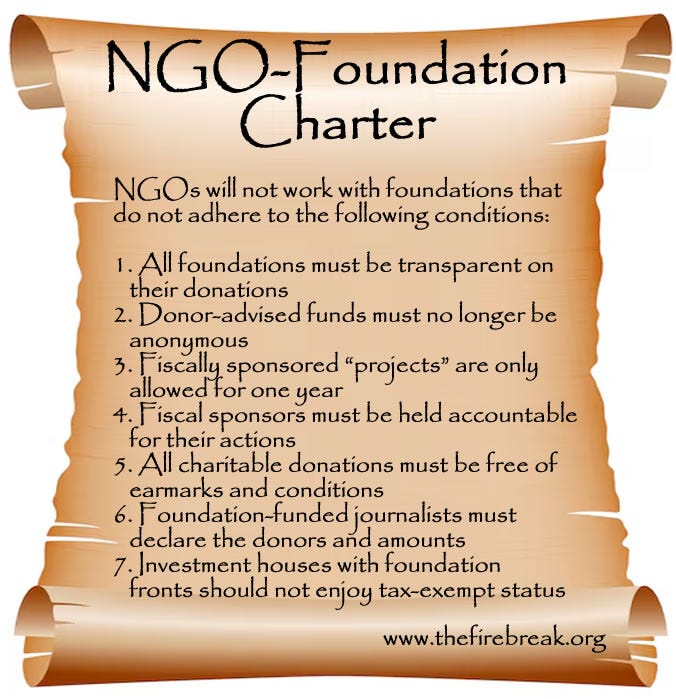
Text version:
The NGO-Foundation Charter
NGOs will not work with foundations that do not adhere to the following conditions:
All foundations must be transparent on their donations
Donor-advised funds must no longer be anonymous
Fiscally sponsored “projects” are only allowed for one year
Fiscal sponsors must be held accountable for their actions
All charitable donations must be free of earmarks and conditions
Foundation-funded journalists must declare the donors and amounts
Investment houses with foundation fronts should not enjoy tax-exempt status