


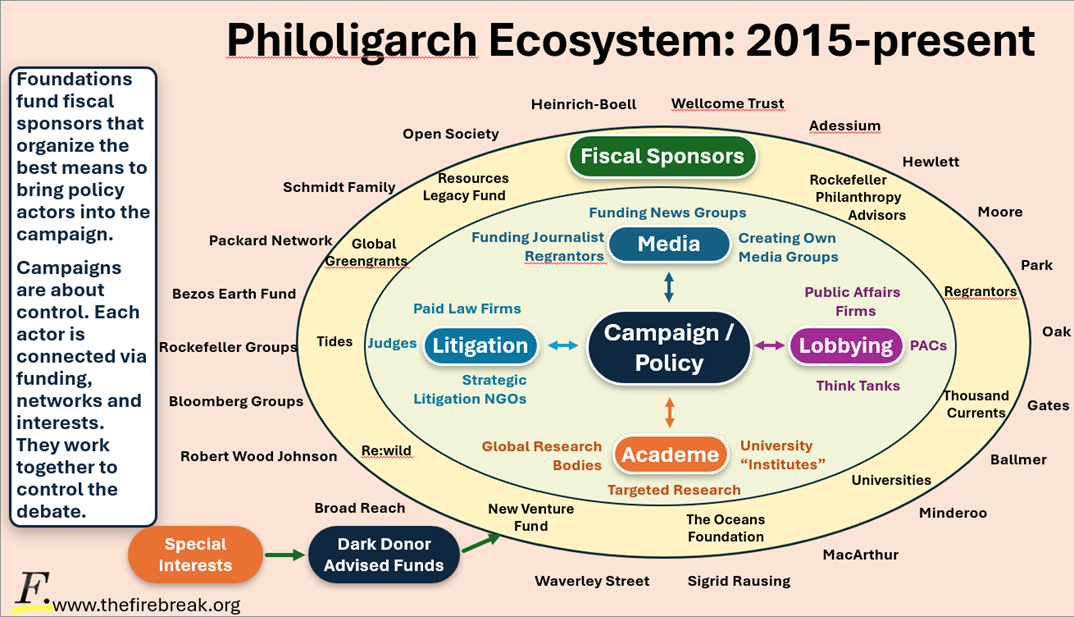
In order to control the narratives and own the issues, foundations and fiscal sponsors are not just running campaigns, they are dominating all actors and situations. There are four key policy fields that they fund or populate with their own organizations: the media, lobbying, academic research and litigation. With unlimited resources, foundations behind project campaigns are able to:
work with captive (internally-funded) news organizations,
use their in-house public affairs agencies or think tanks,
have their researchers publish campaign-relevant reports in their journals or promoted through the UN agencies they fund,
get their strategic litigation groups to wage relentless lawfare on the campaign adversaries (ie, industry).
When money is no object, the objectives become easy. The key objective for any oligarch is control. As Part 1 of this Playbook section demonstrated, NGOs on shoe-string budgets could only dream of the total control that these philanthropic oligarchs are exerting on their policy campaigns.
The Media
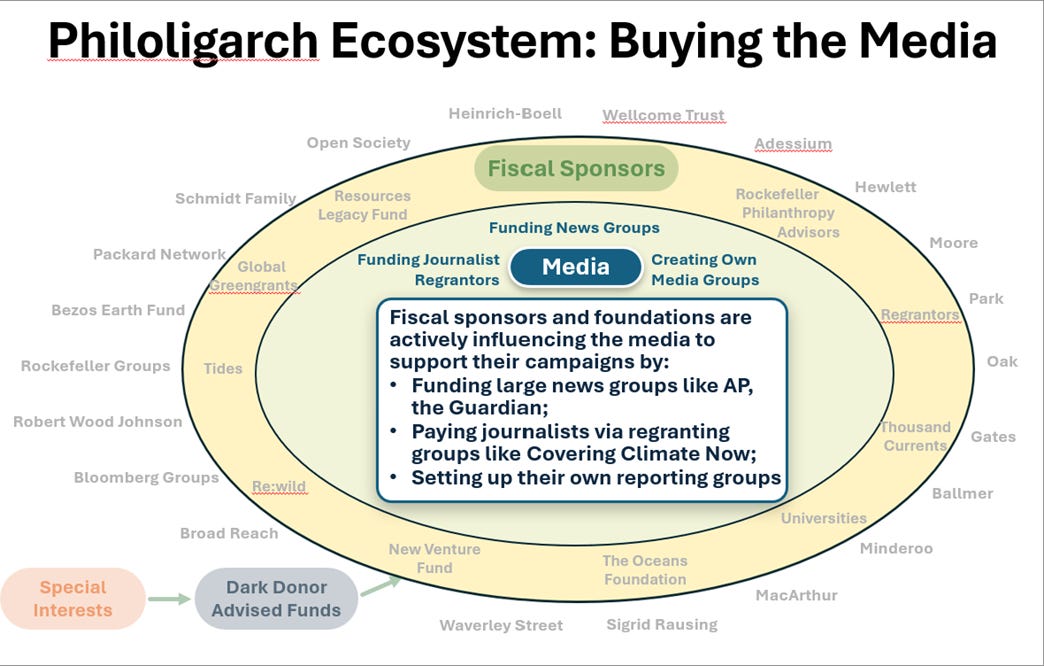
In the past three decades that ushered in the Age of Philoligarchy, the media simultaneously went through a dramatic decline, restructuring and re-emergence. When I was a journalism student in the early 1980s, newspapers earned revenue from subscriptions, advertisements and classified ads. The Internet destroyed that business model in the early 2000s. Today, leaner news organizations like AP or The Guardian are largely funded by direct foundation grants (but try as they might to deny it, that ink comes at a significant cost to journalistic independence).
Foundations have set up their own news organizations to report on issues their grantees are campaigning on. Bloomberg Philanthropies (via the fiscal sponsor, Rockefeller Philanthropy Advisors) financed the start up of The Examination to conduct investigative research in partnership with large news groups to produce reports on issues Michael Bloomberg has been funding (food, plastics, tobacco/nicotine, fossil fuels…). Investigative NGOs like Lighthouse Reports don’t get out of bed until some foundations contract them.
There are also many opportunities for freelance investigative reporters to get grants from foundation-funded journalism regrantors. A large number of the 21 main foundations have funded Covering Climate Now and the Solutions Journalism Network to train and fund journalists to work climate into every news story they cover (see the Firebreak story). The Pulitzer Center awards grants and fellowships to reporters who spur change thanks to the generosity of their foundation partners.
Lobbying
The wealth classes have always tried to influence politics through direct donations or support to political action committees (PACs). This is the main reason why there will never be legislation demanding that foundations and fiscal sponsors be transparent and accountable. Foundations also build direct donations to decisionmakers into their campaigns. Michael Bloomberg, for example, created the Tobacco-Free Kids Action Fund as a 501(c)(4) nonprofit organization to be separate from, but affiliated with the Campaign for Tobacco-Free Kids (501(c)(3)). A 501(c)(4) donates to political interests, in this case, funding political candidates who are against tobacco harm reduction strategies like vaping.
Foundations can lobby the policy process via think tanks they are actively involved in supporting and subcontracting for campaign-related reports. Likewise they can work with public affairs firms to influence policymakers, but they may get better value if they just poach the consultants. The European Climate Foundation (not a foundation but an affluent lobbying regrantor receiving around €275 million a year from most of the 21 main foundations) hired many of Brussels’ leading lobbyists to work on advancing their net-zero strategy.
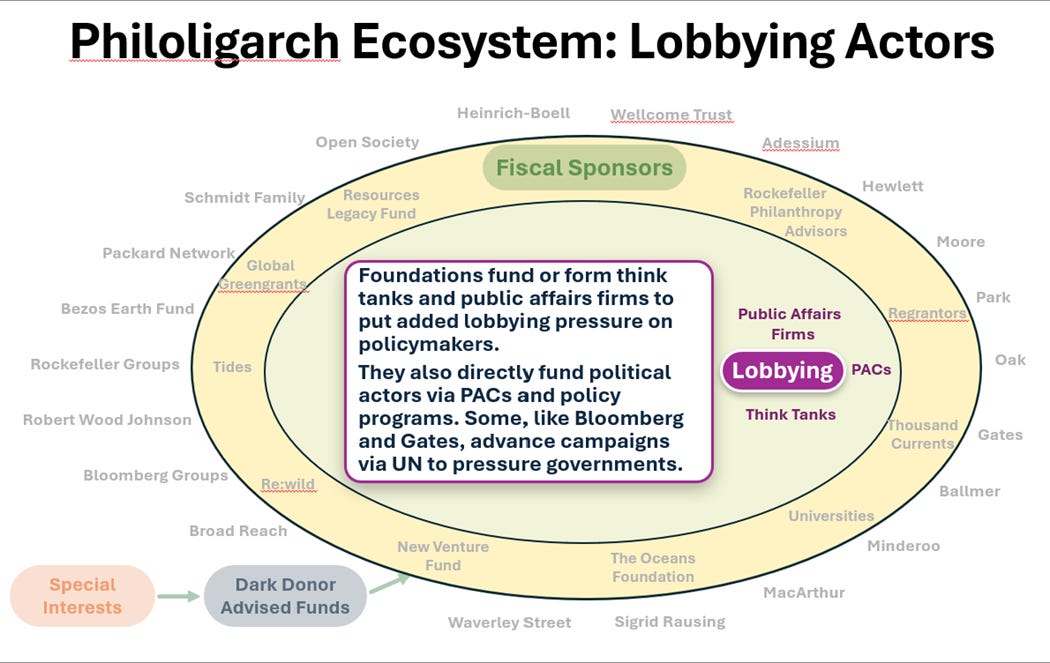
One of the more curious evolutions in policy influence is taking place largely outside of the United States. Foundations are funding many programs within UN agencies (which are chronically desperate for cash). Groups like the Gates Foundation or Bloomberg Philanthropies can set the agenda for international conferences, assemblies and conventions that then obligate UN member states to implement their declarations. At the moment, the WHO is trying to force its tobacco control dogma on the European Union.
Academic Research
One of the more significant Firebreak exposés was the unravelling of the Heartland Health Research Alliance. It was built around four activist scientists who created small institutes or labs in their universities to receive funding from foundations (via dark donor-advised funds originating from the litigation industry). Because the universities acted as a pass through to the “institutes” or “labs” these scientists had created, there was no need to declare the special interests actually funding the Heartland’s “litigation-ready” research publications. This is a common tactic for foundations trying to legitimize their campaigns with what could only be considered as “shadow science”.
To flex their dominance in controlling the research field, foundations have created global research bodies of scientists they fund, to work with journals they fund, to produce reports with declarations that fit within the foundations’ campaigns. The Lancet Countdown on Health and Plastics aims to provide global monitoring of the impact of plastics on human health and the environment. The initial report contained a 95-line declaration of interests for the authors (with most funding for the plastics researchers coming from foundations like Minderoo). The Firebreak discussed why these academics do not believe that funding from foundations running campaigns against plastics represents a conflict of interest (even if the Minderoo Foundation is funded by Andrew Forrest, the billionaire CEO of Fortescue Metals Group).
A foundation created by an iron ore and steel magnet funding a group of scientists pretending to be a global research body attacking plastics … move along people, nothing to see here.
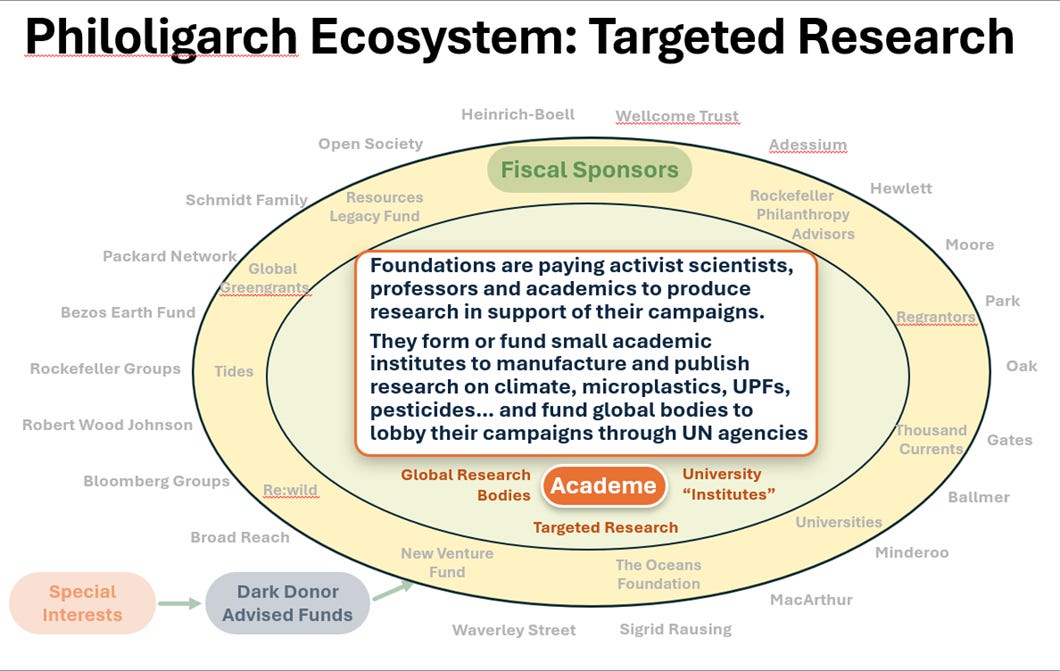
Why have there been so many publications on microplastics recently? Which interest groups would be funding researchers to conduct such expensive and speculative lab tests? No transparency, no accountability.
Litigation Industry
For 12 years I have been chronicling the evolutions in the litigation industry, particularly the tort industry’s tactics to extort industry into submitting to multi-billion dollar settlements, be it glyphosate, talc, paraquat… In most cases, the scientific evidence was not with the plaintiffs, but the system, the corporate structures and the Predatort ecosystem allowed these mass tort campaigns to yield lucrative profits. As debts from litigation finance companies at loan shark rates could pile up quickly, litigators would never enter the game if they did not have a good chance of a winning hand. But now that foundations have entered the game to underwrite any potential losses, the litigation game has changed completely.
Seven large foundations created a tort law firm, Sher Edling, with the sole goal of suing fossil fuel companies for the damages caused by climate change (part of the La Jolla Tobacconization Playbook). The relentless lawfare strategy might add value as a flanking weapon in the larger climate campaign, but these millions to keep the tort lawyers on their private jets has amounted to nothing more than a reputational assault. Spending heavily on Hollywood-based supporters, Sher Edling have yet to win a case, but they have managed to keep the lights on.
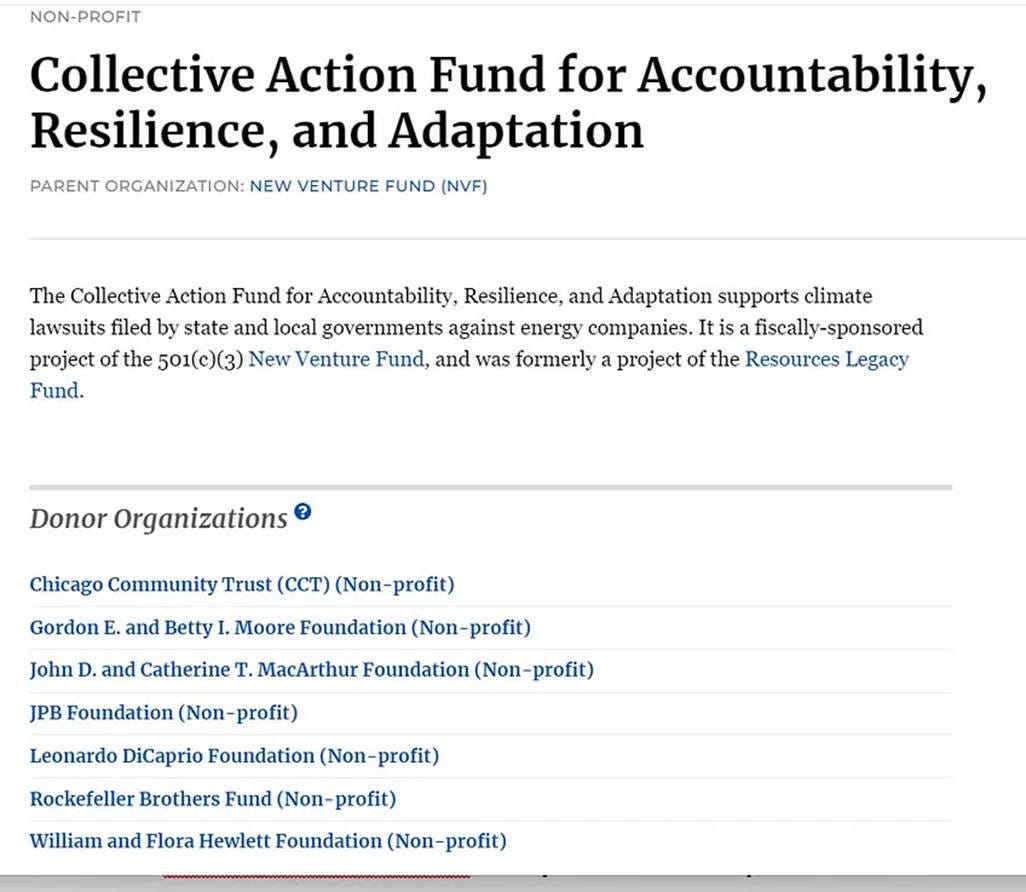
“Strategic litigation” is a recent term to describe how activists can use lawfare against targeted industries in their larger campaigns. Earthjustice and EarthRights International are two such cases of NGOs that file lawsuits based on foundation funding to serve ongoing activist campaigns. They have dismal success records but they aren’t funded to win. In one case, the Minderoo Foundation paid an NGO to hire a law firm to sue ExxonMobil for making false claims about plastic recycling, and the law firm then used some of those funds to donate to California Attorney General, Rob Bonta’s political campaign fund to launch an identical lawsuit against the Exxon on behalf of the State. Audacious.
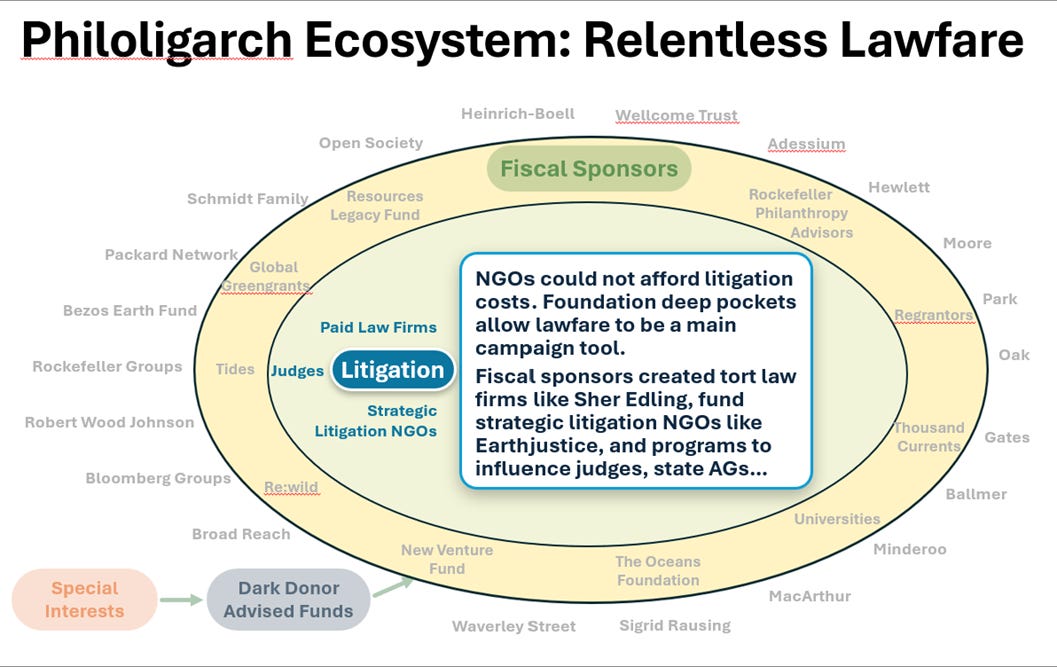
Even more audacious is how foundations are trying to control state attorneys general and court judges. The Firebreak showed how a Bloomberg-funded project, fiscally sponsored by New York University’s School of Law, planted their paid staff in 11 state AGs to serve as Special Assistant Attorneys General (SAAGs). As their lawfare became more obstructive and frivolous, Congress began an investigation. One night, the entire project was shut down. It was easy since it was only a project and not a legitimate organization. Less than two months later, the same seven staff showed up in a Vermont law school, fiscal sponsoring the same project there.
But why buy the cow when you can control the judiciary for free? Foundations have been heavily funding the idea of climate attribution science, a far-fetched attempt to link weather events to CO2 emissions of particular fossil fuel companies (enabling their climate lawsuits against these companies to go forward). These same foundations were then funding the Environmental Law Institute’s Climate Judiciary Project that trained judges to believe the climate attribution dogma. A House Committee on the Judiciary report accused ELI of trying to “rig” the judicial process.
Only in an oligarchy would “buying a judge” be considered a legitimate strategy.
Creating and funding law firms, financing strategic litigation NGOs to use lawfare as campaign support, buying off State AGs, moving into the state AG offices to wage environmental lawsuits in the name of the public, and influencing judges to rule in their favor in court cases… If someone wants to argue that this philanthropic oligarchy is simply a conspiracy theory, then I look forward to hearing your response.
The Full Mapping
While the full mapping in the image below seems cluttered and chaotic, the initial point this section hoped to establish is that there has been an important evolution in the nature of environmental-health campaigns. This is no longer about a couple of NGOs trying to raise awareness through a stunt, letter or event and hopefully effect change for what they believe is a better way. It is now all about a network of well-funded political activists coordinating the necessary actors to control the narrative and dominate the issue.
The Impact of the Playbook
How has this transition impacted the nature of environmental-health debates? Industry can no longer compete with the coordinated, relentless onslaught of well-funded, non-transparent groups who play to win at all costs. These same groups are choreographing the policy actors to control the narratives.
Two decades of controlling the media, policies, research and lawfare strategies on climate change are evidence what billions of dollars of foundation funding can do to an issue. The same for tobacco control, where one malicious billionaire has spent $2 billion to impose his narrow, prohibitionist view on tobacco control.
Having established the playbook to control the climate policy process, it is now being applied against other environmental-health issues like plastics, salmon aquaculture, ultra-processed foods, pesticides, PFAS, … As the public and policymakers are being pulled in by their slick rhetoric and political opportunism, more reflection on these philoligarchic tactics is necessary.
The Philoligarch series will try to break down how the nature of environmental-health policy management has evolved with the transition to foundation-driven advocacy. This mapping is the first step. Chapter 2 will look at case studies of how foundations have taken control of the four key policy actors. Chapter 3 will plug the key environmental-health campaigns (climate, plastics, pesticides, tobacco harm reduction, aquaculture, PFAS, UPFs…) into the Philoligarch Playbook to help shed some light on how the issues have been manipulated by the unlimited funding from Big Change.
Chapter 1 will continue by addressing two more important issues. The next section will expose some unethical practices from the professionalized philanthropy consultants and needs to ask why the public chooses to trust them, why scientists do not equate lucrative foundation funding with reputational risk and why key actors choose not to scrutinize the integrity violations committed by these actors. The last section of this chapter will look at the motivations for the use of fiscal sponsors and the need to control this integrity-challenged campaign weapon.